The Supreme Allied Commander had just made a decision that threatened to tear his own command apart, and he knew it. General Dwight D. Eisenhower sat with the weight of a continent on his shoulders, facing a chorus of his most trusted and aggressive field generals demanding one thing: the head of a man named John C.
H. Lee. Bradley wanted him gone.
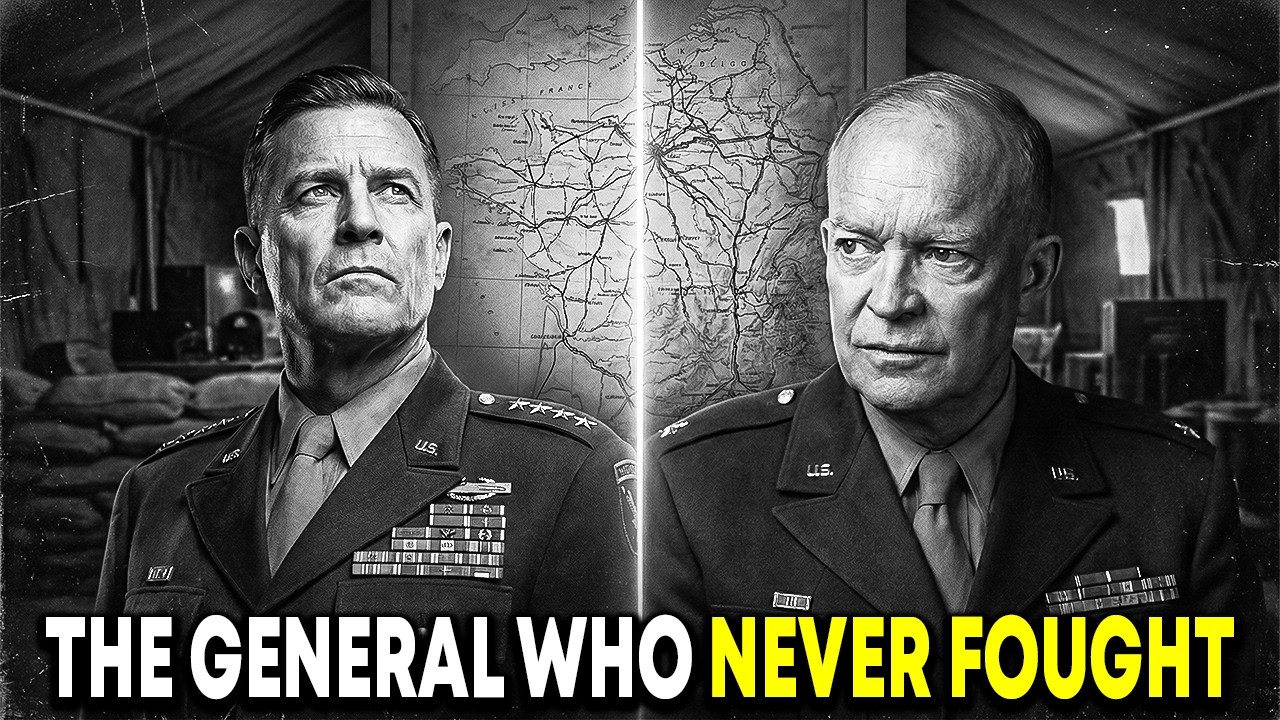 Patton wanted him gone, allegedly threatening to relieve the man personally if Eisenhower didn’t act.
The evidence against Lee seemed damning. He was a command general who ran the largest army in the European theater but never commanded a single frontline unit. He had moved his headquarters into the Hotel Majestic in newly liberated Paris while his convoys ran dry at the front.
The war had ground to a halt, not because of enemy resistance, but because the supply chain designed to support the greatest military advance in modern history had collapsed under the weight of its own complexities. And yet, Eisenhower’s response to this administrative mutiny was not to fire Lee.
It was to keep him. The reason, deeply embedded in the operational logic of the war, reveals a side of leadership that history often overlooks. Before the summer of 1944, John C.
H. Lee was a master of a realm as far removed from combat as the moon: logistics.
His command, the Communications Zone, known by all as COMZ, was an army behind the army, a massive industrial enterprise responsible for moving millions of tons of material, fuel, ammunition, and food across the Atlantic and into the hands of the infantry, up to a million and a half personnel were under his direct authority. A force larger than the entire armies of many nations.
To front-line brass, Lee was a bureaucrat, an imposing, dignified figure who wore the finest tailored uniforms and carried an almost religious certainty about the rightness of his methods. Behind his back, they called him ‘Jesus Christ Himself Lee,’ for his initials, JCH, and his demeanor.
The summer of 1944 was a lightning bolt. After the breakout from the Normandy hedgerows, Patton’s Third Army moved farther and faster than any in history. The problem was that every mile eaten by Patton’s tanks was a mile stripped of supply lines.
Lee’s answer was the Red Ball Express: a desperate, ingenious hustle that kept the armies moving. A one-way traffic system of nearly 6,000 trucks drove non-stop, every day, delivering the lifeblood of war to units miles ahead of the pre-planned supply depots. For six weeks, they did the impossible.
 The Red Ball Express was a testament to Lee’s ability to improvise on a colossal scale. But just as the situation was breaking open for the Allies, the entire strategy hit a brick wall. The issue was the city that would become Lee’s crossroads.
With the liberation of Paris and the advance of the front lines eastward, the supply lines stretched to the breaking point. Eisenhower had ordered an Army-wide halt, pulling fuel from the front, even activating a supply unit to carry the poison across the English Channel. It was at this precise moment his performance threatened the entire campaign.
Lee still had control over the multitudes. He had over a million people in the rear echelon, and he commanded his own fate. He chose to move COMZ’s headquarters to Paris.
The city was not just a symbol; it was the central transit node of the French network, a logistical key if positions allowed. Lee saw it as the vital nerve center for the next stage. But the move involved thousands of personnel, staff, and officers taking over the finest hotels in the city, comforts utterly foreign to the soldiers dying in trenches just a few miles away.
Within days, Lee set up shop in the Majestic Hotel, while Patton’s army was screaming for fuel. The front-line generals were furious. Bradley called it a catastrophe.
Patton saw it as rank insubordination orchestrated for the enemy. The cost of transport mission spent moving COMZ into Paris was mis-attributed to
trucks that should have carried fuel to the dry lines. The symbolic weight of the image was catastrophic to morale. The focus of the entire operation’s war effort was being rebuilt in the rear, losing the cohesion needed at the front.
Lee’s defenders argue it was purely pragmatic. Paris was the rail and road nexus, and that all subsequent supply operations would come from there. The Paris hotels were command nodes, and the living there was just a by-product.
 But Bradley and Patton saw something else: a senior commander isolating himself in the city, building a fiefdom of logistics while the fighting man starved. They warned Eisenhower that if Lee stayed, the entire campaign would be in jeopardy. This wasn’t mere complaining; it was a coordinated insurrection.
The moment was now on Eisenhower. The political pressure was so intense that they could have fired a dozen generals on the spot. But he didn’t.
He boarded the floor. Eisenhower knew the truth: both aspects were valid.
Lee was invaluable in one key respect: he knew the answer to the problem. He knew the systems, the ports, the railways, the managers, the code. The whole logistical operation was tailored to him.
Replacing him could destroy the operational tempo for months, and the supplier chain was the very architecture of the invasion. In a battle where the progress was measured in the practicality of self-escalation, Eisenhower did not want to risk a blackout of the machine.
So he made a calculated choice and kept Lee in place while absorbing the political blowback from the First Army and Third Army generals. Eisenhower understood that they were furious because they were right, and yet the situation still required Lee’s specific kind of expertise.
The winter of 1944 to 1945 proved Eisenhower’s inclusion to be the fulcrum on the edge. When the Germans launched their surprise carpet bomb in the Western’s defence at Bulge, the supply lines were pushed to the limit.
COMZ rose to the challenge. The hated Lee logistical machine held, delivering the trauma solutions, ammunition, and reserve units to the sectors where they were needed most, breaking the German offensive. The system he built, despised by Patton, was the reason the battles could be fought.
 By the end of the war, Lee’s name had simply disappeared into the backdrop of grand Allied victory. He demanded no recognition. There was no statue.
Movements for heroes drew their attention to Eisenhower, Montgomery, and Patton. But in the massive, unglamorous world behind the front, the world of the supply commanders, historians still debate whether the man was a necessary evil or a self-promoting hamper.
Lee was unquestionably ruthless, self-confident, and obstructive to those he deemed his betters. But the campaign that swept from Normandy did not win on initiative alone. It was a war of production, of supply chains, of endless tonnage.
General Lee ensured those chains held, even when it meant angering almost every man he served.
The old military maxim says that amateurs talk strategy, and professionals talk logistics. Eisenhower knew that value. He was a man with the weight to keep a supply chief in place despite the political firestorms of his own generals.
When the victors returned, the war history was treated under Lee. But in the record, if you know where to look, is the evidence: the line of thousands of trucks, moving through the night, holding together the contract between the rear and the front who was an engineering miracle. And John C.
H. Lee provided the man who made the engine of war run right up to and into the heart of the German Reich itself.


