The sun rose—
but daylight never really came.
For months, people across Europe looked up and saw something terrifying.
A pale disc.
Weak.
Colorless.
Almost like the moon.
It gave light—
but barely any warmth.
Then summer arrived.
And snow began falling.
Frost killed crops in the middle of the growing season.
Fruit refused to ripen.
Wine turned sour.
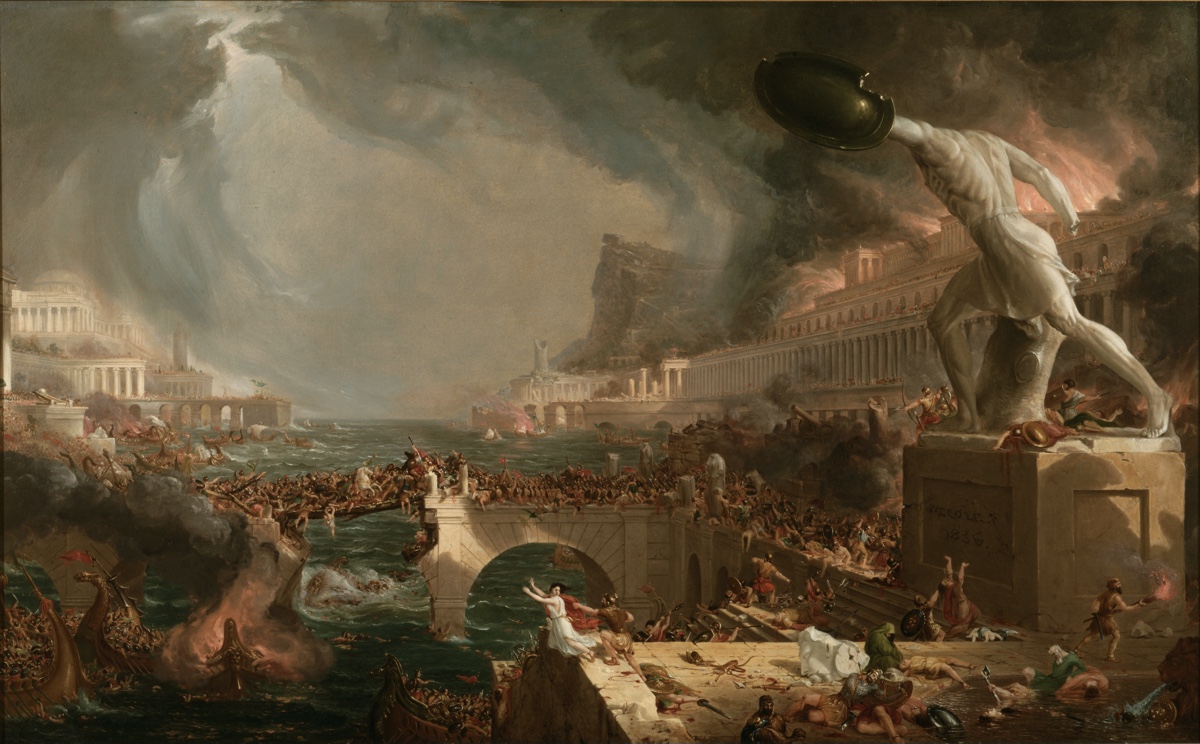
Fields that should have been green went gray.
Families opened their food stores far too early.
Then the harvest failed again.
And before people could understand what was happening—
disease arrived.
Not one crisis.
A chain of them.
Darkness.
Cold.
Famine.
War.
Then plague.
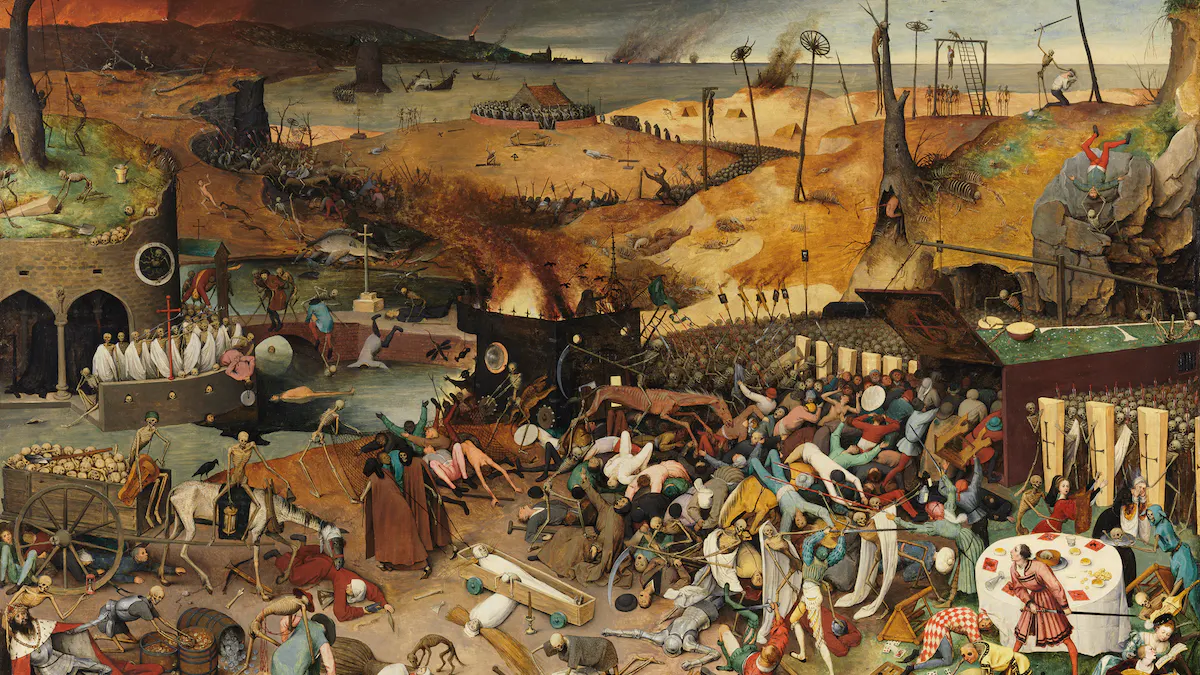
Entire cities began smelling of death.
Bodies piled up faster than they could be buried.
In some regions, chronicles claimed populations collapsed by horrifying percentages.
And nobody knew why the world suddenly seemed to be dying.
This was not the Black Death.
Not 1348.
Not World War II.
Not the year of some famous global war.
This was 536 AD.
And several modern historians have argued that if you had to choose one of the worst years in recorded history to be alive—
536 would be a serious contender.
Because what happened that year did not simply hurt one empire.
It appears to have triggered climatic disruption across much of the Northern Hemisphere—
with consequences that may have lasted for years.
And the most frightening part is that the disaster began somewhere most of its victims could not see.
A volcano erupted.
Possibly more than one.
The eruption hurled material high into the atmosphere.
A veil spread across the sky.
Sunlight weakened.
Temperatures fell.
And suddenly people separated by thousands of miles began describing the same impossible world.
One historian living in the Byzantine Empire left one of the most haunting descriptions.
Procopius.
He was traveling with the great general Belisarius when he noticed something deeply wrong with the sky.
The sun, he wrote, gave forth light without brightness—
almost like the moon.
And it continued like this for much of the year.
Imagine living through that without modern science.
You wake up.
The sun rises.
But it looks sick.
Days pass.
It does not recover.
Weeks pass.
Still weak.
Months pass.
Still wrong.
No satellite images.
No volcanologists.
No climate models.
No international news telling you that farmers thousands of miles away are seeing exactly what you’re seeing.
Only one question:
Is the sun coming back?
Later chroniclers described similar darkness.
Michael the Syrian wrote that the sun remained dim for an extraordinary period and gave only feeble light for a few hours each day.
Whether every detail in later accounts is literally precise is difficult to establish—
but the pattern is unmistakable.
Something disrupted the atmosphere.
And the planet reacted.
Temperatures dropped.
Growing seasons shortened.
Crops failed.
The effect did not remain local.
Ireland recorded harvest failures.
China recorded bizarre weather.
Europe experienced cold and agricultural stress.
Tree rings preserved evidence of unusually poor growing conditions.
Ice cores would eventually preserve another clue.
Volcanic material.
But the people alive in 536 had no way to read any of that evidence.
They only saw what happened next.
Food began disappearing.
And when food disappears—
civilization changes very quickly.
The biology is brutally simple.
Plants need sunlight.
They need temperature.
They need predictable growing seasons.
Reduce sunlight.
Lower temperature.
Move frost into months when crops are vulnerable—
and the entire food system becomes unstable.
A bad harvest means less grain.
Less grain means higher prices.
Higher prices mean poorer people eat less.
Livestock receive less feed.
Seed for next year may be consumed for survival.
Then the next planting begins with less reserve.
One failed season weakens the next.
That is how climate turns into famine.
And 536 was not simply one strange summer.
Evidence suggests the middle of the sixth century entered a broader period of cooling sometimes called the Late Antique Little Ice Age.
Another major eruption appears to have occurred around 540.
Another around the middle of that decade.
The atmosphere was hit repeatedly.
The planet did not simply snap back.
Cold conditions persisted.
And the human systems living beneath that climate shock were already fragile.
The Byzantine Empire was fighting wars.
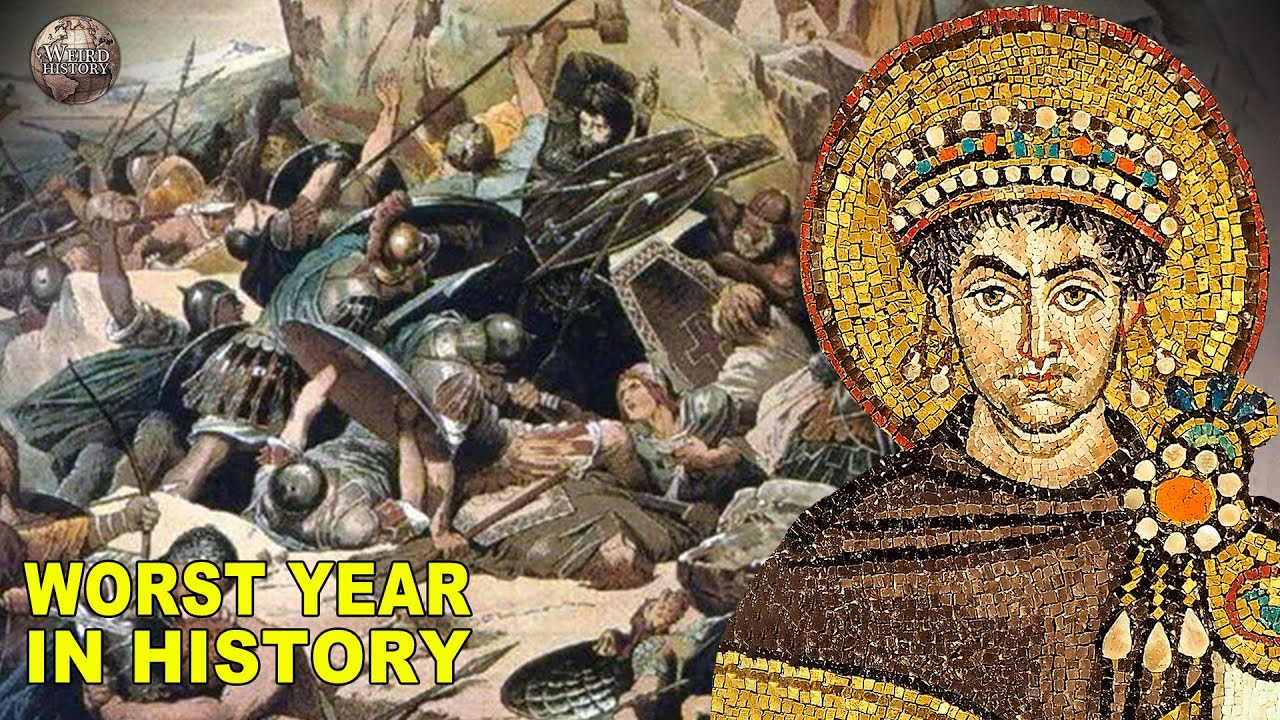
Justinian dreamed of restoring Roman power around the Mediterranean.
His armies under Belisarius fought Vandals.
Goths.
Other rivals.
The empire was spending enormous resources trying to rebuild imperial greatness.
Then nature changed the rules.
War depends on food.
Armies need grain.
Cities need supply lines.
States need taxpayers.
If harvests weaken—
everything becomes harder.
Then, only a few years after the strange darkness began—
one of the most devastating disease outbreaks of the ancient world arrived.
The Plague of Justinian.
Beginning around 541.
Bubonic plague spread through the empire and beyond.
Constantinople was hit brutally.
Contemporary accounts describe massive numbers of dead.
Bodies accumulated.
Burial systems were overwhelmed.
Authorities struggled to remove corpses.
The disease spread through every social level.
Poor.
Rich.
Soldier.
Merchant.
Official.
Even Emperor Justinian himself reportedly became ill and survived.
But countless others did not.
Modern estimates for total mortality vary enormously.
Some older claims put deaths across the wider pandemic at tens of millions.
More recent scholarship debates the exact scale.
But there is no serious doubt that the plague caused enormous disruption.
And the timing is what makes 536 so haunting.
A population already weakened by cold—
crop failure—
malnutrition—
war—
then confronted epidemic disease.
One disaster makes the next worse.
Hungry bodies resist infection poorly.
Displaced populations spread disease more easily.
Trade routes move grain—
and pathogens.
Armies move soldiers—
and parasites.
Ships carry cargo—
and rats.
The exact mechanisms of plague transmission remain more complex than the old simple “rat on every ship” picture—
but trade and movement clearly helped disease travel.
And Constantinople was one of the great connected cities of the world.
That connectivity had made it powerful.
Now it made it vulnerable.
But the horror was not limited to the Mediterranean.
China was also recording extraordinary climatic events.
Chronicles described strange atmospheric phenomena.
Yellow dust or ash-like material falling from the sky.
Frost during summer.
Snow during months when snow should not have been appearing.
Crop failures followed.
Famine struck some regions with devastating force.
Later accounts describe catastrophic population losses in particular areas.
Again, exact numbers from ancient chronicles must be treated cautiously.
But the basic signal is clear.
People on opposite sides of Eurasia were living through abnormal cold.
Something global had happened.
Centuries later, researchers began finding physical evidence supporting those accounts.
Ice cores from Greenland and Antarctica preserve layers of material deposited year after year.
Volcanic sulfate can become trapped inside those layers.
Think of an ice core as a frozen diary written by the atmosphere.
One year.
Another.
Another.
Then suddenly—
a chemical spike.
Something enormous happened.
Researchers identified strong volcanic signals associated with the middle of the sixth century.
Tree rings told a similar story.
Trees grow differently depending on temperature and climate.
Good year—
wider ring.
Bad year—
narrower.
Across parts of the Northern Hemisphere, tree-ring records show major cooling around this period.
The trees were recording what chroniclers had described.
Weak sun.
Cold summers.
Bad harvests.
The ancient writers had no explanation.
The natural archive did.
Then researchers tried to answer the hardest question.
Which volcano?
That answer remains debated.
Some evidence has pointed toward a major tropical eruption around 536.
Candidates have included eruptions in Central America and elsewhere.
Later volcanic activity in the North Atlantic region may have contributed to continued cooling.
Researchers have proposed multiple eruptions rather than one single blast as the explanation for the prolonged climatic crisis.
That distinction matters.
536 may not have been one apocalypse.
It may have been the beginning of a sequence.
One atmospheric blow.
Then another.
Then another.
And that helps explain why the effects stretched far beyond one year.
But while Eurasia froze—
other civilizations were facing their own environmental shocks.
On the coast of what is now Peru, the Moche civilization depended heavily on agriculture and marine resources.
Their irrigation systems supported farming in an extremely dry landscape.
Fishing supported communities along the coast.
Then powerful climate fluctuations associated with El Niño events could destabilize both.
Warmer ocean waters disrupt marine ecosystems.
Heavy rainfall can produce destructive flooding in places normally adapted to arid conditions.
Canals can be destroyed.
Fields buried.
Fish populations disrupted.
Researchers have connected major climatic disturbances during parts of the sixth century with serious stress in Andean societies.
Whether every specific event can be tied directly to the same volcanic cause is harder to establish.
But the broader picture is striking.
Around the same era, civilizations across very different environments were being tested by abnormal climate.
And societies do not collapse simply because weather becomes bad.
They collapse when environmental pressure finds existing weakness.
The Byzantine Empire was overextended by war.
European agricultural communities operated with limited reserves.
Cities depended on fragile supply systems.
Rural populations lived close to subsistence.
A small reduction in food availability could become enormous suffering.
That is one of the great lessons of 536.
The eruption did not need to kill people directly.
It only needed to push systems beyond their margin.
A little colder.
A little less grain.
A little more expensive food.
A weaker population.
Then plague arrives.
And everything compounds.
This is why calling 536 “the worst year ever” is both powerful—
and slightly misleading.
For the people living through it, the disaster did not begin and end neatly between January and December.
536 was the opening blow.
The suffering continued.
Another eruption.
More cooling.
Crop failures.
Then plague.
Political instability.
Economic contraction.
The crisis stretched across years.
For some regions—
decades.
And that is exactly why historians became fascinated with the period.
One team including historian Michael McCormick and scientists studying glacier ice discovered something extraordinary while examining pollution trapped inside ancient ice.
Their original interest involved metal production and economic activity.
Then the ice exposed the climatic catastrophe.
Volcanic debris and sulfate helped researchers narrow the timing of major eruptions.
The same ice later revealed something else.
Lead.
Not poison killing people.
Industrial pollution.
Lead contamination in glacier layers can indicate large-scale silver production because lead was often released during the processing of silver-bearing ores.
After years of crisis—
lead levels began appearing again.
That meant mines were operating.
Silver was being produced.
Coins were being minted.
Trade was recovering.
Human economic activity was returning.
Imagine the beauty of that evidence.
The same glacier records catastrophe—
then recovery.
First volcanic material.
Darkness.
Cold.
Then years later—
metal pollution.
People working again.
Markets functioning.
Money moving.
Civilization rebuilding.
The ice contains both stories.
Collapse.
And return.
But if you had been standing in Constantinople during the worst of it—
you would not have known recovery was coming.
That is the part modern people struggle to imagine.
We know what happened next.
They did not.
To them, the abnormal sun might never recover.
The famine might continue.
The plague might kill everyone they knew.
The empire might fall.
The world might truly be ending.
There was no historical chapter titled:
“The Late Antique Little Ice Age.”
There was only today.
Another cold morning.
Another failed crop.
Another funeral.
Another rumor.
Another body.
Another winter approaching.
And that uncertainty changes the experience completely.
A disaster becomes easier to endure when you know it has an ending.
People in 536 did not.
The strange sun could have been permanent.
The cold could have been permanent.
The hunger could have been permanent.
Now return to Procopius.
Look upward.
The sun is there.
But its light has changed.
It no longer behaves like the sun.
You do not know about sulfate aerosols.
You do not know about volcanic forcing.
You do not know that ice cores will preserve the evidence for scientists fifteen centuries later.
You only know that the light which has governed every season of human life—
is failing.
Then crops stop growing.
Then food disappears.
Then disease enters the city.
And suddenly one terrifying thought becomes unavoidable.
Maybe this is not a bad year.
Maybe this is simply the way the world is going to be now.
That may be the most frightening thing about 536.
Not the volcano.
Not the snow in summer.
Not even the plague that followed.
It was the moment millions of people realized that something as permanent as the sun—
something their entire civilization depended on—
could suddenly stop behaving the way it always had.
And they had absolutely no idea why.