VERSAILLES, France — In a candlelit hotel room here on the final night of 1944, the Supreme Allied Commander prepared to burn the alliance to the ground.
General Dwight D. Eisenhower, sleeves rolled up and face gray with fatigue, sat before a draft cable that would have torn the Western Alliance apart. The message, composed by his chief of staff, was a brutal ultimatum to the Combined Chiefs of Staff: Field Marshal Bernard Montgomery would be removed from independent command, or Dwight Eisenhower would resign.
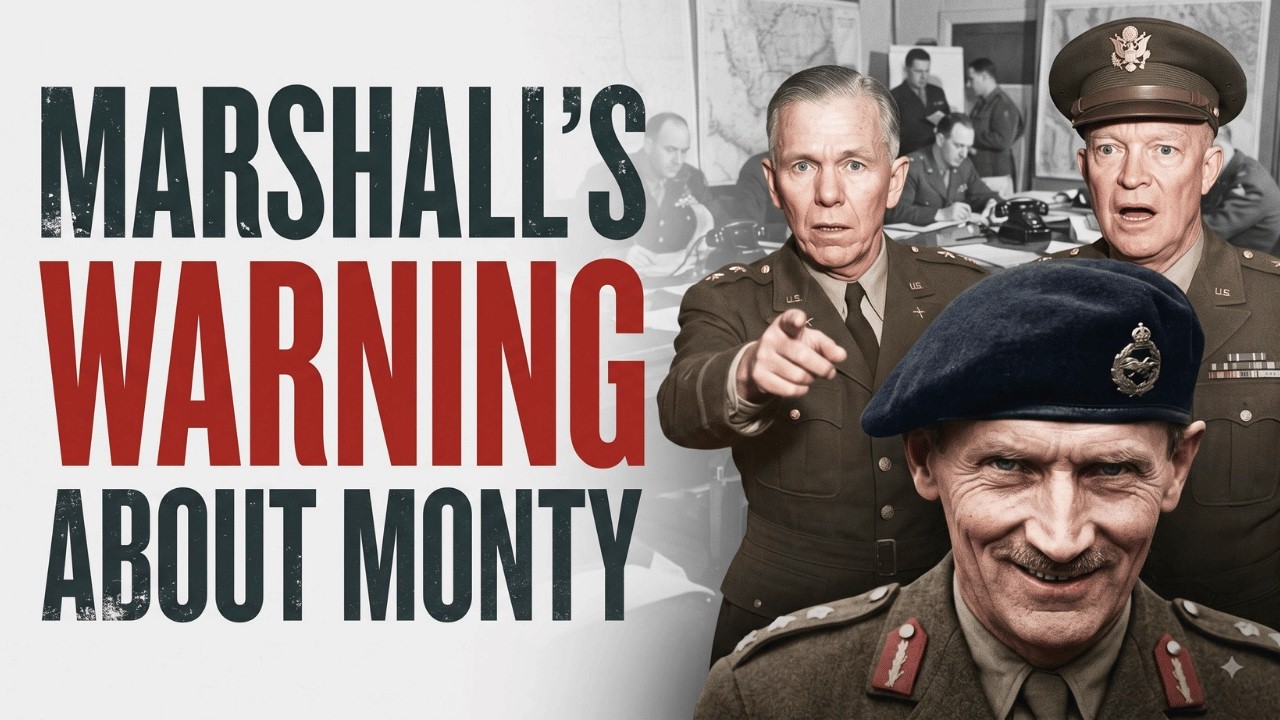 The war in Europe was in its darkest hour. The Battle of the Bulge, now entering its third week, had already cost thousands of American lives in the frozen forests of Belgium. Yet as German armor lunged westward, Eisenhower’s most dangerous enemy was not on the front lines—it was the man leading the British 21st Army Group, Bernard Law Montgomery.
Fourteen days into the deadliest campaign in American military history, the coalition was on the verge of self-destruction.
—
In Washington, D. C. , another general was watching the cables roll in.
Chief of Staff George Catlett Marshall faced a birthday and a decision that would determine whether the Allied war machine survived.
Marshall, a man who had languished as a captain while his peers were promoted past him, understood something Montgomery never grasped: the American government would never place its soldiers under permanent British command. The politics of the home front were as treacherous as the German artillery—and infinitely more fragile.
So Marshall wired his protégé that evening. History has preserved only fragments, but those who saw the cable described it as vindication of Eisenhower’s authority. “Do not forget who is in charge,” the message read in essence—you are the Supreme Commander; act accordingly.
The cable gave Eisenhower license to reply to Montgomery’s insubordination with force.
—
The crisis had been brewing for months. Montgomery had argued for a “single thrust” strategy that would make his 21st Army Group the spearhead of continental victory. Eisenhower favored a broad front, a decision that infuriated the British commander.
As the Ardennes offensive slammed into the American lines earlier in December, Eisenhower had placed the U. S. First and Ninth Armies under Montgomery’s temporary operational control—a move meant to restore order, but one Montgomery misread as a concession.
He seceded the moment. Within days, Montgomery was briefing war correspondents with unflattering accuracy, implying British generalship had saved a “collapsing” American army. Visits to American lines by Montgomery’s staff were compared to inspections by a conquering hero, with the Field Marshall advising beleaguered American generals on strategy, posture, and command.
By December 29, Montgomery had formalized that disrespect in writing. In a letter to Eisenhower, environmental report titled “The Effect of the Battle of the Ardennes,” he demanded permanent operational command of all ground forces in the north, adding insult to injury by casting doubt on Eisenhower’s leadership in multiple emotional paragraphs.
The letter, arriving late in the evening of the 30th, broke the patience of a man not known for breaking.
—
Eisenhower initialed the cable drafted by his hatchet-man, General Walter Bedell Smith. It was a nuclear option, threatening his own resignation. That he would take that path was a measure of the desperation—of a man within a hair’s breadth of tearing the alliance apart.
But Marshall’s cable, the one sent from a Pentagon office facing an inner courtyard (he had refused the rooms with scenic views), had done its work. It contained a brutal summary of America’s political status: in a democracy, the votes of millions of soldiers and civilians mattered more than any military doctrine on the withering front.
The cable reached Versailles by late evening. Eisenhower read it, read it again, and then placed the resigned letter in his desk. He did not send it.
 Instead, a single British general made a safer, more clandestine decision.
—
Major General Francis “Freddie” de Guingand, Montgomery’s frail but loyal chief of staff, was wrenched from his bed by a phone call from Bedell Smith. Smith was explicit: the American command was about to fire Montgomery from his American duties and formally relay to the Combined Chiefs the dimensions of the disaster.
A junior officer was connecting the wires, a gamble of the stratosphere. Against the weather forecast, in a stiff fog and a weak engine that fought icy rain, de Guingand flew from Holland to Paris. He landed, past midnight, outside the Trianon Palace.
Brought before Eisenhower, the supreme commander looked honestly at Montgomery’s letter. He took the room to see the draft of the reply. De Guingart asked for 24 hours.
Nothing more.
“I pleaded with him to allow me to see Montgomery first,” de Guingand later wrote. “I could not guarantee anything. But I could try.”
Eisenhower gave him 24 hours.
—
De Guingart flew back to Montgomery’s caravan at Zonhoven in the same foul weather, landing in the early morning of December 31. He walked into the trailer, closed the door and told Field Marshal Montgomery, without circumspection, that he had a few hours to save his career and the alliance.
Montgomery was genuinely stunned. He had so convinced himself of his own narrative that he failed to see the precipice.
He was presented with a draft of a letter he had written: a retreat, a declaration that he had no desire for permanent operational command.
History would not wait. At any “Barren shatter” — had Montgomery continued, 21st Army Group would have been replaced by the American chain of command. The title of Supreme Allied Commander would be stripped of all trust in the White House.
The attack on the Rhine came to a halt that was to come.
He signed it.
De Guingart risked his life again to return to Versailles with the note, landing just in time. Eisenhower read the withdrawal in silence, then put it in his pocket stiffening when no thanks were given. As he did, he tore up the cable of resign and the madness ended.
—
 For decades, the story of the wire—the one that arrived from Washington to save the alliance—enabled combat. Only men who were there understood its magnitude.
The message George Marshall sent that day crystalized military and political necessity. He did it without passion and without a public voice. He did not seek spotlights; he chose his office with no view so he would think nothing of the desk in front of him.
He was the connector of the whole. He, too, was over by the lights of the decision.
The plain voice of Marshall’s cable quieted the storm. It made clear that the Allied coalition would be driven by American authority and support, and it stopped Montgomery at the altar of his own ambition.
—
The moments of December 30 and 31, 1944, were not in the newspapers. No rank or file understood it. They knew only that the battle continued, the frontlines held, and the British general remained on the map.
The timeline remained intact. Germany sowed the Rhine and surrendered in May 1945. The coalition reached Berlin.
And the peace—and the alliance—held.
What did not survive was any semblance of Montgomery’s authority over American forces. On January 16, the American First and Ninth Armies were returned to Omar Bradley’s control, ungently and without public comment.
The story of those two critical days stayed hidden for another 30 years. The stern words Marshall sent by the wounded brought the gateway to commandment were relegated to a first report and eventually the memoir of an exhausted British staff officer who risked his life to prevent the war from having a new leadership.
—
George Marshall had, that night, written a message that said war was so important it could not be left to lead against the ambitions of the field. In an internal courtroom, he had used a memory of a younger man’s past to stay from breaking.
He later said the purpose of the communications was simple: that the strength of the alliance was the only thing that held in the winter cold, and that strength had a name—an American name.
Eisenhower was sleeping when the certainty of 1944 closed, secure in the way. Montgomery called the field. It was 54 and worn; the alliance that had held by a thread of its gasp moving into the sharpest winter of the century.
—
As dawn broke in Paris, the countdown to 1945, a tired staff officer in a tiny room overheard his chief speak, wasn’t to anyone.
“Done. Good riddance,” Eisenhower said.
 But they didn’t know. They would die and never know.
He was not Illinois. He died in 1972 and 1976—in in 1959 and 1969. And Byron had outlived Dwight, but he didn’t outlast the memory of the dark.
He saw in his own hand what he had to pull back from.
The men who fought in the Ardennes never read the secret wire. The men who froze of the Meuse had them to save the library.
Well, the Americans waiting for supply huts had next to 600 kilometers.
No, those two wires—one from Washington, one from Hovind—they created the final situation.
The paper did not win the war, but they came fractions from losing it.
The war was won because the message was ten. Marshall broke.
The two old generals—Eisenhower and Montgomery—saw many battles in their careers, and for the rest of their lives, even though a cold memory passed between the grim speed of the end of 1944.
—
## The Final Verse
The Western Alliance of Operation Overlord had its pivot toward the pot. Every one of those young men had legs that had to be buried.
Maybe still.
March 22, 1945: The First Allied Crossing under Montgomery’s army group with strategic against commitment; the gun shells landed in a field, and when the searchlights grimed down over the Rhine, the Field Marshal stepped onto the deck of his Duck, in lakes he lost line of American leather.
They staged to, instead.
It was only yesterday.
The world had ever known.
In the shadow of the Selvian, the echo of 30/31, we decided.
Only letters on the wax.


