
The final roll call of the Third Reich’s most notorious blood feud did not end with a volley of gunfire in the Berlin courtyard where Colonel Claus von Stauffenberg was executed. It ended in a maternity ward, a concentration camp, and a mountain hostage convoy, where the regime’s desperate attempt to erase an entire bloodline from history met its match in the stubborn survival of a widow and her five children. On January 27th, 1945, as the Red Army closed in on the Oder River, a prisoner in a Nazi maternity home gave birth to a daughter.
The baby’s father had been dead for six months, shot by firing squad the night his bomb failed to 𝓀𝒾𝓁𝓁 Adolf Hitler. She was Konstanze, the fifth child of the man who had tried to change the course of the war, and her birth was the final act of a punishment that Himmler had ordered to be absolute.
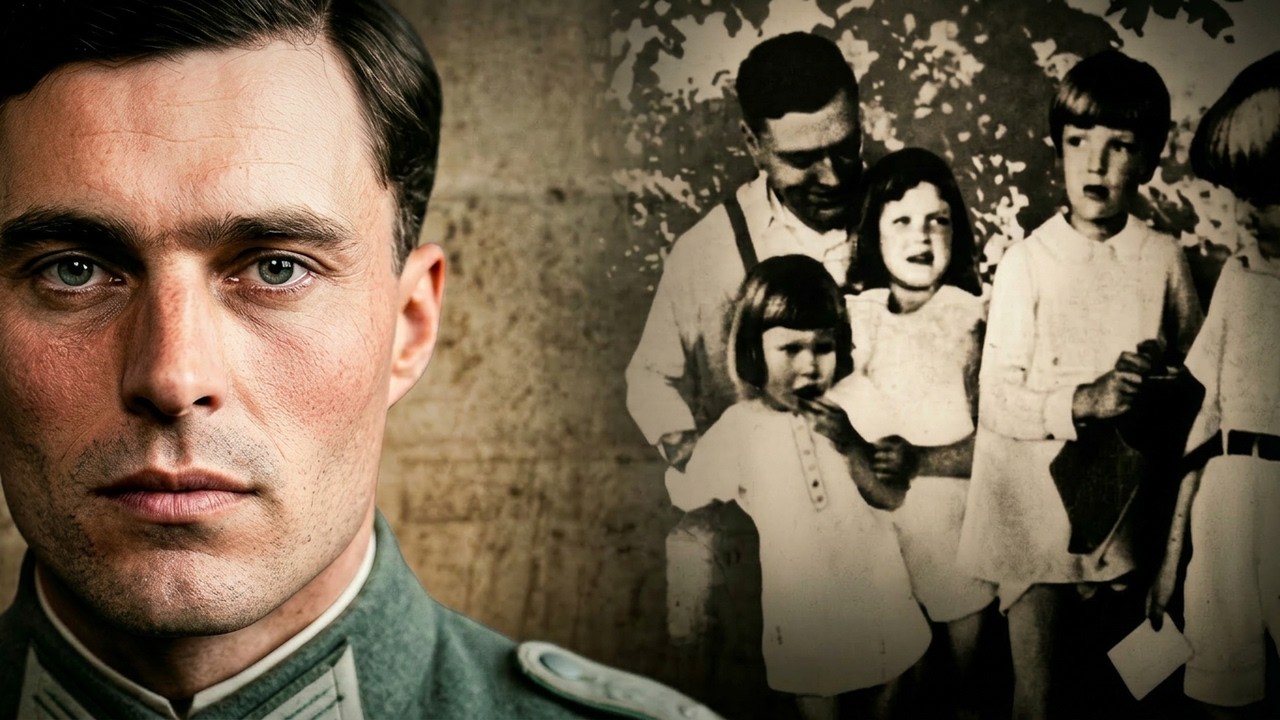 The plot of July 20th, 1944, was a desperate gamble that shattered in the Wolf’s Lair when the bomb failed to 𝓀𝒾𝓁𝓁 the Führer. By the early hours of July 21st, Stauffenberg was dead, but Heinrich Himmler, the architect of the SS police state, was not satisfied with the life of one officer. Within days, he invoked Sippenhaft, an archaic legal principle of kinship guilt, declaring that the Stauffenberg family would be wiped out to the last member.
The order was not a threat; it was a bureaucratic directive that set the machinery of terror into motion across the Reich. The family was large, and the regime reached for all of it, treating a shared surname as proof of shared treason.
Stauffenberg’s brother, Berthold, a fellow conspirator who had been arrested in the immediate aftermath of the plot, was dragged before the People’s Court and executed in August 1944, hanged with piano wire in a grotesque display of Nazi justice. His surviving brother, Alexander, who had been serving in Greece and had no part in the conspiracy, was taken into custody anyway, a hostage to a name he had done nothing to dishonor. The net was cast wide, ensnaring uncles, cousins, in-laws, and even elderly relatives who had never been near Berlin.
Dozens of people were detained across Germany on the strength of a shared bloodline, their lives upended by the simple fact of their surname.
Then the regime came for the children. Claus and Nina von Stauffenberg had four of them at home in the summer of 1944. Berthold, just ten years old, Heimaran, eight, Franz Ludwig, six, and Valerie, three, were living at the family estate in Lautlingen when the Gestapo arrived in late July.
They were taken from their mother and transported to a children’s home called Buntal in the quiet Harz town of Bad Sachsa. There, the erasure became literal. The staff confiscated the photographs and keepsakes from the children’s luggage, forbade them from contacting relatives, and stripped them of their identity.
They were given a new surname, Meister, because the name Stauffenberg was now treated as something too dangerous for a child to carry.
To the youngest, barely more than a toddler, none of it could be explained. The plan went further than a change of name. The younger children were to be handed to reliable Nazi families for adoption, their true origins buried forever.
The older boys were marked for the regime’s political boarding schools, where the state raised promising children to serve it, indoctrinating them into the very ideology their father had tried to destroy. Had the war run longer, the Stauffenberg children might have disappeared into Germany under invented identities, raised by strangers to become the opposite of their father. But the war did not run longer.
As Allied forces closed in during the spring of 1945, the plan stalled, and the children waited in Bad Sachsa for someone to come for them.
While her children were being renamed in the Harz, Nina von Stauffenberg was in a cell. She had been arrested on July 23rd, 1944, at Lautlingen, three days after the plot, and while she was pregnant with her fifth child. She was the wife of the man the regime hated most that summer, and the Gestapo treated her as a source rather than a widow.
 She was taken to Berlin and questioned at length about what she had known of her husband’s plans. She insisted she had known nothing, and she gave the Gestapo little to use. From Berlin, she went to Ravensbrück, the concentration camp north of the city, and was held in isolation as her pregnancy advanced.
She had gone in a matter of days from the wife of a colonel to a prisoner whose surviving value to the regime was the child she was carrying.
The regime had a practical problem. It wanted the Stauffenberg name erased, but it was not going to let the birth happen inside the camp. As her due date neared, Nina was moved to a maternity home in Frankfurt an der Oder.
There, on January 27th, 1945, she gave birth to a daughter and named her Konstanze. The child of a man condemned as a traitor had been born a prisoner seven months after his death. Even childbirth had become something the regime controlled, a logistical detail in the machinery of persecution.
Mother and baby did not stay long. With the Red Army advancing on the Oder, the regime moved its high-value prisoners away from the front, shuffling them like pawns in a collapsing game.
The wider Stauffenberg relatives, the uncle Alexander among them, had been gathered into an isolation barrack at Buchenwald in February, then marched south as the camps were cleared. By the war’s last weeks, Nina and her newborn had been taken to the mountains of South Tyrol in northern Italy and held as hostages the SS hoped to trade for protection or property. The trade never came.
When the war ended in May 1945, American troops reached the area and the prisoners the SS had dragged across the Alps were freed. Nina was free, holding a three-month-old daughter she had carried through a concentration camp, a prison maternity ward, and a mountain hostage convoy. She still did not know where her other four children were.
The reunion came in July 1945, a year almost to the day after the bomb. The four older children were found at Bad Sachsa, the home reached before they could be sent on, and brought back to Lautlingen, where Nina was waiting with the baby they had never met. For the first time, all five children and their mother stood in one place.
Konstanze met her brothers and sister at six months old. They met a sister who had been born in a prison they had never seen. They had survived, but none of them came through it untouched.
The family that came back together had lost almost everything else. Klaus was dead. Nina’s own mother had died in a Soviet detention camp that year.
 The estates were gone, the accounts frozen, and the name that had once opened doors in Bavaria was now attached to the most famous act of treason in the Reich’s history, for better or worse, depending entirely on who was judging it.
Nina did not rebuild quickly, and she did not rebuild loudly. It took until 1953, eight years, before she could move the family back to her home city of Bamberg. She managed it only because a general’s pension finally came through and paid to restore the house.
She raised five children largely alone in a country still arguing about whether her husband had been a hero or a traitor. She made one choice that defined the rest of her life. She kept her husband’s memory, but she refused to turn him into a monument.
She did not present him as a saint or build a cult around July 20th. When she spoke about those years, she spoke plainly, and she let her children decide for themselves what to make of their father. She never wrote her own account.
The book about her life would come much later, written by the daughter born in captivity.
The five children’s lives pulled in different directions, and not all of them were long. Valerie, the youngest of the four taken to Bad Sachsa, married in 1964 and died two years later in 1966 of leukemia. She was 25.
The others lived to see the decades their father did not. Heimaran, the second son, kept to a deliberately private life, unmarried and far from the public arguments over his father’s legacy until his death in Zurich in 2020. Konstanze, the child born in captivity, trained as a maternity nurse, settled in Sweden, and married in 1967.
Decades later, she gave her mother the voice Nina had never claimed for herself, publishing her biography in 2008. The two oldest sons took a different road, one that led straight back to the institutions of the German state.
In the Reich that executed their father, the Stauffenbergs had been branded the offspring of a traitor. In the Federal Republic that followed, the same name came to mean the opposite. Nowhere was that turn clearer than in the life of the eldest son.
Berthold Maria von Stauffenberg had been a ten-year-old renamed Meister at Bad Sachsa. In 1956, when West Germany built a new army from nothing, he joined it. He trained as an officer and made the military his life.
 By the early 1970s, he commanded an armor battalion at Münster, the largest base in the country. He rose to lead a territorial command in the south, and when he retired in 1994, he was a major general and after 38 years in uniform, the longest serving soldier in the German army. The son of a man executed for raising his hand against the German state had spent his career defending the German state that replaced it.
His brother, Franz Ludwig, carried the family name into politics. He had been six years old at Bad Sachsa, too young to understand why he was suddenly called Meister. He grew up to qualify as a lawyer, joined the Christian Social Union in Bavaria, and won a seat in the West German parliament where he served from 1976.
He later sat in the European parliament. He also became a guardian of how his father was remembered. In 1994, on the 50th anniversary of the plot, he objected publicly to communist resistance figures being honored alongside the men of the July 20th plot, arguing they had only wanted to trade one dictatorship for another.
The name the Nazis had tried to erase was now being defended in public by the man who carried it.
Their mother lived to see almost all of it. Nina von Stauffenberg died on April 2nd, 2006, near Bamberg at the age of 92. She had outlived her husband by more than 60 years, the years the regime had tried to deny her and her children.
By the time she died, her husband’s name marked streets and barracks and a national day of remembrance, and the Berlin courtyard where he was executed had become a memorial to German resistance. Two years after her death, the film Valkyrie brought the story to a global audience with Tom Cruise as Claus von Stauffenberg. One of the smaller parts was played by Philipp von Schulthess, Konstanze’s son, the grandson of the daughter who never met him.
The family the regime had set out to erase to the last member was by then three generations deep and telling its own story in its own voice.
The Nazis tried to erase the Stauffenberg name. Instead, it outlived them in the army, in parliament, and in the memory of the country they once ruled. The children were scattered, renamed, and hidden, but they were not broken.
The eldest son rose to command soldiers in the army of a new Germany, a direct rebuke to the regime that had branded him a traitor’s offspring. The second son carried the name into the halls of parliament, defending the legacy his father had died for. The daughter born in a prison maternity ward wrote her mother’s story, ensuring that the voice of the woman who had endured the worst of the regime’s vengeance would not be silenced.
The family that Himmler had ordered to be wiped out to the last member stood, generations later, as a living testament to the failure of that order.
But the Stauffenbergs were not the only family left to live with what the Third Reich had done. Some families had resisted the regime, others belonged to the men who ran it, like Adolf Eichmann, whose sons took very different paths after the war. The aftermath of World War II was a landscape of shattered lives, and the stories of those who survived the Nazi machinery of vengeance are as varied as they are harrowing.
The Stauffenberg children were marked for erasure, but they were given a second chance by the collapse of the regime that had condemned them. Their lives were a testament to the resilience of the human spirit, but they were also a reminder of the cost of resistance. The name that had once been a death sentence became a badge of honor, but the scars of the years spent in hiding, in camps, and in the shadow of the gallows never fully healed.


