The private notebook was a secret he had carried through the fall of an empire, a trove of bitter humor and sharp-edged mockery that he kept hidden from the Führer he had sworn to serve unto death. Inside a prison cell at Nuremberg, Hermann Göring began to peel back the layers of his own myth, revealing to his American captors a portrait of his relationship with Hitler that shattered the public narrative of the dashing, loyal paladin. He presented a theory of a man divided against himself, insisting that he had served two different Hitlers, a claim that becomes the central riddle of his legacy.
To understand this fractured loyalty, one must look back to November 1922, when a decorated war hero walked into a Munich beer hall and surrendered his entire future to a failed painter with a hypnotic voice. Göring was already a legend, a fighter ace who commanded the famed squadron once led by the Red Baron, a man of sterling medals and privileged connections, but the end of the Great War had stripped him of his purpose and his stage. Drifting through the chaotic, humiliated Weimar Republic, he was a man without an identity until he heard Hitler speak, and he described the experience as a total surrender that clicked everything into place, a political anathema that felt almost like falling in love.
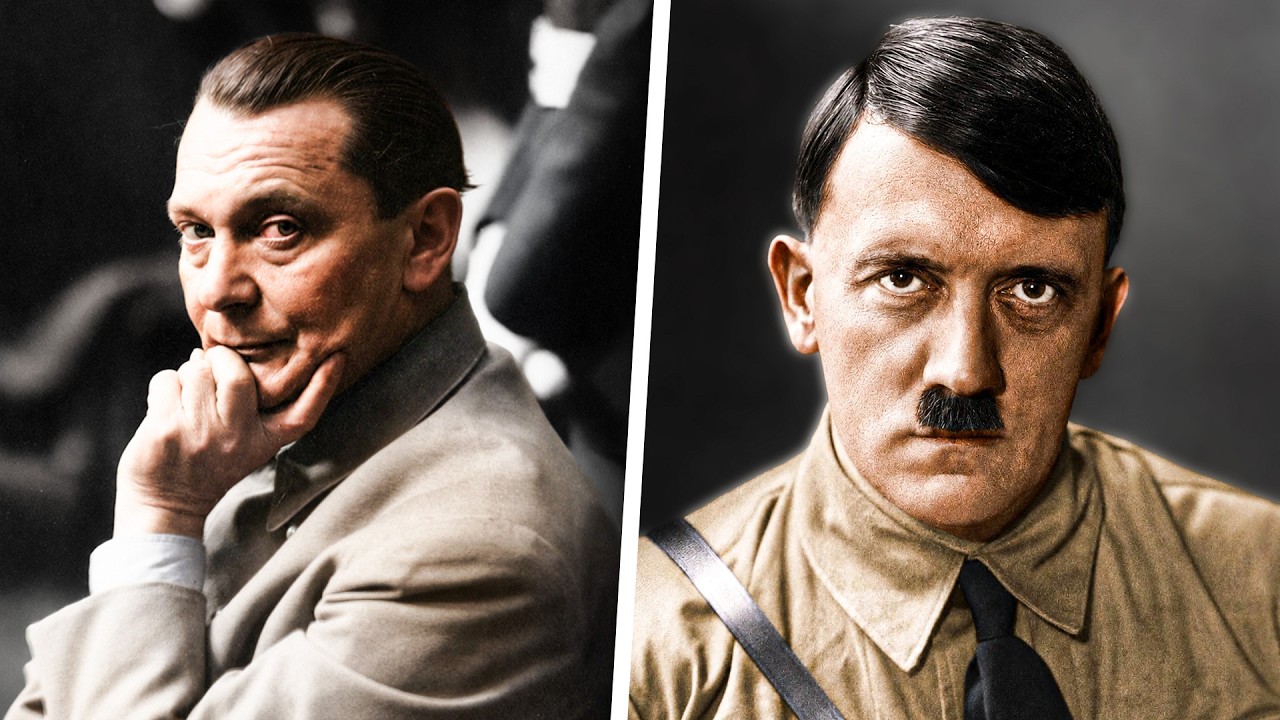 But the alliance was forged in utility from the very first moment, a transaction between two men who saw in each other the key to their own salvation. Hitler needed Göring’s war-hero status and polish to lend respectability to a fringe political movement, and Göring desperately needed the fire and direction that Hitler provided. For Göring, the attraction was never rooted in the dark ideologies of race or blood, but in the horsepower of power and the proximity to control that Hitler provided.
The psychiatrist John Douglas Kelly, who spent unmatched hours interviewing Göring, would later conclude that the Nazi’s loyalty was self-serving at its core, a means to feed a bottomless ambition.
What followed was a deluge of catastrophe that crushed Europe under its own weight, securing their partnership not with a document but with a bullet. In November 1923, Göring marched beside Hitler in the failed Beer Hall Putsch, where he was shot in the groin, a wound that required morphine and sparked a dependency that would permanently ravage his body and judgment. That shared moment of violence and blood cemented a bond of fate, which carried him into the highest echelons of power in 1933.
The payoff for his early faith was decisive and lethal, as he became the second most powerful man in Germany, seizing authority across intelligence, military, and economic realms with an insatiable greed.
To demonstrate his loyalty, Göring offered a sacred promise: he bound his destiny to the founding Führer for better or worse, even unto death, a vow he later stubbornly insisted he never regretted. Yet this is the puzzle—a man who privately mocked Hitler, believed in a two-stage Führer, and admitted to following him for personal gain, refused to break that oath even with the gallows looming. It is a contradiction that could only be born from the strange fusion of hero-worship and coldly calculated self-interest, and it unraveled only when the supply of glory ran out.
The problems began when Göring’s promises of miracles stopped coming true, and his fatal miscalculation at Stalingrad destroyed the basis of his credibility.
 When over two hundred thousand German soldiers were trapped in the frozen hell of Stalingrad, Göring made a personal guarantee to Hitler that his Air Force could sustain them with a massive airlift. It was a lie born of delusion, a fantasy that ended in disaster, starvation, and the deaths of tens of thousands of men who never received the promised supplies. The utter failure of his logistics turned Hitler’s trust into a cold contempt, and he began cutting the Göring out of all critical military strategic planning.
As the Allies bombed their cities into rubble, the Luftwaffe was powerless, and Göring’s fallen status was made public as he retreated into a fantasy of stolen luxury at KarinHall.
He became a self-parody in the final years of the Reich, drowning in plundered art and the stolen wealth of dead families, weighing more and more under the effect of morphine. Yet, beneath this façade of grotesque excess, there was a strange, cold conviction: he had quietly decided that the man he had served had lost his identity. Göring told his interrogators that between the Hitler who charmed France into submission in 1940 and the paranoid wreck who invaded the Soviet Union in 1941, there was a shift in kind, not degree.
He describes an earlier Hitler as genial, open, and charismatic, while the later Nazi was unstable, suspicious, and hostile to the point of madness. This theory, while self-serving, gains weight because others like Albert Speer, the architect-turned-armaments minister, independently described a similar hardening of personality in the Führer as defeat became inevitable.
Whether it was genuine fragility or a convenient narrative to escape the horror he’d participated in, this story of the two Hitlers is the key to understanding Göring’s own state. By the time the Reich was collapsing, he had become intellectually, psychologically separated from the cause he had sworn him to, remembered only as a decorated relic of the magic that had faded. The final act of their 23-year partnership in April 1945, was a bitter betrayal that reveals exactly how deep his loyalty really went.
 In his Bavarian refuge, thousands of miles from the bunker under Berlin, Göring sent a telegram to Hitler, referencing the 1941 decree that named him official successor and question his authority if the Führer was entangled in Berlin.
His transgression was procedural in his own view, a legal check on a legal provision, but the timing was dreadful. Martin Bormann, Göring’s ruthless, shadowy rival, saw it as his shot, and he presented such a telegram as a naked attempt at usurpation. In the paranoid environment of the collapsing bunker, Hitler believed the accusation without hesitation, labeling his designated inheritor a traitor.
He stripped Göring of his titles, expelled him from the party, and signed an order for his arrest on April 23, 1945, crushing with his initiative of the entire Empire of the Gore. The message Göring had ended with a final obsequious line anything less than his surrender, signing as “your silent Göring,” a sacrifice he conquered in that moment.
The irony is that the telegram was by the letter of the law, perhaps not even a crime, but in the depth of the infection, the man he once loved was beyond seeing. This was the point in his mind where the trajectory of his own ambition finally invaded, and he was forced once again to point out his most unforgettable truth: that the Führer he had loved was already the dead and the paranoid tyrant who was dividing his empire was a stranger. Locked up in Nuremberg, with his vast and intact hierarchy of memory, Göring attempted to drink his own final testimonies into the light of day.
In talks with Dr. Kelly, Göring did not fall into a frenzy of denial, on the contrary, he was easy, logical, and brutally honest about the catastrophic end of the military campaign, offering jokes to cut through the undeniable weight of the horror. He argue that he was one of the few men who had the courage to speak out, but any man who had said no to Hitler was 6 feet below.
 Though he tried to shape his own portrayal as the realist, he turned on the very man he had followed, claiming that he had seen the comparisons of the past. Yet, when directly asked if he would retract his loyalty to Hitler, the réponse unified his contradictions: a hard “No.” He had bound his fate to the other and accepted to die for it.
The psychological interpretation that Kelly drew from Gouring’s cell was not a monster, but an even more terrifying proof of human evil. Göring was intelligent, charming, and remarkably sane under standard measure, a man who could be at a dinner party in one age and direct the machinery of the murder in the next, so his range again. There was no madness to quarantine, no psychiatric label for the comfortable distance we seek from the failure of our reasoning.
The insight of Killy would haunt him: among those who are capable of such horror, it also lives in a place where we might find ourselves, and that is not an escape. As the trial reached its end, he accepted his sentence of death without the theatrical breakdown that came to his fellow defendants.
To give the fragility of the Allies a final defeat, he swallowed a hidden cyanide capsule and lay escaped on the gallows, ending his own life with the same method his dead predecessors had used and which would later also become the mysterious end of Douglas Kelly. In the end, Göring’s very being remains a testament to the plural truth of his relationship with Hitler: a mix of faithful loyalty and bitter contempt. The point that you saw your own Dogs come and go fine and the intelligence that permitted him to see himself in the entire tragedy, was the same capacity for the ambition that drove him.
There were, as he said, two Gougons, too: one who believed in the myth and the other who used of the magic for his own end, and it was the latter who betrayed us all.
## Disclaimer
This article is a creative adaptation of a provided video transcript and historical research. It aims to provide an engaging narrative on a complex historical topic. For a deeper understanding, please refer to established historical academic sources.