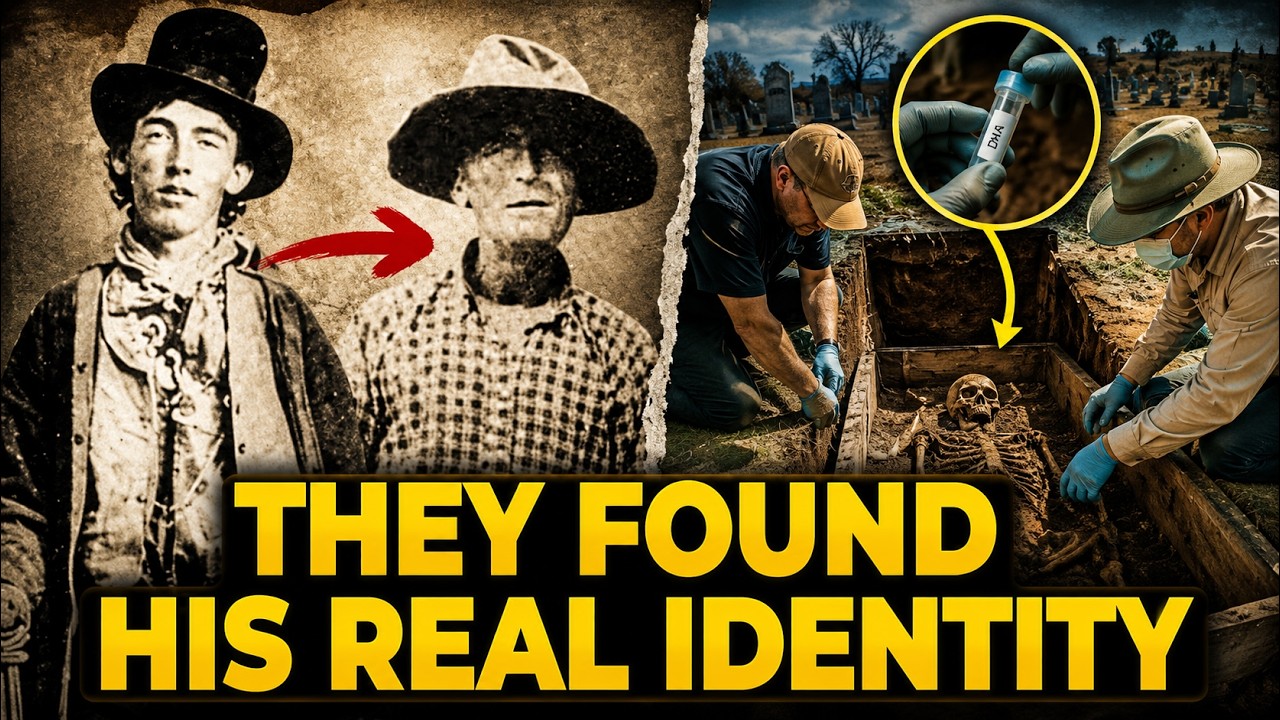
For more than a century, the accepted history has held that Billy the Kid was shot and killed by Sheriff Pat Garrett in 1881. But a persistent alternative claim points to a ranch hand named John Miller, who may have carried the outlaw’s secret into old age. In 2005, investigators exhumed Miller’s grave in Arizona, examined his remains, and collected DNA samples. What they found did not settle the mystery.
Instead, it raised new questions about unidentified skeletons, disputed injuries, and a bloodstained bench that may or may not have held the outlaw’s body. The official account is well documented. Billy the Kid, born Henry McCarty and also known as Henry Antrim and William H. Bonney, was one of the most notorious outlaws of the American Old West when Garrett caught up with him at Fort Sumner, New Mexico, on the night of July 14, 1881.
By then, the Kid had taken part in the Lincoln County War, been convicted of killing Sheriff William Brady, and escaped from the Lincoln County jail after killing two guards. According to the accepted version, Garrett entered the home of Pete Maxwell while two deputies waited outside. Billy walked into Maxwell’s dark room, realized strangers were nearby, and asked who was there. Garrett recognized his voice and fired once.
A coroner’s jury examined the body, questioned both men, and identified the dead man as Billy the Kid. He was buried at Fort Sumner the following day. Since New Mexico was still a territory and did not issue modern death certificates, the coroner’s findings served as the official legal record. For most historians, the witnesses, the jury, the burial, and the newspaper reports make this a well-documented death rather than a story told by one lawman alone.
Garrett’s own detailed version appeared in an 1882 book written with journalist Ash Upson, but critics have long questioned parts of it because Garrett had a reputation to defend. Billy had escaped custody before, knew Fort Sumner well, and had known Garrett personally. That left room for later storytellers to suggest the lawman might have helped the outlaw disappear or killed the wrong man in a dark room. The burial site itself created more uncertainty.
Early grave markers were not permanent, and a major flood struck the Fort Sumner Cemetery in 1904, making it impossible for later generations to be completely certain every marker still stood over the original location. None of this proves an escape. People in Fort Sumner saw the body, and a coroner’s jury identified it. Still, the lack of modern paperwork, the damaged cemetery, and the fact that the shooting happened at night gave survival stories room to grow.
Over the following decades, several men were presented as the outlaw who supposedly escaped Garrett. The most interesting of those names was John Miller, a ranch hand whose reliable paper trail appears to begin at a remarkably convenient moment. On August 8, 1881, less than a month after the Fort Sumner shooting, Miller married a woman named Isidora in Las Vegas, New Mexico Territory. Supporters of the Miller theory later claimed he looked weak at the wedding and had a bandaged injury beneath his shirt, but that detail comes from later recollections, not from the marriage license itself.
What is firm is the timing. Researchers have struggled to establish a clear life for this particular John Miller before the marriage. Afterward, he and Isidora lived in New Mexico and Arizona, sometimes working around cattle and ranches. They adopted a Native American boy named Max.
Friends and relatives later said Miller knew a great deal about Billy the Kid and the Lincoln County War. Some stories claimed he privately admitted being Billy, then denied it later. These accounts made the case famous, but most were recorded many years after the events and often passed through more than one person before reaching a writer. The missing early record is suspicious but not proof by itself.
John Miller was a common name. Frontier documents were incomplete, and a person could appear under a middle name, a nickname, or a spelling later researchers did not recognize. The gap creates a possibility, not an identification. Miller’s known records do not form a clean biography.
Arizona Pioneers’ Home documents described him as born around 1850 and said he had been adopted by the Kiowa after his parents were killed. Other later records list a birth year closer to 1859, the same general period associated with Billy the Kid. Those versions cannot all be right. If the 1850 birth year was accurate, Miller would have been roughly ten years older than Billy.
If the later date was accurate, the age would fit. Without a dependable birth record, researchers cannot simply choose the date that supports the theory. Physical comparisons were no stronger. Supporters pointed to Miller’s narrow shoulders, teeth, hands, and facial shape, but the only widely authenticated photograph of Billy shows a young man, while surviving Miller photographs show someone decades older.
Aging and early photography can change apparent proportions, so resemblance cannot establish identity. John Miller died at the Arizona Pioneers’ Home in Prescott in 1937 and was buried in the home cemetery. The claim that he had been Billy the Kid became much more visible after his death, particularly through Helen Airis’s book Whatever Happened to Billy the Kid, which collected stories from people connected to Miller’s life. The book preserved local memories, but much of its case depends on hearsay recorded long after 1881.
Another part of the legend involved a locked trunk that Miller supposedly kept close. Family stories said it may have contained documents or objects connected to Billy, but no verified inventory became public. Some relatives believed it disappeared in a fire that killed Isidora. By the late 20th century, Miller had become one of two major survival claimants.
The other was Ali Roberts, better known as Brushy Bill, who publicly sought a pardon near the end of his life. Neither man produced evidence accepted by mainstream historians. Miller’s case was less public during his lifetime than Brushy Bill’s. That may make him seem more believable, but it also means there was no detailed statement that could be checked while he was alive.
Most major claims arrived when he could no longer answer questions. In 2003, former Lincoln County Sheriff Tom Sullivan and Steve Sederwall, a former federal officer and former mayor of Capitan, began treating the Billy the Kid story like a cold case. Their original plan was broader than John Miller. They wanted DNA from Catherine McCarty Antrim, Billy’s mother, and hoped to compare it with remains from the official Fort Sumner grave and with men who claimed to be Billy.
A mother and son share a clear biological relationship, so Catherine could have provided a much stronger reference than an old photograph or a family story. The plan quickly ran into legal and practical problems. Catherine’s cemetery in Silver City had been moved years after her burial, making the exact location of her remains uncertain. Officials and descendants opposed disturbing graves, and permission to open Billy’s Fort Sumner burial site was not secured.
Sullivan and Sederwall then focused on Miller because his grave in Prescott was known and because they believed another possible reference had appeared. A Maxwell family descendant had preserved old furniture linked to Pete Maxwell’s home, including a wooden bench said to have held Billy’s body after the shooting. Investigators believed dark stains on that bench might contain his blood. On May 19, 2005, a team entered the cemetery at the state-operated Arizona Pioneers’ Home and opened the grave believed to be Miller’s.
The work was supervised by forensic anthropologist Laura Fulginiti, and a DNA specialist was also present. A backhoe removed the upper soil, and the team worked carefully near the burial level. The dig immediately became more complicated than expected. Two sets of remains were found in neighboring unmarked graves.
The old coffins had collapsed, and some bones were no longer in clear positions. One set was thought to belong to Miller and the other to cattleman William Hudesmith, who had died only days apart from him. Investigators examined and sampled both because they could not be certain which was which. One skeleton showed an injury near the shoulder blade.
Sullivan and Sederwall thought it might support the story that Miller had survived Garrett’s shot. Fulginiti was more cautious and said she could not determine that the damage came from a bullet. The second skeleton showed a healing hip injury, which matched a report that Miller had fallen before entering the Pioneers’ Home. She considered that second set more likely to be Miller’s, while the investigators favored the first.
This disagreement mattered because a name on a cemetery map does not automatically follow every bone recovered from disturbed ground. Before DNA could answer whether Miller was Billy, the team first had to answer a simpler question: which remains were actually Miller? The exhumation never produced a completely secure answer accepted by everyone involved. The laboratory could obtain usable DNA from one of the two sets of remains, but not from the set the forensic anthropologist thought was more likely to be Miller.
That created a basic identity problem before any comparison even began. The available bone sample might have come from Hudesmith rather than Miller. The proposed reference sample was just as uncertain. The wooden bench had no modern chain of custody showing where it had been every year since 1881, who had handled it, whether it had been cleaned, or whose blood created the stains.
Even a clean DNA match between a skeleton and a stain would only show that the same person was connected to both samples. Old DNA also breaks into smaller pieces and can be mixed with DNA introduced by later handling. Modern forensic standards treat degradation, mixtures, and contamination as serious limits, especially when samples are old and their history is uncertain. In this case, both sides of the comparison had unanswered questions.
The exhumation also produced a dispute over whether the team had proper authority. The superintendent of the Pioneers’ Home had given permission to open the grave believed to be Miller’s, and the investigators said they believed the work was legal. Arizona officials later argued that the team did not have the required permission to remove samples and had no authorization to disturb Hudesmith’s remains. Prosecutors considered possible charges, but in 2006 they declined to file them.
Their explanation was that officials at the facility appeared to have allowed the work and that the investigators seemed to believe they had permission. A separate fight then developed over the investigation’s records. In 2008, historian Gale Cooper and newspaper publisher Scott Stinett sued Lincoln County authorities, seeking reports connected to the DNA work and other evidence. The dispute lasted for years and produced pages of records, legal costs, and conflicting claims, but it did not produce a publicly accepted scientific identification of John Miller as Billy the Kid.
Reports about the laboratory work have used different language, but they agree on the most important point: no verified DNA result has been made public that identifies John Miller as Billy the Kid. PBS described the test results as unreleased, while a later Washington Post account said the comparison was useless. Those statements are not proof that Miller was someone else. They mean the attempted test did not answer the identity question.
A strong test would need remains securely identified as Miller and a reliable reference from Billy or a close biological relative. Catherine Antrim would have been useful because a maternal relationship can be checked genetically, but her remains were never made available for the planned comparison. The official Fort Sumner grave presents its own location and permission problems, and opening it could disturb the remains of other people buried nearby. The historical record still identifies the man killed by Pat Garrett in 1881 as Billy the Kid.
The Miller claim rests mainly on the timing of his first known records, later personal stories, uncertain physical similarities, and missing evidence. The 2005 exhumation added real bone samples to the case, but it also added a second unidentified skeleton, a disputed injury, an uncertain bloodstained bench, and laboratory work that could not establish the outlaw’s identity. Newer DNA technology may recover more information than laboratories could obtain in 2005, but it would not automatically fix the older problems.