The rain was a curtain of water over Cape Cod, a brutal, driving November storm that seemed to swallow the Kennedy compound whole. It was November 29th, 1963, seven days after the shots in Dallas, and the man who had just pulled his car into the driveway was a journalist named Theodore White. He was there at the summons of a 34-year-old widow, a woman whose husband had been buried for less than a week, and he believed he was performing an act of charity, offering a grieving soul a chance to speak.
He was wrong. He was walking into a meticulously orchestrated session of historical revisionism, conducted by a woman whose calm voice and total recall would mask a calculated, four-hour-long effort to seize control of a narrative that threatened to consume her. White would later describe her demeanor as composed, her memory as flawless, but he failed to recognize the strategic mind at work behind the veil of grief.
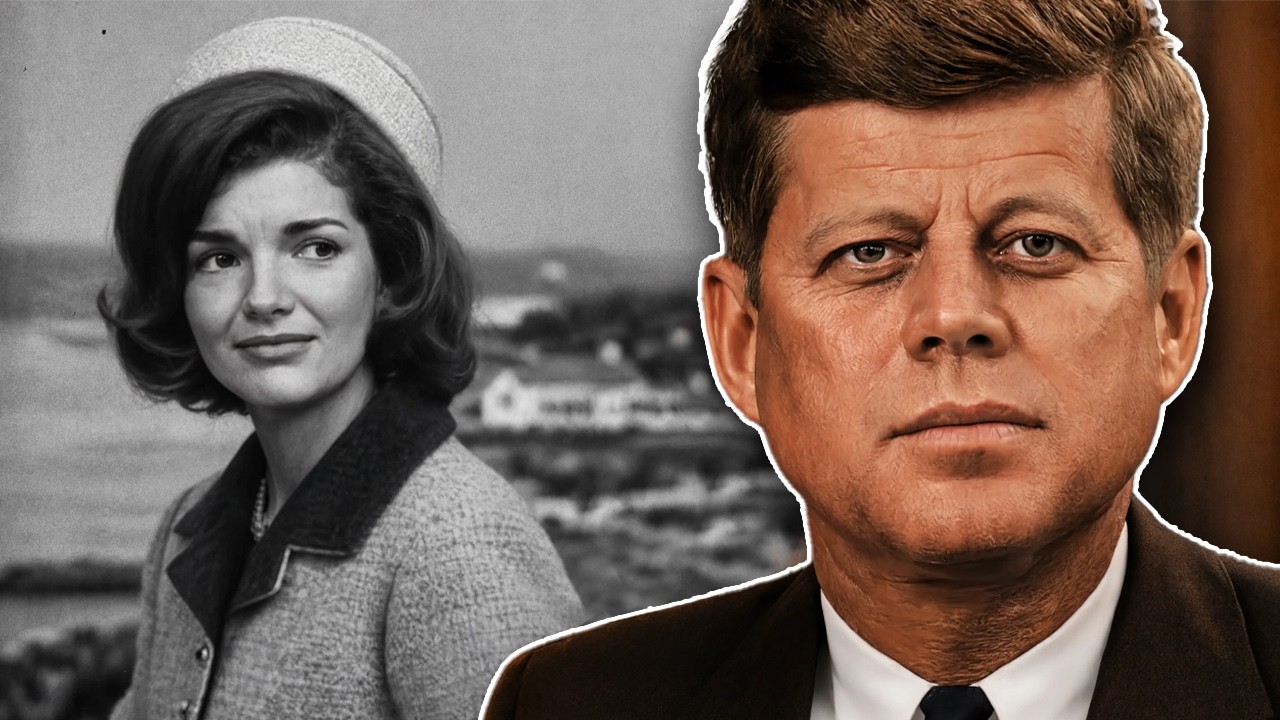 He saw a widow in mourning; he was actually facing an editor in chief.
The American political machinery, in the chaotic aftermath of the assassination, had already made its predictions, calculating that the grieving widow would be a manageable asset. They envisioned a transitional role for her, one that was dignified and ceremonial, a figurehead of national sorrow who would eventually recede gracefully into the quietude of private life. The Kennedy family and their institutional allies, meanwhile, were focused on managing the historical record, ensuring their version of the fallen president’s legacy would be the one that endured.
The American public, however, had a different, more visceral calculation. They saw the woman who had emerged from Parkland Memorial Hospital in a blood-stained pink Chanel suit, a woman who had refused to change her clothes for Lyndon Johnson’s swearing-in ceremony because she wanted the world to see the physical evidence of what had been done. They believed she would remain the eternal keeper of that image, a living monument to her husband’s sacrifice for the rest of her natural life.
Theodore White, driving through the relentless rain, calculated that he was doing the widow a favor, providing her with a platform for her grief, a vehicle to shape her own narrative in a moment of profound vulnerability. He believed he was offering a sympathetic ear, a conduit to the nation’s heart. He did not realize that Jacqueline Kennedy was not grieving in the way he assumed; she was editing, and he was her instrument.
The sealed Theodore White papers, which he had instructed to be kept under lock and key until one year after Jackie’s own death, were finally released in 1995, and they confirmed with startling clarity what she had been doing that night. Her handwriting was found in the margins of his copy, a ghostly blueprint of her intentions. The legend she launched from that Cape Cod rainstorm was not a widow’s spontaneous, emotional memory; it was a deliberate, calculated first draft of history, written by a 34-year-old woman with a clear vision.
She would spend the next three decades of her life slowly, quietly, and methodically escaping the very prison of myth she had so brilliantly constructed that night. The story of Jacqueline Lee Bouvier began on July 28th, 1929, in Southampton, New York, born to a Wall Street stockbroker father known for his charm and his drinking problem. Her mother divorced him when Jackie was just 13, remarrying into established wealth and providing her daughter with a world of privilege and expectation.
Her education was a path of refinement, from Vassar to a year at the Sorbonne in Paris, culminating in a degree in French literature from George Washington University in 1951. Her first foray into the professional world was as the “Inquiring Camera Girl” for the Washington Times-Herald, a job that required her to take photographs and ask strangers questions on the street, an early training ground for her understanding of public perception. It was at a dinner party in Washington in 1952 that she met the charismatic young congressman, John F.
Kennedy.
They were married on September 12th, 1953, in Newport, Rhode Island, a union that was as much a political alliance as a romantic one. She was aware of his other women throughout their marriage, a knowledge she managed with the same tools she applied to everything else in her life: discretion, intelligence, and an unerring instinct for what the situation required. The story of Mary Meyer, the Georgetown artist who was a presence in the White House during the Kennedy years and was found shot on a canal towpath 11 months after Dallas, is a separate, documented tragedy.
This narrative, however, is about the woman who was not on that towpath, but in the backseat of the motorcade car in Dallas, holding her husband as the vehicle raced towards Parkland Hospital. It is about the woman who stood in her blood-stained suit and watched Lyndon Johnson take the oath of office, who flew back to Washington with the coffin, and who, seven days later, sat in Hyannis Port and directed the first draft of history. The Theodore White papers revealed the true nature of that night, showing a woman who was organized, purposeful, and utterly in command.
She covered the horror of Dallas with a chilling efficiency, then pivoted to describe her happiness with her husband, declaring her deep mistrust of history, which she famously called something that “bitter old men write.” Then, with the precision of a master storyteller, she introduced the Broadway musical Camelot and the lyric that JFK had loved: “Don’t let it be forgot that once there was a spot for one brief shining moment that was known as Camelot.” White wrote his thousand-word piece from the servants’ quarters that night, dictating it by phone to his editors at Life magazine.
The editors objected to the Camelot passages, finding them too overwrought for the gravity of the moment. Jackie, however, objected to their objections, and her will prevailed. The word “Camelot” ran in Life on December 6th, 1963, and it instantly became the defining metaphor for the Kennedy presidency.
No one who had known JFK while he was alive had ever compared his White House to Camelot; his own special assistant, Arthur Schlesinger Jr. , later wrote that Kennedy himself would have mocked the comparison without hesitation.
 The Camelot myth was not a product of the Kennedy presidency; it was a product of Jacqueline Kennedy’s strategic grief management, executed in a rainstorm seven days after Dallas with a journalist’s copy in her hands. She built the legend, but in doing so, she also became its most famous prisoner. She moved to New York in the spring of 1964, fleeing the Georgetown house that had become a tourist attraction, with mourners gathering outside at all hours.
She took an apartment at 1045 Fifth Avenue on the Upper East Side, near Central Park.
The legend she had built required something specific from her. Camelot demanded a widow who remained above ordinary life, a figure of silent, graceful, eternal mourning. The public expected her to maintain her position as the keeper of the flame she had personally lit over her husband’s grave at Arlington.
But she was only 34 years old, a woman with a lifetime ahead of her, and the weight of that expectation was immense. Into that vacuum stepped Bobby Kennedy, who became a fixture at her Fifth Avenue apartment.
He came for breakfast with the children, John and Caroline, and took long walks with Jackie through Central Park, two people bound by a shared and devastating grief. Biographer C. David Heymann, in his 2009 book Bobby and Jackie, alleged a sustained intimate relationship between 1964 and 1968, drawing on Secret Service reports and personal interviews, though Kennedy family historians dispute the physical dimension of the claim.
What is documented is the constancy of their bond, the shared sorrow, and the implicit understanding that had formed by the middle of 1967.
The plan was set: Bobby would run for president, and Jackie would return to Washington beside him, a powerful symbol of continuity and legacy. She called Bobby the night she decided to tell him about her intention to marry Aristotle Onassis, and he, in the middle of his presidential campaign, asked her to wait. She agreed.
On June 5th, 1968, Bobby Kennedy was shot at the Ambassador Hotel in Los Angeles, minutes after winning the California Democratic primary. He died the following day. It was the second Kennedy assassination Jackie had witnessed in five years.
Whatever had been planned, the White House, the return, the second chapter, ended at the Ambassador Hotel. The dream of a Kennedy restoration was shattered, and Jackie was left to confront a terrifying reality. In October of 1968, she announced her engagement to Aristotle Onassis, a Greek shipping magnate who was 62 years old, 23 years her senior.
He owned a private island called Skorpios in the Ionian Sea, had been persistently involved with opera singer Maria Callas, and was decidedly not American, not Catholic, and not Camelot.
The reaction was immediate and global. American newspapers ran headlines like “Jackie Marries Blank Check,” while an Italian paper reportedly screamed, “America has lost a saint.” Onassis’s own children called her a gold digger from the start.
She was 39 years old, and she told a close friend, “The world is wide. It’s not just America.” She understood exactly what the Onassis marriage would do to her public image, and she did it anyway, a calculated act of self-destruction aimed at freeing herself from the gilded cage of her own creation.
 Biographer Barbara Leaming has argued that after Bobby’s death, Jackie was convinced the Kennedy name was a death sentence, that staying inside Camelot meant staying inside a system that had twice killed the men beside her. She was buying distance with the only currency she had: her own reputation. The marriage was not a fairy tale.
For most of its six and a half years, they lived on opposite sides of the Atlantic, with him staying at the Pierre Hotel when in New York and her keeping her Fifth Avenue apartment. He resumed his connection with Callas shortly after the wedding.
He was reportedly taking steps to limit Jackie’s inheritance when he died of pneumonia at the American Hospital in Paris on March 20th, 1975. Her public statement said he had “rescued her at a moment when her life was engulfed with shadows.” After legal battles with his daughter Christina over the full estate, she inherited approximately $26 million.
She was 45 years old, had been first lady, the widow of Dallas, and the wife of one of the world’s richest men, and she was now, for the first time in her adult life, entirely free to choose what came next.
She went to work. She took the subway to work. She negotiated with authors and ate lunch at her desk.
She was a senior editor at Doubleday for 16 years. The woman America called a saint was doing line edits on manuscripts about dance and architecture in Midtown Manhattan. She began at Viking Press in New York in 1975 as a consulting editor, then moved to Doubleday in 1978, where she remained until her death.
Her title was senior editor, and she worked on books about dance, architecture, photography, history, and cultural subjects.
Authors and colleagues described her as genuinely skilled, not a vanity hire or a celebrity figurehead. She had taste, judgment, and the ability to make a manuscript better. It was a quiet, unglamorous existence, a stark contrast to the palace of myth she had inhabited.
Sometime around 1980, Maurice Tempelsman became a visible presence in her life. He was Belgian-born, the same age as Jackie, 1929, and his family had fled the Nazis to America in 1940 when he was 11. He had built a significant fortune in the diamond industry.
He had met the Kennedys in the 1950s through business connections, and he was separated from his wife, though Orthodox Jewish law prevented a formal divorce. He moved into Jackie’s life quietly, without announcement. By 1982, he was spending several nights a week at the Fifth Avenue apartment.
He managed her finances and reportedly quadrupled her estate to nine figures through careful investment. They spent summers at Martha’s Vineyard, sailed together on his 70-foot yacht, and walked in Central Park in the mornings.
He was not glamorous. He was not famous. He was described in profiles as plain-looking and unpretentious, the physical and temperamental opposite of the dashing figures who had defined her earlier life.
 He read books. He was kind. He was present.
They were together for approximately 14 years, a relationship defined by its quiet stability rather than its 𝒹𝓇𝒶𝓂𝒶. In the spring of 1994, Jackie was diagnosed with non-Hodgkin’s lymphoma, and she died on May 19th, 1994, at her Fifth Avenue apartment. She was 64 years old.
Three people were with her in the room at the end: her daughter, Caroline; her son, John F. Kennedy Jr. ; and Maurice Tempelsman.
Her funeral was held at Saint Ignatius Loyola Church on Park Avenue, and Tempelsman read C. P. Cavafy’s poem Ithaca, then set it aside and added his own words: “And now the journey is over, too short, alas, too short.
It was filled with adventure and wisdom, laughter and love, gallantry and grace. So, farewell, farewell.” She was buried at Arlington National Cemetery alongside JFK, their stillborn daughter, and their son, Patrick, who had lived only three days in August of 1963.
One year after she died, the JFK Presidential Library released Theodore White’s notes from November 29th, 1963. Her handwriting was in the margins of his copy. The word “Camelot” had not emerged spontaneously; it had been introduced, deliberately shaped editorially, and inserted into the historical record by a 34-year-old woman who had been awake for most of seven days and who understood with complete clarity what the alternative was.
The alternative was history as the bitter old men wrote it, and she did not accept that alternative.
She built the legend herself in a rainstorm on Cape Cod with a journalist’s notes in her hands. Then she spent 30 years slowly, quietly dismantling what the legend required her to be. She married Onassis and destroyed the saint.
She took the subway to Doubleday and did her job. She walked in Central Park with a quiet man who read books and was present when she died. Three people in the room at the end.
The Theodore White papers confirmed what she had done at the beginning. The two bookends of her widowhood, the interview she controlled and the room she chose. Between them, 30 years that history spent trying to keep her in Camelot.
She kept leaving.