When Queen Maria Theresa of France attended a lavish celebration dedicated in her honor, her husband, King Louis XIV, chose that very event to publicly parade his mistress before the court. The humiliation was so blatant that witnesses described the queen as horrified, and the moment became one of the most painful in a marriage defined by betrayal. Maria Theresa of Spain has often been overlooked by history, remembered mainly as the pious, long-suffering wife of the Sun King. But her life was marked by tragedy, political maneuvering, and secrets that would fuel rumors for centuries after her death.
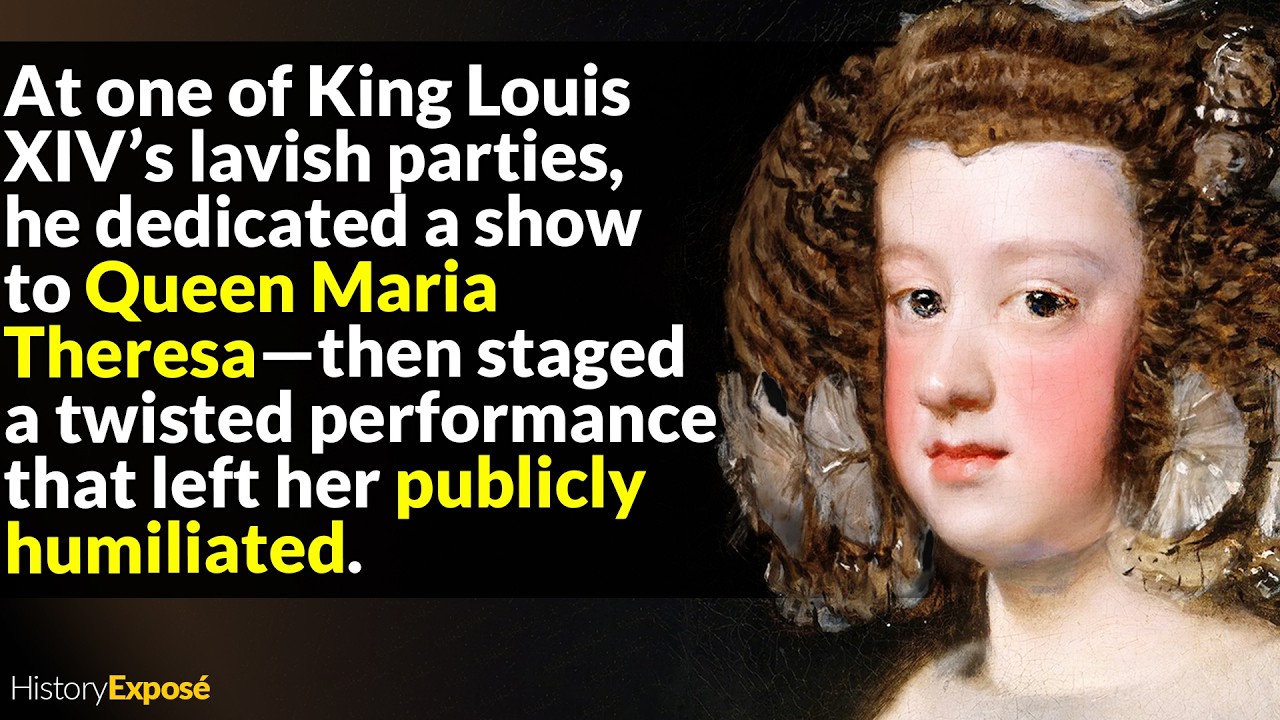
Born in 1638 to King Philip IV of Spain and his wife, Queen Elisabeth of France, Maria Theresa’s early years were shadowed by loss. Her mother died when she was just six years old, and shortly afterward, her older brother succumbed to smallpox. The boy’s death left Spain without a male heir and suddenly positioned Maria Theresa as the likely future queen of the Spanish Empire. Her hopes were dashed, however, when her father remarried.
In 1649, Philip IV wed his 14-year-old niece, Mariana of Austria, who was also Maria Theresa’s first cousin. The Habsburg family’s long tradition of intermarriage would have devastating genetic consequences for future generations, but for the young princess, the immediate blow came in 1657 when Mariana gave birth to a son. The arrival of Prince Philip, followed by two more sons, ended any chance Maria Theresa had of ruling Spain. Her destiny instead lay in France.
After 24 years of war, the French and Spanish crowns sought peace through marriage. The plan made Maria Theresa a pawn in a political settlement, betrothed to the young King Louis XIV. She did not speak French, had never visited the country, and had never met her future husband. The two were legally married by proxy before she ever laid eyes on him.
Blood ties already bound them closely. Louis’s father was the brother of Maria Theresa’s mother, and his mother, Anne of Austria, was the sister of Maria Theresa’s father. This made the couple double first cousins, a connection that would have serious consequences. For the first year of their marriage, Louis showed genuine devotion to his bride, even vowing to spend every night by her side.
But within about a year, that commitment faded, and he began a pattern of infidelity that lasted for the rest of Maria Theresa’s life. The religious and cultural divide only deepened her isolation. Raised in the conservative Spanish court, Maria Theresa was deeply devout, valuing modesty and prayer above all. The decadence and frivolity of Versailles shocked her sensibilities.
She never mastered French, barely understanding the language and avoiding speaking it whenever possible. Her difficulty with the language left her unable to follow court conversation and made her the target of mockery behind her back. Her mother-in-law, Anne of Austria, was one of the few people she could speak Spanish with, and the two women shared a close bond. When Anne died in 1666, Maria Theresa’s isolation grew worse, and her husband compounded the injury by flaunting his mistresses more openly.
Louis’s fondness for beautiful women was an open secret. He took many lovers, both official and unofficial. After his mother’s death, he brought Louise de La Vallière to live permanently at court. Maria Theresa was forced to endure living alongside a woman everyone knew was her husband’s lover, a woman who had once been one of her own maids of honor.
The situation worsened when Maria Theresa’s only confidante at court, Madame de Montespan, proved to be anything but a friend. She had befriended the queen only to get closer to the king, and her scheme worked, as she soon became Louis’s preferred mistress. Louise de La Vallière, upon losing the king’s favor, chose to become a nun. Before leaving court, she threw herself at the queen’s feet and begged forgiveness for the pain she had caused.
Maria Theresa accepted the apology graciously and even visited Louise regularly at her convent. Madame de Montespan, by contrast, never apologized. She openly mocked the queen for failing to hold the king’s attention, and her disrespect was so flagrant that even Louis occasionally felt compelled to put her in her place. One reason Maria Theresa suffered so deeply from Louis’s affairs was that she was completely infatuated with him.
His interest in her cooled quickly, but she adored him. Even after years of sharing him with other women, she still hoped he would one day turn faithful and recognize her as his destiny. There was one thing Maria Theresa could give Louis that none of his mistresses could: a legitimate heir. In 1661, a year after their marriage, she gave birth to a healthy son, also named Louis.
He would be the only one of her children to survive past the age of six. Royal births in France were public events, with courtiers present to witness the arrival of the heir and ensure no child-swapping took place. Maria Theresa gave birth after 12 hours of labor in front of an eager crowd of noblemen. The public nature of these births would later tie her to a scandalous rumor.
Though she never involved herself heavily in politics, Maria Theresa played a powerful role when her husband went to war. Louis appointed her regent in his absence, making her the official head of state on several occasions. One notable instance of her regency power came when Louis decided to fight for inheritance rights Maria Theresa had signed away at marriage. Her father, Philip IV, had agreed that she and her heirs would lose their claim to the Spanish throne only if Spain paid her dowry—which, according to Louis, Spain never did.
When her half-brother Charles took the Spanish throne, Louis seized Spanish territories and asserted his wife’s claim, triggering a war. Although he failed to hold the territories, he ultimately won the larger fight over whether Maria Theresa’s heirs could rule Spain. Beyond the pain of infidelity, Maria Theresa suffered the agony of losing five children. Over a decade, she gave birth to two more sons and three daughters, but all of them died in infancy or early childhood, except for her eldest son.
Modern historians believe inbreeding played a significant role. Because Maria Theresa and Louis were double first cousins, and both came from generations of intermarriage between the Habsburg and Bourbon families, genetic complications likely caused their children’s short lifespans. A persistent rumor, however, claimed that one child survived. According to court gossip, Maria Theresa gave birth to a dark-skinned daughter in 1664 who disappeared shortly after birth.
Some whispered the father was a dark-skinned court servant, while others suggested her excessive consumption of chocolate caused the baby’s dark coloring. Historians believe the infant was actually her daughter Marie Anne, who lived only a few weeks and whose dark skin was likely the result of oxygen deprivation at birth. Despite the scandalous whispers, most people felt sympathy for the queen. She was not as beautiful or quick-witted as her husband’s lovers, and she lost most of her children and close allies during her first decade as queen.
Her accent, her love of sweets, heels, and gambling often made her an object of ridicule. Some measure of justice finally arrived when Madame de Montespan fell from favor. Not only had she lost the king’s affections, but she was publicly accused of practicing black magic and conspiring to eliminate a rival. She denied the charges, but her reputation was ruined, and a new woman had captured Louis’s attention.
That woman was Madame de Maintenon, the governess of Louis’s children with Madame de Montespan. Unlike the others, she did not immediately accept the king’s advances. Instead, she encouraged him to pay more attention to his neglected wife. Grateful for the kindness, Maria Theresa welcomed the governess into her inner circle, unaware that Madame de Maintenon would eventually become the most significant favorite of the king’s later life.
After losing five other children, Maria Theresa focused her attention on her surviving son, the Dauphin. She devoted herself to his religious education, hoping he would become more devout than his philandering father. Louis, however, did not share her adoration. He reportedly found his eldest child indolent, fatuous, and dull, noting that the only thing they shared was a love of hunting.
Louis limited Maria Theresa’s control over her son’s life and did not even consult her when choosing a bride for the young prince. Maria Theresa had hoped her son would marry Maria Antonia of Austria, the daughter of her half-sister. Instead, he married Maria Anna of Bavaria. The queen felt jealous that the wedding celebrations for her daughter-in-law were more extravagant than her own, and she was stung by courtiers’ praise of the German princess’s perfect French.
Still, she lived long enough to see one joy: in August 1683, a month before her 44th birthday, her daughter-in-law gave birth to a son. Maria Theresa would not live to meet her next grandchild. Her end came suddenly. After returning to Versailles from a trip with the court, the queen fell gravely ill.
An abscess on her arm led to severe complications, and no treatment from the court doctors could relieve her worsening symptoms. On July 30, 1683, Maria Theresa died at the age of 44, leaving behind a grieving son and a swirl of rumors. Some whispered she had been poisoned. The claims were unlikely, but speculation that someone at court had wanted the queen gone persisted.
Her husband’s response to her death was characteristically detached. Louis reportedly remarked that her passing was “the first chagrin she has ever given me. ” Despite his failures as a husband, he gave her a funeral worthy of a queen, with burial in the Basilica of Saint-Denis. But he did not grieve long.
Just two months after losing his wife of over 20 years, Louis XIV secretly married Madame de Maintenon. They remained inseparable for the rest of his life. Louis had finally committed himself to one woman, but that woman was not Maria Theresa. Her misfortunes continued after death.
During the French Revolution, revolutionaries looted the royal tombs at Saint-Denis and threw her remains into a mass grave. After the restoration of the monarchy, Louis XVIII had her bones and those of other royals reinterred in the church crypt. Louis XIV outlived not only his wife but also his first two heirs. Maria Theresa’s son and firstborn grandson both died young, leaving her great-grandson, another Louis, to eventually rule France from Versailles.
Maria Theresa’s grandson Philip, the second son of the Dauphin, would fulfill the destiny denied to his grandmother. When his uncle Charles II of Spain died without a son, Philip inherited the Spanish crown. The most significant scandal of Maria Theresa’s life resurfaced after her death. France became fascinated by a story of a dark-skinned nun who claimed to be related to the royal family.
Many believed this woman, Louise Marie Thérèse, known as the Black Nun of Moret, was the dark-skinned child Maria Theresa had given birth to in 1664. The truth may never be known, but the belief that she was the queen’s long-lost daughter persists to this day. Despite enduring unceasing humiliation and being overshadowed by the king’s mistresses, Queen Maria Theresa remained a pillar of the French court, remembered for her virtue, resilience, and piety.