The myth of Erwin Rommel, the Desert Fox, the “good Nazi,” the gentleman general who defied Hitler and fought with honor, is one of the most enduring and successful pieces of propaganda to emerge from the Second World War. A new examination of declassified documents, personal testimonies, and operational histories reveals that the legend of the man who had tea with captured British commandos instead of having them shot is a carefully constructed narrative, built by three distinct regimes for three distinct purposes, and it is now under direct assault by modern historians and military analysts who argue that the reality of his command was far more complex, and far less noble, than the popular image suggests. The central question, whether Rommel was truly the opposite of every other general in Hitler’s Wehrmacht, is not a matter of simple historical fact but a live, contested battlefield in the ongoing struggle over how Germany remembers its military past.
The foundation of the Rommel legend rests on a single, verifiable act of defiance. On October 18, 1942, Hitler signed the Commando Order, a directive that mandated the immediate execution of all captured Allied commandos, without trial, regardless of whether they were in uniform. The order was clear: no prisoner status, no surrender, only a bullet from the Gestapo.
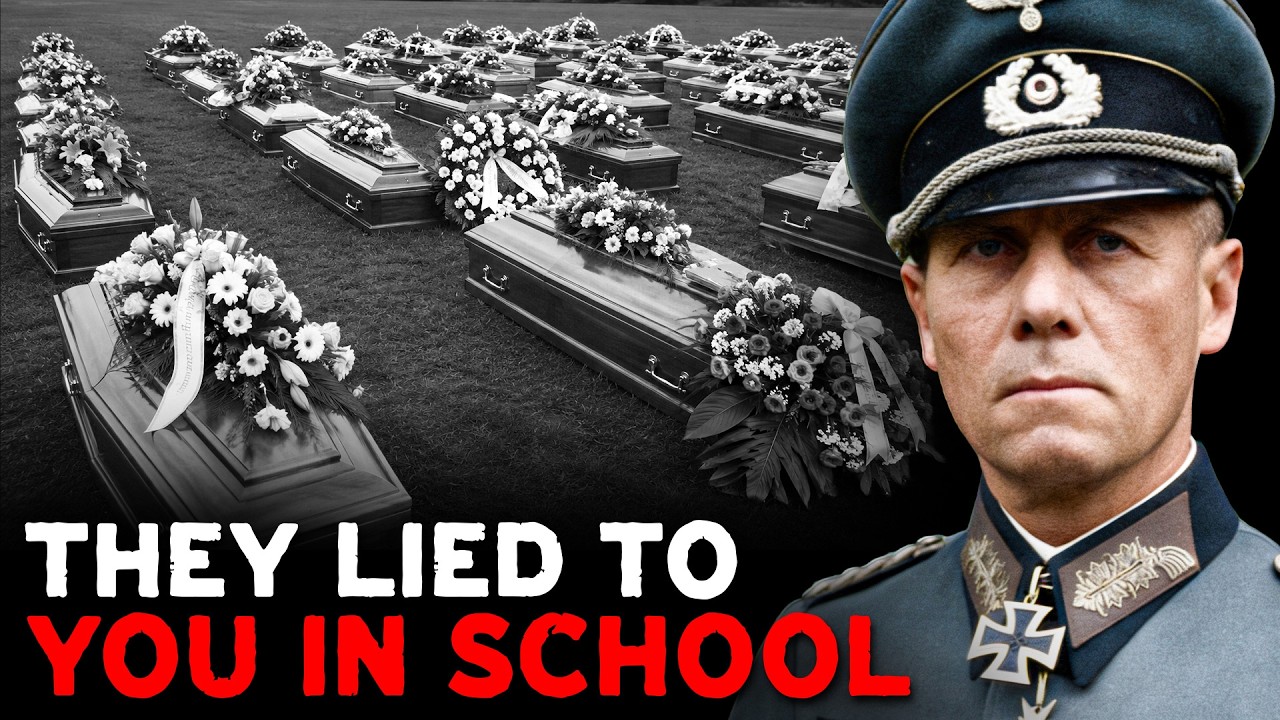 Distribution of the order was limited to just twelve copies within the entire German military hierarchy. Rommel received his copy. He then did something extraordinary.
He destroyed it, refusing to pass the directive down to his subordinate units in his theater of command. This is not a post-war fabrication by his admirers; it was documented at the Nuremberg trials. The order was enforced in other theaters, leading to the deaths of countless special forces operatives, but in Rommel’s area of operations, it was ignored.
The most famous example of this defiance occurred in May 1944, when two British commandos, Lieutenant George Lane and Roy Wooldridge, were captured on a beach in occupied France. Under the standing order, they should have been handed to the Gestapo and shot. Instead, they were blindfolded and driven to a chateau, where Lane was led into a library and met by a field marshal who rose from his desk, shook his hand, and invited him to sit down for tea.
That field marshal was Erwin Rommel.
This single act of humanity, however, must be weighed against the broader context of his command and the operational realities of the Nazi war machine. While Rommel refused to enforce the Commando Order, his peers did not. Field Marshal Albert Kesselring, who commanded in Italy, enforced the order without hesitation, leading to the execution of hundreds of captured commandos.
After the war, Kesselring was tried and convicted for these war crimes, sentenced to death, a sentence later commuted to life imprisonment. The legal finding was clean: the order had been enforced in his theater. It was not enforced in Rommel’s.
This distinction is the bedrock upon which the entire legend of the “clean” general was built. It is a real distinction, a documented divergence from the criminal behavior of his peers. Yet, to hold Rommel up as the sole bastion of decency within a criminal organization is to ignore the fact that he was still a highly effective, ambitious, and ruthless commander of that same organization.
He was not a dissident; he was a star player in the regime he served.
To understand the man behind the myth, one must look at his origins, which were as unusual as his later actions. Rommel was not a product of the Prussian military aristocracy that dominated the German officer corps. He was the son of a schoolmaster from Heidenheim, a small town in southern Germany.
He came up through the infantry, a path that placed him firmly on the outside of the elite General Staff circles before he ever saw combat. His rise was due to sheer, audacious talent. In 1915, during World War I, he crawled alone through French barbed wire in the Argonne Forest, took four bunkers, and held them against a battalion counterattack.
Two years later, at Caporetto, he captured nearly 9,000 Italian soldiers with a small unit. He was awarded the Pour le Mérite, a medal almost exclusively reserved for generals and senior staff officers, but Rommel was a lieutenant. This pattern of unconventional brilliance continued in World War II.
In February 1940, despite having no armor experience and against the explicit recommendation of the army’s personnel office, he was given command of the 7th Panzer Division. He was an outlier in his own army, a fact that made him uniquely useful to the Nazi propaganda machine, which needed a face that did not look like the Prussian elite.
 The military results were staggering. In May and June of 1940, the 7th Panzer Division moved through northern France so fast that the German High Command sometimes lost track of it. The unit earned the nickname the “Ghost Division.”
In a matter of weeks, it captured roughly 30,000 prisoners, 277 artillery pieces, and 458 armored vehicles, at a cost that was a fraction of what other panzer divisions paid for less ground. These numbers are not interpretation; they are pulled from his own after-action reports. In February 1941, he was sent to Libya with a defensive mandate to stabilize the collapsing Italian line.
He disobeyed the standing order, attacked within days of arriving, and pushed the British back to the Egyptian frontier. On June 21, 1942, Tobruk fell, and 33,000 British and Commonwealth soldiers surrendered in a single engagement. Hitler promoted him to Generalfeldmarschall, making him the youngest field marshal in the German army.
The British, humiliated by his tactical genius, gave him the nickname the “Desert Fox.” On January 27, 1942, five months before Tobruk fell, Winston Churchill stood in the House of Commons during a vote of confidence debate and called him “a very daring and skillful opponent against us, and, may I say, across the havoc of war, a great general.” This public praise from the British Prime Minister cemented Rommel’s status as a military titan, a man above the fray of politics and ideology.
But the legend was not built on military victories alone. It was a deliberate project orchestrated by the highest levels of the Nazi regime. As early as 1941, before Tobruk and before the major desert victories, Hitler personally instructed Joseph Goebbels, the Minister of Propaganda, to elevate Rommel into a popular hero.
It was a propaganda ministry decision signed off at the very top. Goebbels obliged, featuring Rommel in the 1941 documentary film Sieg im Westen, where the general personally reenacted his 1940 Somme River Crossing for the camera. By early 1942, Goebbels was writing in his diary that Rommel “continues to be the recognized darling of even the enemies’ news agencies.”
The British press picked up the myth and ran with it, partly because losing to a tactical genius was an easier story to print at home than losing to the Wehrmacht. The “Desert Fox” label served British morale at the same time it served German morale. The myth spread so fast that by the summer of 1942, the British General Claude Auchinleck, Rommel’s actual opposite number, issued a written order to his officers instructing them to “Stop altogether talking of Rommel.”
Inside British units, the cult of personality had become a measurable morale problem, with soldiers attributing every German tactical move to one man as if the Wehrmacht was unbeatable wherever he stood.
The most damning evidence against the “opposite of every other general” framing, however, lies not in what Rommel did, but in what he failed to do, and in the operational context of his advance. By July 1942, while Rommel’s Panzer Army Afrika was pushing across the Egyptian desert toward Alexandria and the Suez Canal, the SS had already assembled a separate unit. It was called Einsatzkommando Ägypten, Task Force Egypt.
The unit, 24 men in total, was commanded by SS-Obersturmbannführer Walter Rauff, the same officer who had previously overseen the development of mobile gas vans on the Eastern Front. The unit was staged in occupied Athens, with equipment loaded and transport arranged, awaiting deployment orders. Its purpose, documented by German historians Klaus-Michael Mallmann and Martin Cüppers from surviving German archives, was to follow Rommel’s army into mandatory Palestine and Egypt and carry out the Final Solution against approximately half a million Jews living in the region.
The operational plan included recruiting local collaborators among Arab populations to extend the killing far beyond what 24 men could do alone. The unit was loaded and ready to move. It never deployed at all.
 The reason it never deployed is not that Rommel refused to allow it. There is no documented contact between Rommel and Rauff’s unit, and no surviving evidence that Rommel even knew the operation existed. The reason it never deployed is that Rommel lost the Second Battle of El Alamein.
The Panzer Army was broken, the advance reversed, and the corridor from Athens to Cairo to Jerusalem closed behind him as he retreated. His clean reputation, in a real and measurable part, is a downstream effect of his military defeat. The Holocaust did not reach Cairo because Rommel could not get there.
This is the crux of the modern critique. The unit existed. The plan existed.
The operational corridor existed. The killings would have proceeded with local recruitment regardless of whether Rommel personally raised an objection because he was never asked. What kept the operation off the map of the war’s completed atrocities was the British Eighth Army at El Alamein, not the field marshal whose advance the Einsatzkommando was waiting to follow.
Even beyond the Holocaust, the pure generalship is now being contested. The US Army War College’s Military Review and the Israeli military analyst Martin Van Creveld, neither of them apologists, converge on the same critique: Rommel’s tactical brilliance masked a serious negligence at the operational level. Logistics, field sanitation, and the unglamorous parts of running an army that win wars when the tactical genius runs out were ignored.
At points during the North African campaign, up to roughly half of the Afrika Korps was incapacitated by preventable disease, primarily dysentery and infectious hepatitis, traceable to field sanitation his command did not enforce. By 1942, close to half of Rommel’s transport fleet consisted of captured British and Commonwealth trucks because he had outrun his own German supply chain so badly that he was driving on enemy vehicles to keep moving forward. He personally drove a captured British AEC Dorchester command vehicle that his staff nicknamed “Mammut,” because his own German staff car could not keep pace with the front he himself was running.
During the 1940 France campaign, he had a habit of raiding adjacent division supply dumps without authorization to fuel his own advance. His commanding officer at the time, General Hermann Hoth, considered court-martialing him for it before the victories arrived and made the question moot.
The legend reached its tidiest version in the suicide on October 14, 1944. Around noon, a dark green staff car with Berlin number plates stopped outside Rommel’s villa in Herrlingen. Two emissaries from Hitler stepped out, Generals Wilhelm Burgdorf and Ernst Maisel.
They went inside. The offer they brought was binary. Rommel was suspected of involvement in the July 20th bomb plot against Hitler.
He could swallow the cyanide capsule they had brought with them, receive a state funeral with full honors, and his wife, Lucie, and his 15-year-old son, Manfred, would be left alone. Or he could face the Volksgerichtshof, the People’s Court, with the show trial, the dishonor, and the standard Nazi reprisals against his family. He had 45 minutes to decide.
He changed into his Afrika Korps tunic. He told Manfred, in the words Manfred later wrote down, “I have just had to tell your mother that I shall be dead in a quarter of an hour.” The capsule was fatal in three seconds.
 The legend reads this as proof he opposed Hitler. The narrower historical finding from Britannica, from the United States Holocaust Memorial Museum, and from the German historian Peter Lieb, is more careful than that. Rommel sympathized with removing Hitler from power.
He opposed assassination as a method. He was likely not directly inside the July 20th plot itself. The line between sympathy and conspiracy matters, and the documentary record places him on the sympathy side.
According to post-war testimony from the men who escorted him to the car, testimony reported in secondary sources with provenance that cannot be independently confirmed, what he said on his way out was, “I love the Führer, and I love him still.” Treat that line as reported, not certain. But even the most charitable reading of his death is narrower than the legend wants it to be.
Even his suicide gets retroactively cleaned.
So, was he the opposite of every other World War II general? In specific documented narrow ways, yes. He destroyed the commando order in his theater.
The tea with Lane and Wooldridge happened. He kept the SS Einsatzkommandos out of his immediate operational area in North Africa, even if there is no evidence he knew about the worst of what they were prepared to do. He did not denounce officers he suspected of being in the July 20th plot.
But the totalizing label, the “opposite of every other World War II general,” was authored by Goebbels in 1941, ratified by the British press by 1942, defended by his former chief of staff, Hans Speidel, inside the new Bundeswehr in the 1950s, and cemented by Cold War politics that needed a “good German” to make West German rearmament palatable to the rest of NATO. He is the only Nazi general most people can name. He is the only one whose name still requires a defensive footnote on a German barracks wall in the 21st century.
That is not an accident of decency. That is the longest-running propaganda operation the Wehrmacht ever produced.
The fight over this legacy is not a closed historical question; it is a live one being run right now. Two Bundeswehr barracks in modern Germany still bear his name: the Field Marshal Rommel Barracks in Augustdorf in North Rhine-Westphalia, and the Rommel Kaserne in Darmstadt in Baden-Württemberg, less than an hour’s drive from where he killed himself. In 2017, German Defense Minister Ursula von der Leyen ordered a formal review of all Wehrmacht-era barracks names after a series of far-right Nazi memorabilia incidents inside the modern Bundeswehr forced the question into the open.
The Rommel barracks survived the review. In 2020, the city of Heidenheim, Rommel’s birthplace, dedicated a new sculpture next to the original 1961 Rommel Denkmal, the granite monument that veterans associations had erected in his honor 60 years earlier. The new sculpture by the artist Rainer Jooss is a small, fragile bronze figure of a land mine victim.
It stands at the foot of the warrior monument and casts its shadow upward onto it. The original monument did not come down. A second one was added beside it to argue with it.
The German Bundestag has commissioned formal expert opinions on whether Rommel still qualifies as a “traditionswürdig” military figure, literally “worthy of tradition,” in the technical sense German military law uses the word for soldiers whose legacy the Bundeswehr is permitted to honor. The opinions are split. The fight over whether Erwin Rommel is the opposite of every other Nazi general is being re-litigated on paper, in German city council meetings, and parliamentary committees right now.
The most successful propaganda of the war is still fighting its final battle, and the outcome is far from certain.


