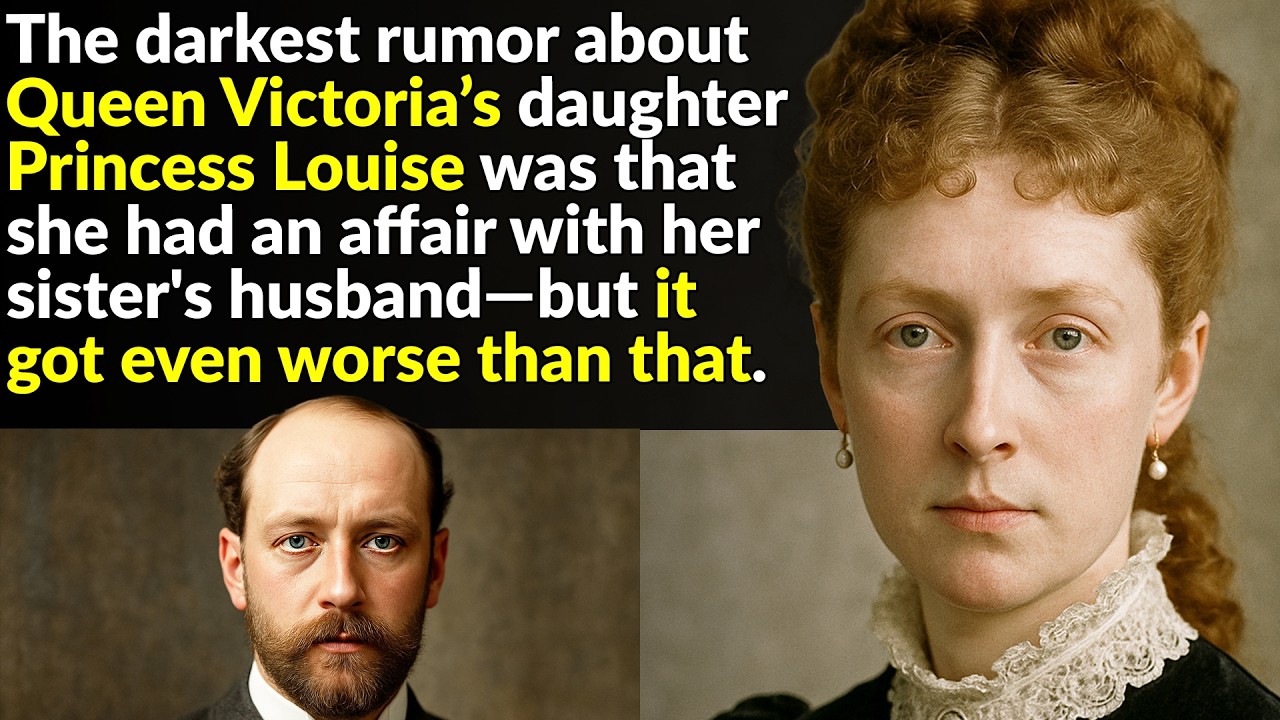
Princess Louise, Queen Victoria’s sixth child, was labeled the royal family’s rebel from the moment she was born on March 18, 1848—a year defined by revolutionary upheaval across Europe. The darkest rumor swirling around her claimed she had an affair with her own sister’s husband, but the scandals attached to her name went far beyond that single accusation. Louise’s birth was itself considered unconventional. After five painful labors, Queen Victoria defied her advisers and used chloroform for pain relief, a controversial treatment at the time.
The Queen later described the experience in glowing terms, saying it made labor “delightful. ”
From childhood, Louise proved difficult to control. Her constant questioning earned her the family nickname “Little Miss Y,” and she refused to accept the strict Victorian rule that children should be seen and not heard. She was reportedly her father Prince Albert’s favorite child, and his death in 1861 hit her hard.
Her mother, consumed by grief, was not available to comfort her, leaving Louise withdrawn and despondent. The relationship between mother and daughter only deteriorated as Louise grew older. Queen Victoria reportedly called her daughter “indiscreet” and an “imprudent child” who seemed to enjoy arguing. The Queen cancelled Louise’s coming-out ball, believing the family was still in mourning.
Louise’s response was to storm around the palace in fury. In 1863, Louise broke convention by becoming the first British princess to enroll at a public institution, the National Art Training School. She pursued sculpture, a field dominated by men and considered highly inappropriate for a woman, let alone a royal. She also took on a role as her mother’s personal secretary, a position she found tedious until rumors began to circulate about her alleged involvement with her younger brother’s tutor, the Reverend Robinson Duckworth.
The Reverend was 14 years her senior, and Queen Victoria dismissed him from the palace once she caught wind of the situation. Rumors of other relationships followed. Sources claimed Louise carried on affairs with one of the Queen’s later secretaries and with the architect Edwin Lutyens. According to one biographer, Louise also had a relationship with another of her brother’s tutors, a man named Walter Sterling.
That rumored connection gave rise to one of the most persistent mysteries of her life. In the 1860s, Louise adopted a young boy named Henry Loch. Throughout his life, Henry claimed he was not simply an adoptee, but the illegitimate son of Louise and Walter Sterling. The truth has never been established.
The royal family reportedly blocked two attempts to conduct DNA testing on his remains. At 23, Louise made a historic choice. She refused to marry any European prince and instead set her sights on John Campbell, a nobleman but not a royal. The match caused a family dispute, but Queen Victoria ultimately stood by her daughter.
In 1871, they married, marking the first time in centuries that a British princess had wed a non-royal. The crowds were so large that the authorities installed Britain’s first chain-link barriers to protect the couple. Louise designed her own lace wedding veil for the ceremony. The marriage was not a fairy tale.
The couple spent long periods apart, and a widely circulated rumor claimed Campbell was gay. Louise reportedly tried to keep her husband from going out at night by sealing the windows to their apartment. Despite the difficulties, they remained married for life, and their bond reportedly strengthened in their later years together. When Campbell was appointed Governor General of Canada in 1878, the couple moved to Ottawa.
Canadians were initially wary of the royal presence, but Louise won many over by hosting parties where people of different classes mingled freely, a break from strict tradition. She became the first British royal to visit British Columbia and helped promote the founding of the National Gallery of Canada and the Royal Canadian Academy of Arts. The province of Alberta and Lake Louise were named in her honor. Her time in Canada was not without hardship.
In 1880, she was seriously injured in a sleigh accident when the carriage overturned and dragged her through the snow for 400 meters. She suffered a concussion and her earlobe was torn in two. The accident marked the beginning of a long period of fragile health. During the Northwest Rebellion, she created a medical fund and hired a doctor to treat wounded men on both sides of the conflict, regardless of their race or background.
While in Canada, she was also rumored to have had an affair with an Indigenous man who was modeling for her art, which caused considerable gossip. Louise publicly supported the suffragist movement, directly contradicting her mother’s well-known opposition to it. She also befriended Elizabeth Garrett, the first British woman to publicly practice medicine, and would visit factories unannounced to check on the treatment of female workers. She also helped widows pay for their husbands’ burials.
The most damaging rumor attached to Louise involved her sister Princess Beatrice’s husband, Prince Henry of Battenberg. Louise did not hide her close friendship with Henry, and because of that openness, gossip spread that they were lovers. When Henry died in 1896, Louise reportedly described him as “almost the greatest friend I had,” adding that she missed him more than she could say. The feud between the sisters reportedly escalated after Henry’s death.
According to Louise, Beatrice struck back by spreading a rumor that Louise was romantically involved with Queen Victoria’s private secretary, Arthur Bigge. Louise responded by claiming Beatrice had invented the story out of jealousy and went further, saying she and Henry had been much closer than Henry and Beatrice had been. Louise also suffered deep personal losses. While in Canada, she learned that her favorite sister, Princess Alice, and two of Alice’s daughters had died of diphtheria.
Alice died on the anniversary of their father’s death, making December 14 a permanently painful date for Louise. In 1914, after her husband’s death, Louise suffered a profound breakdown. She wrote to a friend that her loneliness without the Duke was “quite terrible,” wondering what he was doing now. Late in life, Louise and Beatrice repaired their relationship.
The Queen had left them neighboring houses when she died, and when both sisters’ health declined, they chose to live in neighboring rooms at Kensington Palace. Louise maintained habits that would have shocked her strict mother. She was a lifelong smoker and hid the habit from Queen Victoria even as an adult. At the time of her death, she still owed a shopkeeper 15 shillings for cigarettes, roughly equivalent to $300 today.
She also remained devoted to exercise and health food, once declaring she would outlive everyone who mocked her fitness regime. She nearly did, dying at age 91 on December 3, 1939. By that time, the rebel princess had become known as the hermit of Kensington Palace, a reputation cemented when the future Queen Elizabeth II gave her the nickname “Auntie Palace. ”
Her artistic legacy remains visible.
She sculpted one of Montreal’s most famous statues, a work depicting her mother, Queen Victoria, which stands in front of McGill University. Much of her life, however, remains deliberately obscured. Over the years, the royal family has reportedly sealed, locked away, or destroyed many of Louise’s papers and files, and has refused requests from biographers to research her life.
The full truth of her alleged affairs, her adopted son’s claims, and her complicated family relationships may never be known.