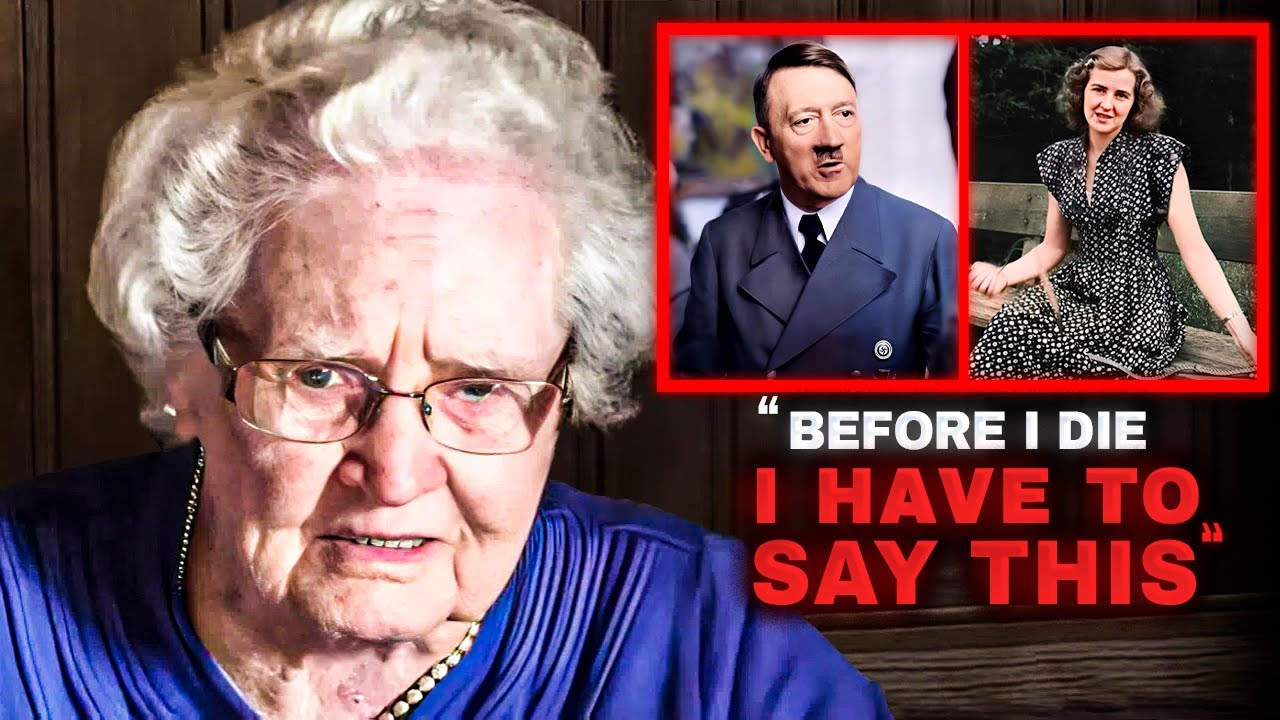
The trembling, ancient voice of Elizabeth Kalhammer, a woman who spent her youth sweeping the floors of Adolf Hitler’s Alpine fortress while the world burned, has finally pierced the silence of nearly eight decades, forcing a global reckoning with the terrifying banality of evil that lurked behind the Führer’s closed doors.
The 96-year-old Austrian, who died in 2023, left behind a testament recorded in her final years, a confession extracted from the shadows of her own memory. Hired in 1943 as a naive 22-year-old office assistant from Salzburg, Kalhammer answered an innocuous job advertisement, completely unaware that she was walking into the heart of the Nazi regime.
 Her destination was the Berghof, Hitler’s private residence perched in the Bavarian Alps, a scenic mountain retreat that served as the operational nerve center for global conquest. She was not told the true nature of the posting until after her mother signed the consent form, and by then it was too late to turn back without drawing suspicion.
Immediately upon arrival, the young Austrian was subjected to an intense indoctrination, warned in stark terms that her survival depended on absolute silence regarding the fortress’s internal affairs. The chilling directive, “Don’t speak about what you see or you will disappear like so many others,” set the tone for her year of service, a period marked by constant dread.
Kalhammer’s account, delivered with the measured calm of a woman confronting her past, paints a portrait of a bizarre domestic universe operating within the war machine. She described a Hitler who was surprisingly courteous to his staff, a man who never shouted in the halls but whose presence was so oppressive it could be felt through the walls, a phantom-like aura of power that paralyzed her.
She witnessed the meticulous routines of the dictator, his vegetarian meals, his sober clothing, and his long, hushed evening conversations with the inner circle that included Martin Bormann and Eva Braun. Yet, she insists, behind the mundane facade of tea-making and sweeping, a thick atmosphere of fear and tension permeated every corridor.
The hidden world she reveals is one of secret midnight meetings and the silent, unexplained disappearances of staff members who may have crossed invisible lines. Kalhammer was instructed to look away, to ask no questions, and never to initiate conversation with Hitler, living on the edge of a historical vortex where decisions about invasions and exterminations were made just feet away.
The women of the Berghof, she recalled, were isolated from the horrors of the front, shielded by the sheer altitude and the strict seal of confidentiality that governed their daily existence. They existed in a bubble of forced normalcy, polishing silver and typing letters while the Wehrmacht fought to the death on distant battlefields and the Holocaust raged in the shadows.
Kalhammer’s testimony provides a rare glimpse into the psychology of Hitler’s staff, individuals who were neither hardened ideologues nor direct perpetrators, but willing cogs in a monstrous machinery. Her recollection of Eva Braun is particularly revealing, describing her not as a dominating force but as a “figurehead,” a woman obsessed with her appearance who possessed no real authority.
Despite the close quarters, Kalhammer was kept at a strict distance, but she experienced fleeting, terrifying moments of contact. She recounts one occasion when Hitler entered her office and personally thanked her for her work, a moment of cloying praise that left her feeling “completely paralyzed,” fully aware of the immense weight of the man standing before her.
The atmosphere at the Berghof shifted dramatically as the war turned against Germany. In 1944, the initial calm gave way to a grim, oppressive silence. The visits from high-ranking military officials increased, the tension became palpable, and the staff could feel the crumbling of the Reich through the frantic, desperate energy radiating from Hitler’s inner sanctum.
She recalled attending film screenings in Hitler’s private cinema, but the atmosphere was not festive. It was, in her words, “like attending a ritual,” a solemn performance where everyone watched the screen in rigid, terrified silence, desperate to please the volatile Führer. There was no joy, only a communal holding of breath.
As the Allied bombing intensified, the Berghof transformed from a peaceful refuge into a fortress under siege. In the spring of 1945, with the Reich collapsing, the residence was evacuated. Kalhammer was sent back to Salzburg just before British air raids partially destroyed the compound, and American forces later demolished it to prevent it from becoming a pilgrimage site.
For decades, Kalhammer remained silent, not out of fear but out of a belief that her role was historically insignificant. The stigma of serving in Hitler’s home was a heavy burden in post-war Austria, forcing her to bury her memories along with her identity as a witness to history.
It was only in her retirement that she broke her silence, participating in interviews for German and Austrian television between 2005 and 2018. Her decision to speak was driven by a fear of misinformation, a conviction that “if people like me don’t tell what it was really like, others will make up stories.”
Her testimony stands out for its lack of sensationalism. She does not seek to justify the regime or condemn herself; she simply recounts the daily mechanics of living within a criminal state. “I didn’t see crimes.
 I didn’t see violence,” she stated, “But I did see how a regime could wrap everything in an aura of order, cleanliness, and efficiency. And behind that facade, the horror of the outside world was hidden.”
Her story adds a vital piece to the historical puzzle, challenging the perception of Hitler solely as a raving madman. Her account aligns with others from his secretarial pool, such as Traudl Junge, who described a “kind boss” and a “father figure,” a duality that allowed those around him to compartmentalize the evil they served.
Traudl Junge, who was Hitler’s personal secretary from 1942 until his death, provided one of the most exhaustive accounts of life in the inner circle. Hired at 22, she too was initially enchanted by Hitler’s charm. She recalled his disgust at her single status, prompting him to introduce her to an officer, whom she married and who later died in combat.
Junge’s memoirs, published in 2002, reveal a Hitler who shifted his personality depending on his audience. With his female secretaries, he was a gentleman discussing films and gossip; with his generals, he was a dictator. She admitted to being fascinated by him, ignoring the “warning signs” within herself, a confession of complicity that haunted her.
She was present in the Führerbunker during the final, desperate days, witnessing the surreal wedding of Hitler and Eva Braun and the subsequent dictation of his political testament. She described the scene as undignified, listening to the fading dictator appointing a new government while the world he created crumbled, and she heard him utter his final, hateful words about the Jews.
Junge spoke openly about her profound guilt, particularly after discovering the plaque for Sophie Scholl, a German resistance fighter who was the same age and executed the same year Junge began working for Hitler. “At that moment, I felt that being young was no excuse,” she confessed, a statement that resonates powerfully in the context of Kalhammer’s testimony.
Rochus Misch, Hitler’s bodyguard and telephone operator, offered a starkly different perspective. He remained in the bunker until the end, not as an ideologue but as a “cog” in the machine, claiming he knew nothing of politics and was simply following orders. His testimony provided crucial details about the mechanics of the last days.
Misch corroborated the suicide of Hitler and Braun, describing the moment he saw the bodies and the subsequent cremation in the Chancellery garden. He also horrifically recalled the premeditated murder of Joseph Goebbels’ six children by their parents, describing how everyone in the bunker knew what was going to happen but did nothing to stop it.
Heinz Linge, Hitler’s valet, provided even more intimate details. He was the man who helped dress Hitler for his wedding and who later received the order to secure gasoline for two cremations. Linge’s testimony confirms the calculated nature of the suicide, detailing how Hitler shot himself while Braun took cyanide.
Otto Günsche, Hitler’s personal adjutant, was the officer responsible for carrying out the final order: the burning of the bodies. He stated he did this prevent the Soviets from displaying them like Mussolini, an act of grotesque loyalty that sealed the visual end of the Third Reich for the outside world.
The testimonies of these individuals, compiled in recent years, present a disturbing psychological profile of the people who surrounded Hitler. They were not monsters in a traditional sense, but rather bureaucrats, chauffeurs, secretaries, and valets who enabled a regime by focusing on their immediate duties and willfully ignoring the larger picture.
Johanna Wolf, Hitler’s chief secretary, lived in the Chancellery and the Berghof for over 16 years. In her post-war interrogations, she insisted they “lived in a bubble,” asking no questions, simply writing what was dictated. Her loyalty was absolute, and she remained devoted to the man she called “the boss” until her death in 1985.
Eric Kempka, Hitler’s chauffeur, provided the Allies with key intelligence regarding the death and cremation. He was the one who procured the 200 liters of gasoline and who threw the match that ignited the bodies of his boss of over a decade, an act he later described with a chilling sense of abstract emptiness.
 Hans Baur, Hitler’s personal pilot, offered a privileged view of the dictator’s mindset. He attempted to convince Hitler to escape Berlin in a Fieseler Storch aircraft on the final day, but Hitler refused, stating the “fate of the Reich is sealed here.” Baur remained loyal until the end, expressing no remorse for his service.
Gerta Christian, another secretary, returned to the bunker in 1945 out of a sense of personal loyalty, not ideology. She witnessed the wedding and the writing of the testament, and her statements to historians highlight a woman grappling with the shame of not having asked more questions while serving a man she continued to obey.
The cumulative weight of these testimonies, now widely analyzed by historians, suggests that the secrecy of the Berghof was not absolute. Yet, the women and men who served there cultivated a deliberate ignorance, a survival mechanism that allowed them to function in the presence of absolute evil without succumbing to madness or resistance.
Elizabeth Kalhammer’s story is not just a historical footnote; it is a stark warning about the dangers of political disengagement. She was a young woman from a modest family, raised under a regime that normalized hatred, hired for her typing skills, and placed in a position where she saw the Emperor without his clothes.
The “shock” of her revelation is not that she uncovered a hidden conspiracy, but that she confirmed the chilling ordinary-ness of it all. Hitler drank tea, watched films, and complimented his staff on their efficiency. The bureaucratic machine of genocide was run by men who had dinner with their families and by women who swept the floors near stolen art.
Her decision to speak, made in the twilight of her life, transforms her from a passive observer into an active participant in historical memory. She forces the world to confront the uncomfortable truth that the infrastructure of atrocity is often maintained by thousands of small, obedient acts performed by unremarkable people.
“Before I die, I must speak,” she said. Her voice, now silent in death, echoes louder than ever, providing a crucial counter-narrative to those who would sanitize history or claim ignorance of the immense crimes committed in the mid-20th century. She serves as a testament to the weight of memory.
The global reaction to her testimony has been one of intense introspection. Historians are re-evaluating the social dynamics of the Berghof, while psychologists study the mechanisms of cognitive dissonance that allowed staff to witness the man responsible for the Holocaust and still see a polite employer.
The story is particularly resonant in a modern context, where the rise of strongman politics and the erosion of democratic norms raise questions about the complicity of ordinary citizens. Kalhammer’s simple choice to not ask questions, to do her job, and to remain silent for 70 years is a profound lesson on the societal cost of apathy.
As the last direct witnesses to the Third Reich pass away, their testimonies become the primary historical record. Elizabeth Kalhammer’s account joins those of Junge, Misch, and others, painting a unified portrait of a regime built on a foundation of cultivated blindness and state-sanctioned fear.
The final irony of her life is that she, a maid who served tea in the Alps, has become a more potent symbol of the dangers of complicity than many of the generals who commanded armies. Her story transcends simple biography; it is a moral fable for the ages.
Her description of the “aura of order, cleanliness, and efficiency” hiding the horror outside is perhaps the most damning indictment of the Nazi system. It reveals that the machinery of death was not a chaotic orgy of violence, but a highly organized, bureaucratically sound project that required the active (or passive) support of an entire nation.
The “shock” of her confession lies in its lack of 𝒹𝓇𝒶𝓂𝒶. There are no secret chambers or whispered conspiracies; there is only the monotonous routine of a household run by a genocidal maniac. This banality, as theorized by Hannah Arendt, is what makes her story so deeply disturbing and eternally relevant.
 As the world listens to her voice for the first time, it is forced to ask a difficult question: what would we have done if we were in her shoes? Her answer, that she simply obeyed and remained silent to survive, is a terrifying reminder of the fragility of human morality when placed under the pressure of authoritarian rule.
Kalhammer lived to 96, passing away in 2023, but her revelation has ignited a new wave of scholarship and public debate. The interviews she gave shortly before her death are now considered essential viewing for anyone seeking to understand the social fabric of the Third Reich.
Experts argue that her testimony fills a critical gap in the historical record, providing a bottom-up perspective that is often missing from the top-down accounts of military strategy and political machinations. Her life story is a testament to the power of survivor testimony.
The public has reacted with a mix of horror and fascination. The idea that a woman could work closely with Hitler and claim to have seen nothing of his crimes is both unbelievable and, upon reflection, entirely plausible given the regime’s capacity for compartmentalization and terror.
Her revelations serve as a stark reminder that the past is never truly dead. The questions she raises about individual responsibility, collective guilt, and the seductive allure of complicity remain agonizingly relevant in today’s volatile political climate.
Elizabeth Kalhammer did not seek fame or absolution; she sought truth. She understood that the silence of witnesses allows history to be rewritten by those with malicious intent. Her voice, however faint, is a bulwark against that historical amnesia.
The world owes her a debt of gratitude for her courage. While she will never be a heroic figure, she has performed a great service by showing us the face of the enemy, and that enemy resides not only in the hearts of tyrants but also in the silent compliance of their servants.
Her final interviews, recorded with a clear mind and a heavy heart, stand as her legacy. They are a warning from a 96-year-old woman who saw the abyss and stepped back, urging us to look before we fall.
In the coming years, historians will continue to analyze every word of her testimony, cross-referencing it with other documents from the era. Her account of the Berghof, with its emphasis on the “closed universe” and the strict rules of confidentiality, will become a canonical text for students of the period.
The story of the “maid who saw everything and said nothing” is a parable for our times. It reminds us of the profound moral responsibility we each hold to speak out against injustice, regardless of the personal cost, a lesson that Elizabeth Kalhammer learned too late in life to change her own history.
The grief in her voice when she spoke of being “paralyzed” in Hitler’s presence is palpable. It is the paralysis of an entire generation that failed to act, a generation that allowed a political movement to destroy their nation and millions of lives for the sake of stability and order.
As the final survivors of the Nazi era die out, the mantle of memory falls to us. Kalhammer’s confession is a part of that inheritance, a heavy burden of truth that we must carry forward. We must listen to her story, not with morbid curiosity, but with a determination to prevent history from repeating its most tragic mistakes.
The world remains in shock, not because the facts are new, but because the voice speaking them is so human. Elizabeth Kalhammer was not a monster; she was a woman who made ordinary choices in extraordinary times, and her story will challenge our conscience for generations to come.


