The United States government once owned Mar-a-Lago, the sprawling Palm Beach estate now synonymous with presidential luxury, and chose to give it back rather than bear the cost of keeping it. The decision came less than a decade after the property was gifted to the nation by one of America’s wealthiest women. Marjorie Merriweather Post inherited the Postum Cereal fortune after her father’s death in 1914, receiving roughly $20 million at age 27. Under her leadership, the company grew into General Foods, absorbing brands like Jell-O, Maxwell House, and Sanka.
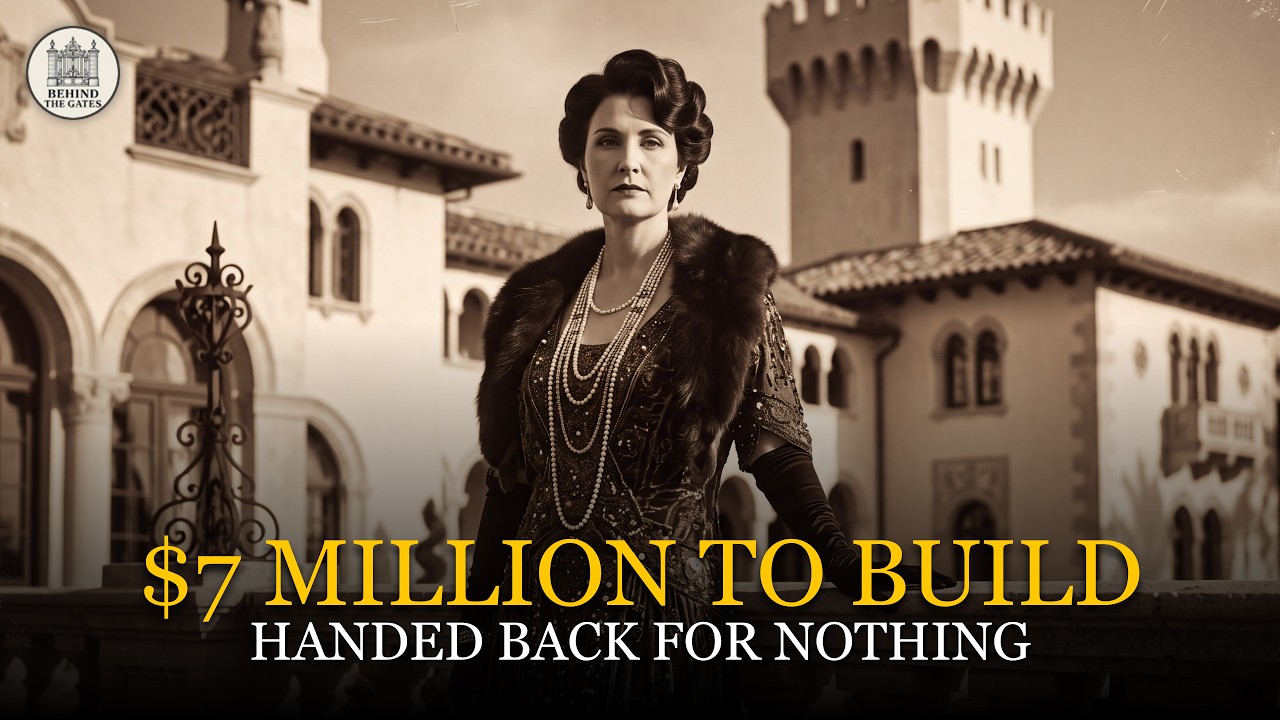
By mid-century, she was widely described as the wealthiest woman in the United States, a label that was close to plain description. In the mid-1920s, Post set out to build a winter residence that would outlast her fortune. She chose a narrow strip of land on Palm Beach’s barrier island, so thin that the house could touch the Atlantic Ocean on one side and the Lake Worth waterway on the other. She named it Mar-a-Lago, Spanish for “sea to lake.
”
The house was assembled rather than simply built. The exterior stone came from Genoa, Italy, shipped across the Atlantic in roughly three boatloads. The roof was laid with about 20,000 antique terracotta tiles taken from Cuban and Spanish buildings, including tiles reportedly linked to a villa connected to Emperor Charles V. The dining room floor used about 2,200 square feet of black and white marble said to have been removed from a castle in Cuba.
The finished estate held roughly 126 rooms, including 58 bedrooms and 33 bathrooms, across about 17 acres. Construction ran through the 1920s, and the house officially opened in January 1927. The building cost approximately $7 million, a sum worth well over $100 million in modern terms and a figure that would become central to the estate’s later troubles. Post did not intend the property to remain with her heirs.
She wanted Mar-a-Lago to become a winter White House, where presidents could retreat during cold months and where the country could host foreign dignitaries. To ensure the plan, Congress created a framework in 1972 designating the estate a national historic site with an advisory commission. That December, Post signed a deed conveying the estate to the United States, with the transfer to take full effect upon her death. She also left a maintenance fund intended to help the government run the property.
One account placed the fund’s yearly yield at roughly $259,000. It would prove to be a small fraction of what the estate demanded. Post died in September 1973 at age 86. The gift took effect as designed, and the Department of the Interior and National Park Service took over administration of the property.
But the plan quickly ran into a problem no law could solve: no president wanted to use it. Richard Nixon, then in office, already had a Florida retreat at Key Biscayne. He toured the shuttered estate with a friend in July 1974, but nothing came of the visit. Jimmy Carter had no appetite for a gilded palace by the sea.
The winter White House sat empty year after year, and the costs did not pause for the lack of occupants. Keeping the estate alive required a large full-time workforce. Post maintained a staff of roughly 60 people, about 30 for the household and 30 for the grounds. The staff were essential, not decorative.
The salt air corroded the imported stone, the humidity swelled the wood, and the grounds on the barrier island fought back against every attempt to tame them. Even empty, the house demanded constant attention. The government soon learned that owning the palace was not an asset but a yearly bill. By most accounts, maintenance ran around $1 million annually, while Congress was willing to appropriate only about $100,000 per year starting around 1980.
Combined with Post’s fund, the available money covered roughly a third of the stated cost. The estate was draining public funds for a house no president used. There was also a security problem. The house sat on an exposed strip of island, bordered by a public ocean beach on one side and a busy waterway on the other, making it difficult to seal and guard.
It also sat near the approach path of Palm Beach International Airport, with aircraft passing overhead. That flight path is often cited as part of the reason the house could not work as a presidential retreat, but it was not among the government’s documented reasons. The stated grounds for rejection were the maintenance cost and the general difficulty of providing security. In late December 1980, Congress enacted a law directing the Secretary of the Interior to convey Mar-a-Lago back to the Marjorie Merriweather Post Foundation within 120 days.
The same law repealed the earlier framework that had designated the estate a national historic site. The structure Post had built to hold the house forever was dismantled in the same stroke that sent it back. The transfer completed across 1980 and 1981, roughly seven years after the gift had taken effect. The foundation had no use for the palace either and put it up for sale.
The buyer, in 1985, was Donald Trump. The exact price is disputed across sources: some accounts cite about $5 million for the house plus roughly $3 million for the furnishings, others state about $8 million for the estate and contents together, and still others place the total near $10 million including an adjacent strip of beachfront. By any count, the estate changed hands for between roughly $8 million and $10 million in 1985. Holding that price against the $7 million build cost of the 1920s makes the decline stark.
A great painting bought in that era would have multiplied in value. Land would have grown. Mar-a-Lago, by contrast, sold in real terms for a fraction of what it cost to build. The low price was not the market undervaluing a treasure; it was the market pricing the enormous future cost of keeping the house alive.
Trump did not keep the estate as a private residence alone. In 1995, he opened it as the Mar-a-Lago Club, a private membership venue whose fees helped support the property’s upkeep. Then, in a turn no one in 1972 could have foreseen, Trump became president. During his term, Mar-a-Lago functioned in practice as exactly the winter White House Post had imagined, with a sitting president staying, working, and receiving visitors there in the cold months.
The obstacles the government had cited in 1980 had not disappeared. The salt still ate the stone, the airport was still overhead, and the beach and waterway still made the grounds hard to secure. What had changed was the will. A private owner wanted the house badly enough to absorb the costs and solve the problems the government had judged insurmountable.
The rejection of Mar-a-Lago was not an isolated decision. It belonged to a larger pattern as the age of the American private palace came to an end. Built for an era of cheap servants and lightly taxed fortunes, the great houses of the Gilded Age and the 1920s became unsustainable as wages rose and taxes reshaped the ground beneath them. Newport’s grand cottages were emptied and turned to museums.
Fifth Avenue’s mansions were pulled down for apartment towers. The great houses were not destroyed by fire or war; they were undone by the slow, quiet math of upkeep. Mar-a-Lago stood apart only in the strangeness of its gift and rejection. The government’s decision proved that extravagance and value are not the same thing.
The features that made the house priceless to look at made it, on a budget, a burden no one could defend. The house still stands between the ocean and the lake, still catching the light off both, exactly as Post designed it. The salt still works at the stone, and the bill still arrives every year. What has changed across the decades was never the house itself.
It has only ever been the answer to the question every owner has faced: whether the cost of keeping the dream alive is worth paying.


