In April 1915, with Germany in the second year of World War I, a princess was born into the House of Hohenzollern who would quietly defy the brutal conventions of her era. Princess Alexandrine Irene of Prussia arrived on April 7, 1915, at the Crown Prince’s Palace in Berlin. She was the long-awaited first daughter of Crown Prince Wilhelm and Crown Princess Cecilie, who already had four growing sons. Her name carried deep family meaning.
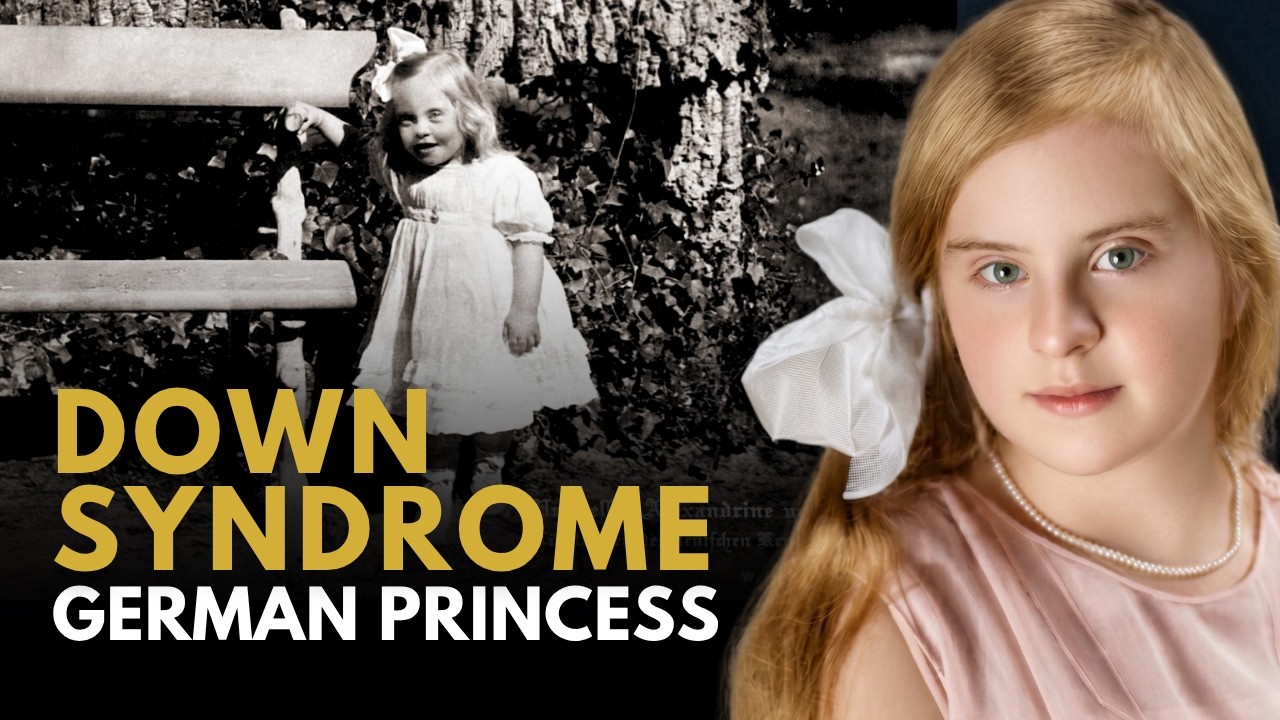
Alexandrine honored historic ties with the Russian imperial house, while Irene, chosen by her mother, came from the Greek word for “peace” — a silent maternal prayer for an end to Europe’s bloodshed. Within the close family circle, the newborn was lovingly called “Adini. ”
But the joy of the birth soon gave way to shock. Court physicians diagnosed the infant with a genetic condition, now known as Down syndrome, though it lacked a modern name in early 20th-century medical terminology.
For European ruling dynasties of that time, such a diagnosis was considered a devastating blow to family prestige. An unwritten tradition stretching back centuries dictated that such children be hidden away — sent to remote estates, isolated convents, or private clinics under false names, erased from official records and genealogies as though they had never existed. Adini’s fate took a different path. Crown Princess Cecilie, displaying rare spiritual courage for her time, flatly refused to surrender her daughter to closed institutions or conceal her from public view.
Supported by her husband, Crown Prince Wilhelm, the couple made a decisive choice: Alexandrine would remain at home and be raised within the family, on equal footing with her brothers. This decision drew sharp opposition from conservative circles at the Prussian court. Yet Adini was not hidden in the palace’s back rooms during official visits. Photographs of her childhood were published openly, and her name appeared regularly in court newspapers and social records alongside those of her siblings.
Her four older brothers grew up as natural protectors of their cherished sister, never embarrassed by her developmental differences. In November 1918, the Hohenzollerns’ familiar world collapsed. Following the November Revolution, the German Empire disintegrated, and Kaiser Wilhelm II abdicated and fled to the Netherlands. Crown Prince Wilhelm, as direct heir to the abolished throne, was also forced to leave Germany temporarily.
Crown Princess Cecilie was left alone with five minor children in Potsdam, amid revolutionary chaos and political instability. Alexandrine had just turned three. After the revolutionary turmoil subsided, negotiations between the new Weimar Republic and the Hohenzollern family allowed them to retain part of their private property. The family officially remained in Germany, keeping the grand Cecilienhof Palace in Potsdam, completed only a year before the revolution.
Life at Cecilienhof unfolded in relative seclusion, surrounded by the tranquil New Garden along the shores of the Holy Lake. This landscape became Alexandrine’s primary world. Her governess and teacher, Selma Biese, became her pillar of support, developing a uniquely personalized developmental program based on the latest German pedagogical and therapeutic psychology. Biese’s approach focused not on strict training but on gently engaging the child’s natural inclinations through daily activities.
Through Biese’s patience and her mother’s sensitivity, Alexandrine grew into a gentle, affectionate, smiling, and exceptionally emotionally responsive child. Her greatest passion was music, and she loved classical pieces and children’s songs. She could observe nature for hours, knew every corner of the Cecilienhof gardens, adored birds and pets, and tended flowers in their beds. Her older brothers — Wilhelm, Louis Ferdinand, Hubertus, and Friedrich — remained devoted protectors as they aged.
They regularly took Adini on walks through Potsdam’s shaded streets, and local residents warmly welcomed the former royal family’s frequent appearances. Townspeople often recalled how the special princess, walking alongside one of her brothers, would wave kindly at everyone, drawing smiles. Even after losing their official political status, the Hohenzollerns maintained traditional court etiquette and royal rituals within the family. In this strict system of rules, Alexandrine was never marginalized.
At all formal family luncheons, dinners, and celebrations, she always held a place of honor at her mother’s right hand, and her participation in all religious and family ceremonies was mandatory. By the early 1930s, as Alexandrine approached adulthood, her mother and Selma Biese recognized that home education alone was no longer sufficient. In 1932, at age seventeen, the family sent her to the renowned Trüper Special School in Thuringia, on the scenic Sophienhöhe near Jena. Founded by Johannes Trüper, a pioneering German educator in therapeutic pedagogy, the institution had an excellent reputation across Europe.
At the boarding school, Alexandrine was deprived of her accustomed servants and luxury, which benefited her greatly. Under experienced guidance, she mastered practical crafts: applied arts, hand weaving, sewing, and basic gardening. Physical outdoor work strengthened her health, and living among peers developed important self-care and independence skills. Teachers noted her diligence, peaceful nature, and remarkable kindness toward others.
One of the most significant moments in Alexandrine’s life came in autumn 1934. Her younger sister, Princess Cecilie, born in 1917, had reached the same age, and the family decided the two sisters would receive their confirmation together. On October 21, 1934, the formal ceremony for both princesses took place in Potsdam. For the deeply Protestant Hohenzollern family, this event transcended ordinary religious ritual.
Alexandrine’s public confirmation, after successfully passing preliminary spiritual examinations with the local pastor, served as the family’s formal declaration to society: “Adini” was a full member of the church, spiritually and morally competent, and a complete representative of her dynasty. All close relatives attended the celebration, marking a genuine triumph for her mother’s love and proof that her special daughter could walk this path equally with everyone. In 1933, Germany’s political landscape shifted radically when the National Socialists, led by Adolf Hitler, came to power. This began the darkest, most dangerous period of Alexandrine’s and her family’s lives.
The Nazi regime elevated the principle of so-called “racial purity” to state law, with propaganda openly promoting ideas of purging the German nation of “genetic burden” and “life unworthy of life. ”
The Hohenzollerns clearly understood the danger threatening Adini. Although her status as granddaughter of the former Kaiser and daughter of the Crown Prince provided substantial protection — Hitler was still trying to court monarchist circles in those years — keeping an adult princess with clearly visible signs of Down syndrome in Potsdam or Berlin under the watchful eyes of Nazi racial offices was increasingly risky. The situation reached a critical point in 1936 with the death of Selma Biese, Alexandrine’s devoted governess, teacher, and protector.
Losing her primary mentor, and aware of growing totalitarian pressures in the capital, the family made a strategic decision to act proactively. In 1936, years before the Nazis officially launched their “T4” program of physically exterminating disabled people in autumn 1939, the Hohenzollerns relocated Alexandrine to the far south of Germany, specifically to Bavaria. She settled in the quiet town of Bocking and its district of Niederbocking, on the shores of Lake Starnberg. This region was traditionally conservative, and its distance from Berlin kept her away from party officials’ scrutiny.
In Bavaria, the princess lived in a secluded villa under an inconspicuous abbreviated name, following the lifestyle of any ordinary person. Local Bavarian authorities, the district Nazi party leadership, and the regional Gestapo branch were certainly aware of the Bocking residents’ identity. However, Crown Prince Wilhelm’s strict and clear order, backed by the Hohenzollerns’ enormous financial resources and international standing, prevented Nazi officials from taking any effective measures or attempting to apply racial purity laws to Adini. In her Bavarian refuge, cared for by Erika Strecker and visited rarely but warmly by relatives, Princess Alexandrine survived the terrible years of World War II unscathed.
The long-awaited end of the war in May 1945 liberated Germany from Nazism, but for the Hohenzollern family it brought new hardships and genuine financial ruin. Potsdam and the historic family home Cecilienhof fell within the Soviet occupation zone. All family properties, lands, palaces, and valuables in the east were completely and permanently confiscated by the new authorities. The famous Potsdam Conference of victorious Allied leaders even convened in Cecilienhof’s halls in summer 1945.
Crown Prince Wilhelm and Crown Princess Cecilie lost everything overnight, becoming elderly refugees. They were forced to seek shelter in the western occupation zones, stripped of their former grandeur and accustomed lifestyle. Amid this chaos, Alexandrine remained in Bavaria. Return to the east was impossible and highly dangerous.
Unlike her displaced parents, she never moved after the war, staying in the same peaceful, safe Bavarian town of Bocking, which had become her true home over the years. Despite the family’s sharply declining financial circumstances, the loyal Erika Strecker never abandoned her charge. She remained by Alexandrine’s side around the clock, maintaining a warm home environment, preserving her daily routine, and shielding her from postwar devastation and everyday hardships. In 1951, Alexandrine’s father, Crown Prince Wilhelm, died.
Three years later, in 1954, her devoted mother, Crown Princess Cecilie, passed away, having prayed for her dear daughter until her final breath. After their parents’ deaths, her eldest brother, Prince Louis Ferdinand of Prussia, assumed full legal, financial, and moral responsibility for Adini’s welfare, becoming the official head of the imperial House of Hohenzollern in exile. Louis Ferdinand handled this duty with deep respect and noble chivalry. Despite being heavily occupied with dynasty affairs, frequent travels, and managing the family’s remaining properties, he personally visited Adini in Bocking several times each year.
He covered all her living expenses, medical care, and Erika Strecker’s needs, ensuring his beloved sister lacked nothing. Despite aging and her developmental characteristics, Alexandrine retained an astonishing purity of childhood feeling into her final years. She remained exceptionally gentle, completely peaceful, friendly, and deeply religious. Her life in Bocking was filled with simple, sincere joys: garden walks, listening to her favorite music records, quiet prayers, and loyal Erika’s companionship.
Princess Alexandrine of Prussia passed away peacefully on October 2, 1980, in Bocking, Bavaria, at sixty-five years of age. For someone born with Down syndrome in the early 20th century, when medicine and educational rehabilitation were extremely limited, reaching that age was a remarkable achievement and a long life. This longevity stood as definitive proof of the ideal conditions of love, psychological peace, and high-quality care she received throughout her life. Her death marked a symbolic end to a long and complex historical era.
The Hohenzollern family decided Adini should return home. Her remains were carefully transported from Bavaria to Baden-Württemberg, the historic land of her ancestors. Alexandrine of Prussia was buried in the small family cemetery in the courtyard of the majestic Hohenzollern Castle near Hechingen, beside the graves of her parents and her devoted elder brother Louis Ferdinand. Alexandrine Irene Princess of Prussia was an “invisible” princess whose life defied all the cruel laws of her era.
She left no political legacy, but something far greater — an example of a family that chose human love over political status. Laid to rest beneath the vaults of Hohenzollern Castle, she remains forever the “bright child” whose story shows that even in times dominated by madness and the pursuit of perfection, quiet kindness can be the strongest act of resistance. A dynasty’s greatness, her life suggests, is measured not by the gleam of crowns but by how carefully it protects its most vulnerable members.