On July 12, 1943, German forces surrounded the Polish village of Michniów and carried out a massacre that would become one of the most brutal examples of rural pacification during the Second World War. Over two days, the occupiers murdered 204 civilians, including 102 men, 54 women, and 48 children, before burning nearly every building to the ground. Michniów, located in south-central Poland between Sucha Ręczna and Bodzentyn, had a long tradition of patriotic resistance. By 1943, it had become a vital base for the Polish underground, sheltering couriers, repairing weapons, and hosting elite Polish agents known as the Cichociemni, or “the silent unseen,” who were parachuted in from Great Britain.
When Lieutenant Jan Piwnik, an agent known by the alias Ponury, arrived in the region in June 1943, he found a community already deeply committed to the resistance. His patrols stayed in the village, and locals provided food and shelter. That support marked Michniów as a target in the eyes of the Germans. German terror in the surrounding countryside had been escalating for months.
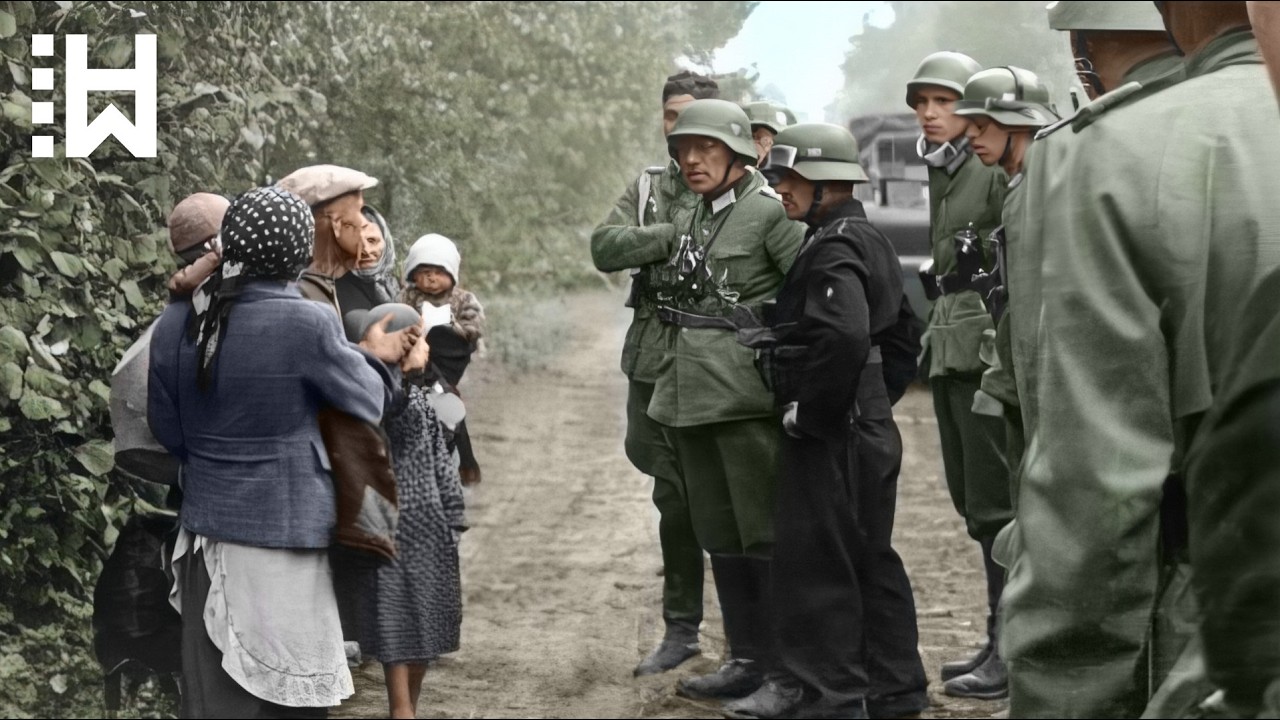
The 62nd Motorized Gendarmerie Platoon under SS-Obersturmführer Albert Schuster was among the most brutal units operating in the area. Lists of suspected underground supporters circulated among Gestapo offices, and names from Michniów began appearing on them. By early July, the decision to destroy the village had already been made. On the night of July 11, 1943, German units moved in from several directions, forming two rings around the settlement.
One pressed against the village itself, while the other blocked all forest paths. At dawn, soldiers entered Michniów, stopped and searched those leaving for work, and forced them to lie face down at the forest edge. Inside the village, soldiers burst into homes, dragging men outside with blows and shouts. The Germans read names from a prepared list.
Those called were driven into barns on the southern edge of the village with rifle butts. When the doors were shut, the Germans threw grenades inside, fired machine guns into the buildings, and set them on fire. The barns burned quickly, collapsing with the weight of the roof beams. Elsewhere, the Germans shot men in the back of the head after confirming their names.
Families believed to cooperate with the underground were murdered with special cruelty. At the Wikło farm, the father was shot first, then his five children aged 16, 14, 11, 8, and 5, and finally their mother. Their house was set on fire, and bodies of other victims were thrown into the flames. By midday, 95 men, two women, and five children were dead.
News of the massacre reached Piwnik’s resistance unit in the hills near the village. Shock and grief spread among his soldiers, many of whom came from Michniów or knew its people. Piwnik rushed his men toward the village, but the German column had left moments earlier. That same evening, the partisans staged their revenge.
They halted a fast train on the Warsaw-Kraków line and stormed the wagons reserved for Germans. A fierce firefight followed, and at least a dozen Germans were killed or wounded. On the wooden walls of the carriages, the partisans carved two words: “Za Michniów,” meaning “For Michniów. ”
But the revenge brought a new danger to the survivors.
The next morning, on July 13, 1943, German police and gendarmerie returned in strength. Before entering the village, they took positions on the hill west of the settlement, cut off every forest path, and opened fire on houses and barns. Some villagers had fled during the night, but many had remained, believing the worst had passed. Women, children, the elderly, and those who thought the Germans would kill only suspected underground fighters stayed.
That belief proved fatal. The Germans entered Michniów again and began killing systematically. Women were driven from homes and shot near wells, barns, and fields. Children clutching their mothers were thrown into burning buildings or executed at close range.
One of the most horrific deaths was that of a nine-day-old baby who had just been baptized that morning in a nearby village. The infant, along with his grandmother and godmother, was herded into a barn and burned alive. His mother, still weak after childbirth, was murdered in her home. By the end of the day, another 102 victims lay dead: seven men, 52 women, and 43 children.
The Germans then burned almost every remaining building. Only a stone barn and the forester’s lodge survived. When they marched away, they took dozens of animals and forced several villagers to drive the herds to the forest, where the livestock was loaded onto trucks. Sixteen of those villagers were lined up for execution but were unexpectedly released.
The Germans forbade rebuilding the village and treated survivors as outlaws. Mayors of surrounding villages were forbidden to help them, and the area was intensively patrolled. Anyone found near the ruins risked being shot. In the weeks that followed, fugitives attempting to recover crops or belongings were murdered.
Some of the wounded or captured villagers were deported to Auschwitz, and only three of them survived the war. On July 15, 1943, residents of neighboring villages buried the bodies in a common grave near the school. The Germans allowed the burial but ordered that the grave remain without a cross or any marker. After the Germans left, members of the Polish underground placed signs near the railway tracks describing the massacre.
The name Michniów became a symbol of the fate that befell hundreds of Polish villages. At least 299 villages were destroyed by the Germans in rural pacification actions, with nearly 20,000 civilians murdered. Justice eventually caught up with some of the perpetrators. Jerzy Wojnowski, an informer known by the alias Motor, was uncovered less than six months after the pacification and executed by the resistance on January 28, 1944.
Leo Metz, commandant of the gendarmerie post in Skarżysko-Kamienna, was killed by Polish partisans in late 1944. SS officers Adolf Feucht and Otto Göring were both killed in 1945 before the end of the war. Other perpetrators faced post-war trials. In 1949, SS Brigadeführer Herbert Böttcher, the SS and police commander of the Radom district, was tried.
The destruction of Michniów was discussed during his trial. He was convicted and executed in June 1950. Otto Böhmisch, recognized by survivors as one of the policemen who took part in the killings, was sentenced to death and executed in May 1950. Julius Hein, another participant, was also sentenced to death and executed.
In 1969, gendarmerie captain Gerulf Mayer was tried in Graz, Austria. Though Michniów itself was not included in the indictment, he was convicted for other mass crimes in the region and sentenced to ten years of imprisonment. In East Germany, Albert Schuster, whose motorized gendarmerie platoon had terrorized the Polish countryside, was arrested after Polish investigators provided information. In 1973, he was convicted of war crimes and crimes against humanity and executed by shooting in Leipzig prison.
Today, the mausoleum in Michniów stands where the barns once burned and where families waited for the last blows. The name of the village, destroyed but not forgotten, remains one of the starkest reminders of the brutality of the German occupation against Polish citizens during the Second World War.