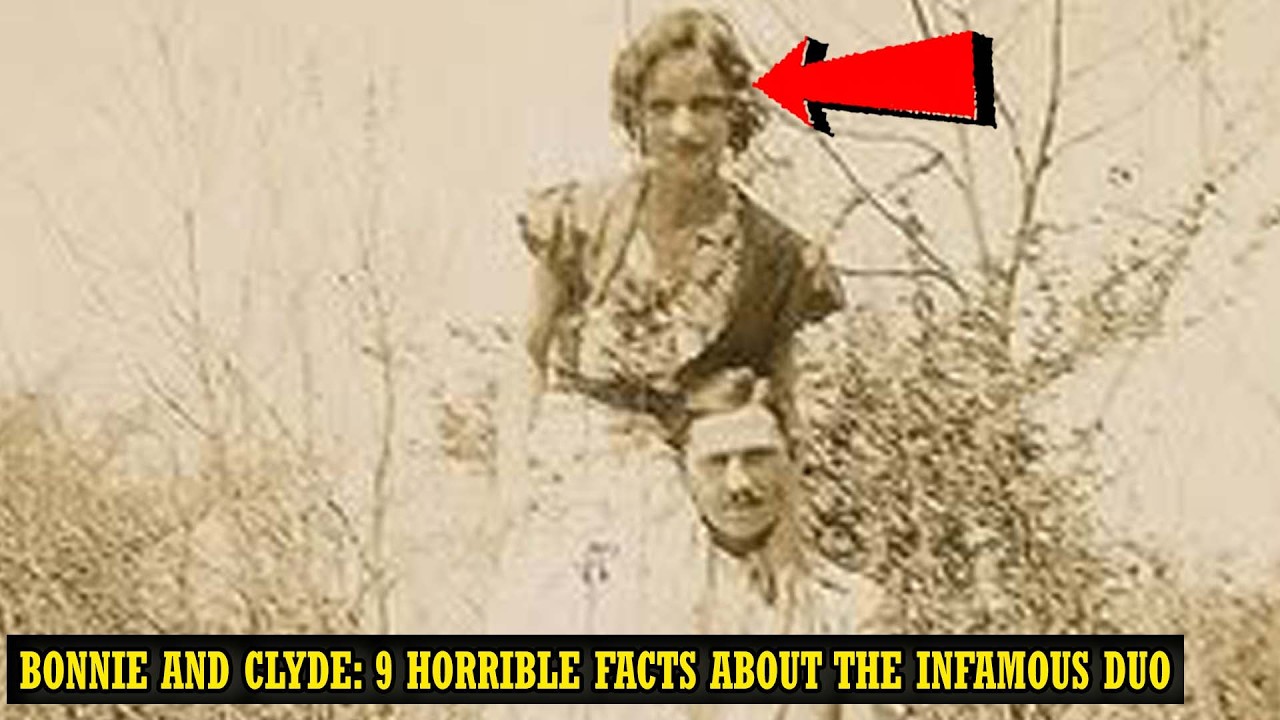
Bonnie Parker and Clyde Barrow are remembered as glamorous, rebellious lovers who defied authority during the Great Depression, but the historical record paints a far less polished picture of their lives than the Hollywood myth suggests. The reality of their existence was marked by instability, frequent mistakes, physical hardship, and constant pressure to stay ahead of capture. The Barrow Gang often operated with poor planning and limited resources, and their experiences were characterized by failed efforts rather than a smooth string of successes. Their transformation into cultural icons accelerated after photographs of the pair posing with firearms were discovered and circulated.
Media coverage amplified selective details, and the dramatic nature of their deaths only strengthened the legend that followed. Clyde Barrow was born into the household of a struggling Texas farmer and showed an early passion for music. He sang and played guitar as a boy, later teaching himself the saxophone. For a time, it appeared music might shape his future.
That path shifted as he grew older. Influenced by his brother Buck and an unsavory family acquaintance, Clyde turned toward unlawful activities, including car theft. Economic hardship and limited opportunity pulled him further from the musical life he once imagined. Bonnie Parker shared a similar love for performance.
She enjoyed the stage as a child, taking part in school programs and talent shows, and she dreamed of a future in film. She often told friends that one day her name would be widely known. Fame did come, but not in the form either anticipated. Instead of appearing on stage or screen, their images were circulated through newsreels, newspapers, and sensational crime magazines.
The attention made anonymity nearly impossible. Neither fully abandoned their original dreams. Bonnie’s movie magazines were often found among personal items left behind in abandoned vehicles. Clyde kept his guitar until it had to be left behind during a narrow escape and later asked his mother to inquire about getting it back, but the request was denied.
Historical accounts note that among the personal belongings recovered after their final encounter was his saxophone, a reminder that beneath the legend were two young people whose early aspirations pointed toward a very different life. Despite popular films depicting Bonnie and Clyde as relentless bank robbers, historical records show that the Barrow Gang carried out fewer than 15 bank robberies over roughly four years, and several involved returning to the same locations. The rewards were typically modest, sometimes less than $100. Bank robberies were most often carried out by Clyde himself, sometimes with his associate Raymond Hamilton.
Bonnie’s involvement was inconsistent. She sometimes served as a driver, but on many occasions she remained behind at a hideout while others carried out the robbery. When operating independently, Bonnie and Clyde generally avoided banks altogether. They more frequently targeted small grocery stores and gas stations, which offered quicker exits and fewer obstacles.
The trade-off was that the money taken was usually minimal, forcing them to rob more often simply to cover basic expenses. Bonnie Parker was married at the age of 16 to Roy Thornton, an attractive classmate she knew in Dallas. Her father had passed away, her mother worked long hours in a factory, and marriage offered the promise of stability. The relationship quickly deteriorated.
Bonnie later reflected that Thornton was unreliable and unfaithful, rarely present and emotionally distant when he returned home. The marriage was effectively over when Thornton was sentenced to five years in prison for robbery. Thornton remained incarcerated when news reached him that Bonnie had died alongside Clyde Barrow. Notably, Bonnie was still wearing her wedding ring at the time of her death.
Formal divorce proceedings were never completed. One of the most widely circulated images of Bonnie Parker shows her posing with a pistol and a cigar in her mouth, but this image was part of a playful series of staged photographs created for the couple’s own amusement. The photographs were discovered later on undeveloped film left behind at a hideout in Missouri. Bonnie was not known to regularly smoke cigars.
Like Clyde, she appears to have preferred cigarettes, with Camel cigarettes often mentioned in contemporary accounts. The enduring image was more a product of visual storytelling than everyday reality. Eyewitness recollections indicate that Bonnie did enjoy drinking whiskey, and several people later recalled seeing her intoxicated. Clyde, by contrast, tended to avoid alcohol, believing it was important to remain clear-headed.
Clyde Barrow was sentenced in 1930 to 14 years at Eastham Prison Farm, known for its punishing labor system and severe conditions. He served only about 17 months, largely due to persistent appeals by his mother. Historical evidence indicates that Clyde endured extreme deprivation and mistreatment during his incarceration. At one point, desperate to escape the most grueling labor assignments, he made a drastic decision that resulted in the loss of two toes on his left foot, permanently affecting his balance and leaving him with a noticeable limp.
By the summer of 1933, Clyde was still driving without shoes when a serious accident occurred that permanently affected Bonnie Parker. He failed to notice a road detour at a construction site and sent the car into a dry riverbed. The damaged battery released acid that severely injured Bonnie’s right leg. Because the pair could not safely seek professional medical care, the injury never healed properly.
Contemporary witnesses later recalled that during the final year of her life, Bonnie often struggled to walk and relied on Clyde to help her move. Over the course of their time together, 14 law officers lost their lives in incidents connected to the gang, a fact that weighed heavily on public opinion. However, Clyde sometimes sought alternatives to direct confrontation, briefly detaining individuals, including law officers, to allow the group to escape. These people were released unharmed, and in more than one instance, Clyde reportedly gave them money to help them return home.
Public sympathy shifted dramatically after events on Easter Sunday in 1934 near Grapevine, Texas. Bonnie, Clyde, and Henry Methvin were resting in their car when they were approached by two motorcycle officers. The situation escalated rapidly, and both officers were fatally wounded. Patrolman Edward Bryan Wheeler and Holloway Daniel Murphy, a young officer on his first day of duty, lost their lives.
Murphy was engaged to be married, and his fiancée later attended his funeral wearing her wedding dress, a detail widely reported in the press. From that point forward, popular sentiment hardened, and many Americans demanded that their flight from justice be brought to an end by whatever means necessary. Bonnie and Clyde came to an abrupt end along a rural road in Louisiana. They stopped after believing they were helping with what appeared to be a disabled truck connected to Henry Methvin’s family.
Unbeknownst to them, the situation had been staged. Once Clyde brought the car to a halt, officers hidden nearby immediately acted. Leading the operation was Frank Hamer, a veteran Texas Ranger who had tracked the pair for months. Official records listed 17 entry wounds on Clyde and 26 on Bonnie, with later accounts suggesting the true numbers may have been higher.
The responsibility for preparing the bodies fell to undertaker C. B. Bailey, who remarked on the extraordinary difficulty of his task. Assisting him was Dillard Darby, a man whose path had crossed with Bonnie and Clyde under very different circumstances just a year earlier.
Darby had been detained by the Barrow Gang after they took his car, an encounter that ended without lasting harm. During that earlier meeting, Bonnie reportedly found it darkly amusing that Darby was an undertaker and jokingly suggested he might one day care for them professionally. Bonnie Parker showed a clear creative streak as a student, inventing songs and short stories, with poetry becoming one of her favorite forms of expression. During a brief period of incarceration in April 1932, she composed 10 poems she later grouped under the title “Poetry from Life’s Other Side.
”
One of her final poems, “The End of the Line,” was written shortly before her death and stands out for its striking realism. Rather than denial or bravado, the poem conveys acceptance and a somber sense of inevitability. Although Bonnie wrote of being laid to rest beside Clyde, the two were ultimately buried in separate locations. Bonnie’s gravestone bears a gentle, sentimental epitaph about bringing brightness into the world.
Clyde’s marker carries a short and direct inscription: “Gone but not forgotten. ”
Both Bonnie and Clyde came from close-knit families who remained loyal to them. They returned repeatedly to the West Dallas area where most of their family members lived, sometimes several times within a single month. Clyde developed a cautious method of communication, driving past his parents’ home at speed and tossing a bottle containing a handwritten note from the car.
His parents would follow the directions inside to a safe meeting place outside the city. When Bonnie and Clyde had money, they shared it with their families. During leaner periods, relatives provided clean clothing, meals, and small amounts of cash. Clyde was reportedly attempting to purchase land in Louisiana for his parents at the time of his death.
Several members of the Barrow family eventually served short jail sentences for helping their well-known relatives. The strong family ties that sustained Bonnie and Clyde also contributed to their downfall. A similar sense of family loyalty appeared in Henry Methvin, a member of the Barrow Gang. Bonnie and Clyde went out of their way to ensure Henry could visit his own family regularly, not realizing that Henry and his father were quietly negotiating with law enforcement.
In exchange for leniency, Henry’s father provided information about Bonnie and Clyde’s movements. It was during a trip intended to reconnect with Henry at his father’s home that authorities intercepted Bonnie and Clyde, bringing their time on the run to an end. When the legend is stripped away, the story of Bonnie Parker and Clyde Barrow looks far less glamorous than pop culture suggests.
Their lives were not defined by romance or rebellion, but by constant pressure, physical hardship, fractured dreams, and consequences that followed every decision they made.