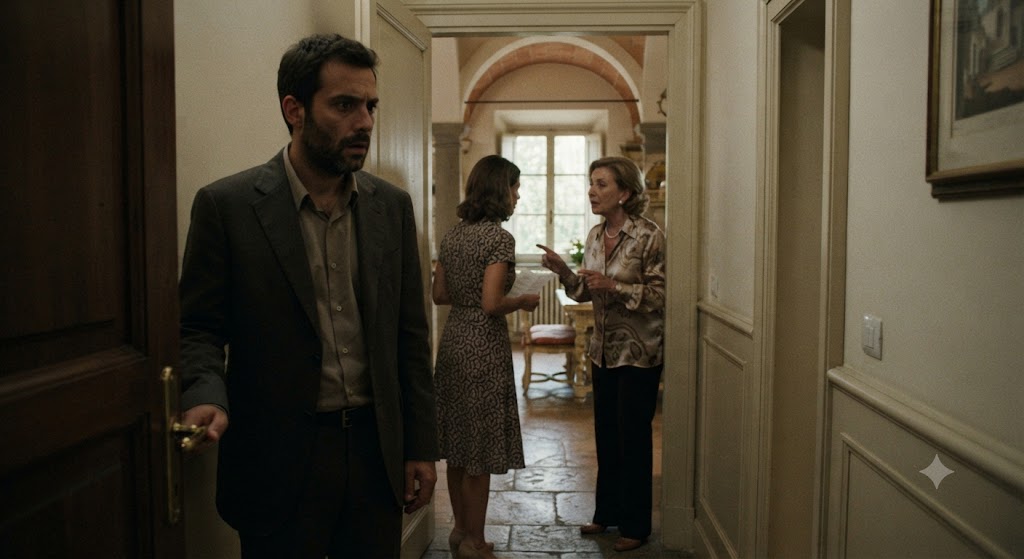
Patty was showing her mother around the house as if it were already hers. She opened every door, every closet, pointing out which room would be hers, which would be for the children. I stood in the doorway of the kitchen, still dressed in my robe, and watched her. My son Robert stood next to me, silent.
I know it’s a bit small, Mom, but the back room has so much potential. Patty said. We can knock down that wall, make it one big living area. Linda nodded, already planning out loud.
I felt my hands tighten around the cup of tea I was holding. That morning, just two hours earlier, I had found the name of a nursing home on Patty’s nightstand. I had heard them talking the night before, when they thought I was asleep. I’m telling you, Robert, she’s not capable of living alone anymore.
Patty had said. She’s a danger to herself and to the kids. We have to put her in a care facility. Robert had tried to protest weakly, but she shut him down fast.
Do you want to be the one responsible when she burns the house down? I heard every word. I lay there, frozen, with tears running down my face, and I thought: this is how they thank me for everything. I gave Robert everything.
When his father died, I was left with a child and a mountain of debt. I worked double shifts, I skipped meals, I wore the same coat for six winters just so he could have new shoes. When he said he wanted to buy a house with Patty, I took out every last dollar I had saved over twenty years. Twelve hundred dollars.
I gave it to him without a single condition, because that’s what a mother does. And now they were going to take my little house, my only possession, and put me away like a piece of furniture they no longer needed. That morning, Linda said: You know, Martha, with everything that’s happening, maybe it’s better if they only come on weekends. I looked at her, confused.
What do you mean? I asked. Patty quickly jumped in. It’s just that the kids need their space, and so do you.
All this noise and running around must tire you out. She smiled sweetly, but I saw the real meaning behind her words. She was preparing the ground. She was making me believe that I was a burden, so that when the papers came, I would sign them without objecting.
And the papers did come. Later that morning, Patty presented them to me with a bright smile. Mom, we need you to sign this. It’s just an update of your documents, the new legislation requires it.
If you don’t sign before we leave, you could lose your benefits. I took the papers from her hands and began to read. I felt my heart drop. Property transfer.
Power of attorney. Rights over my home transferred to Robert and Patty. All in flawless legal language, perfectly designed to leave me with absolutely nothing. Robert, I said, my voice trembling.
What is this? What do you mean, Mom? Patty replied instead. It’s just standard paperwork.
Robert looked at the floor and said nothing. That silence told me everything. He knew. He was part of this.
Patty had seen me cry my whole life, because I cry easily and she knew it. But this time, I didn’t cry. I felt something different, something cold and hard forming inside me. When my husband died and I was left with a baby and no money, I cried for weeks.
When Robert was sick and I feared losing him, I cried until I couldn’t see. But now? No. Now I felt a strange calm, a clarity I hadn’t experienced in decades.
Patty tried to push the pen toward me. Here, just sign at the bottom. Do you want me to show you where? she asked, already taking my hand.
I pulled my hand back slowly. I think it would be better to have a lawyer look at these first, I said. Patty’s face changed for a fraction of a second. A flash of something dark, immediately replaced by a sweet smile.
Mom, that’s just a waste of money and time. It’s just formalities. Tomorrow they close for the weekend and we fly back to New York. If you don’t sign now, you’ll lose everything.
She said the word “everything” with a particular emphasis, and I knew exactly what she meant. I won’t sign now, I said, more firmly. I want my old friend Thomas, who’s a lawyer, to take a look. Robert finally raised his eyes.
Mom, don’t you trust us? he asked. His voice was strange, almost accusing. I looked at my son, the baby I had rocked in my arms at night, and I realized I was seeing him clearly for the first time in years.
I don’t know what I trust anymore, I replied. But I won’t sign anything until I understand it. Patty forced a laugh. Of course, Mom, take your time.
We can have Thomas look at them. We have no problem with that. Then she went to put the papers away. But in that moment, I knew we had an open war between us.
That afternoon, while Linda and Patty went to the mall, I called Thomas. When I told him what they wanted me to sign, he was silent for a long time. Martha, that document is a full transfer of property. Notarized authorization for them to sell your house.
If you signed that, you would be left on the street with nothing, and they could even block your pension. Thomas quickly made a few calls. Then he asked to meet me in person. As I was hanging up, Robert walked into the kitchen.
He looked tired, uneasy. Mom, can I talk to you for a minute? I nodded. He sat down at the table, ran his fingers through his hair, and said: Patty thinks you’re not well, that you need constant care.
And maybe she’s right. I’ve been thinking about it too, and a nice place where they take care of you, where you don’t have to worry about anything, might be better for you. I looked at him without changing my expression. And what would happen to my house?
I asked. He shrugged. We could sell it. The money would help cover the care costs.
There it was, the truth spelled out clearly. My son was selling me out to pay his own way, because the business he had claimed to have was bankrupt under mountains of debt. I pretended to consider it. Of course, sweetheart, I said.
If you think it’s the best for me. But let Thomas look at the documents first, and then we can decide together. Robert smiled, relieved, thinking he had won. He had no idea that while he was smiling, I was searching the house for every single piece of paper, every document, every bank statement I had ever hidden.
For years, my habit of keeping copies of everything had been called paranoia by my late husband. He would roll his eyes and say, Martha, why do you keep all this stuff? But that old paranoia, every receipt, every contract, every bill carefully filed in my closet, now became my most valuable weapon. A few days later, Patty tried to take me to a doctor.
A “geriatric evaluation,” she said, her voice full of fake warmth. I need you to see a doctor before you can sign the documents, she insisted. It’s for the insurance. But something told me this doctor wasn’t going to check my blood pressure.
This doctor was going to judge my mental capacity, to declare me unfit, so that the signatures could be forged in my name. I smiled. Of course, honey, we can do that. But I promised Robert I would come with him to the bank first, remember?
The mortgage is in my name and they need my signature to move it. I had invented this appointment on the spot, but it sounded plausible, and Patty hesitated. Then I remember you telling me the bank on Fifth Street. I’ll pick you up at ten.
She said. Perfect, I replied. Of course, at ten o’clock the next morning, Patty showed up early with that smile she wore when she thought she was controlling the situation. We went to the bank, but instead of signing a mortgage transfer, I asked to speak with the manager and had him give me an official statement of my account and a copy of the original title deed to my house, which had been lodged in the bank’s safe deposit box for over twenty years.
Patty waited outside, impatiently tapping her foot. But she couldn’t hear anything from behind the reinforced glass. That night, alone in my room, I looked at the documents Thomas had prepared and the bank statements I had gathered. I felt a strange hatred I had never known before, but also immense sadness.
I thought of the day I carried Robert in my arms, in this very house, when he was sick and I was poor and alone. I had sacrificed everything, absolutely everything, for this child. And now he was selling my life for a fraction of what I had given him. Two days before they were to leave, Patty pulled out a new set of documents, even more aggressive.
She didn’t waste time with introductions. Mom, these are urgent. If you don’t sign these today, we lose the chance to restructure the mortgage and the entire house could be repossessed by the bank. She pushed the paper under my nose, her voice sharp, rushed.
She had stopped pretending to be gentle. Now she was openly hostile. I took the papers and slowly put on my reading glasses. Slowly, I read every line.
And then I spotted it. One single detail. The so-called mortgage, the debt she claimed you had to pay today, was actually a business loan in Robert’s name, with Robert’s signature, and it had a different date, years old. This debt had existed before they even set foot in this house.
I read. I read again. And then I looked up at Patty, who was already smiling, expecting my signature. But instead of signing, I took a pen, held it over the paper, and said: You know, Patty, in all these years I’ve never once lied to you.
I gave you everything you asked for, without complaint. I watched, silent, when you changed the way my son spoke to me, when you decided that I was an inconvenience, when you mocked me in front of your friends. She rolled her eyes, ready to mock me again. But I continued.
But I never, ever gave you permission to make a fool of me in my own house. And these papers, Patty, these papers are a lie. I know it. You know it.
And the lawyer knows it. Her face went pale. What did you just say? I repeated calmly.
This loan is from years ago, in Robert’s name. It has nothing to do with me or this house. And then, I tore the papers in half, right before her eyes, and let the pieces fall onto the table. She jumped up as if she had been stung.
You have no right! she screamed. That’s my house! It will be my house!
I leaned in, and in a low voice, I told her: No, Patty. You will never see this house. Ever. Robert arrived shortly after, furious.
What did you do to Patty? He said, his face red. I didn’t do anything to her, I said. I just told her the truth.
It seems she’s a little upset. Robert looked at the papers torn on the table and paled. Mom, why did you do that? Why don’t you just trust us?
I looked at him, my son, and in that moment I felt a strange shift. Robert, you trusted her, and in doing so, you forgot who raised you, who gave you your life. From that day on, everything changed. Patty stopped pretending.
She began to openly talk about “the necessity of housing her mother” right in front of me, as if I were invisible. She and Linda went through my closets every day, deciding what to keep and what to throw away. They had already ordered new furniture for the rooms I lived in. And me?
I patiently watched, patiently smiled, and waited. Because I had a plan, and it was beautiful. Before they had arrived, I had secretly hired Thomas, my old lawyer friend. He had prepared a full notarial act, a document that transferred the ownership of the house to a trust set up in my name.
That meant that even if I died tomorrow, neither Robert nor Patty would ever put a finger on it. I had also filed an official complaint about the attempt to forge my signature and fraudulent manipulation. And I had done something else, something that Patty would never see coming. On the day I told my son I wanted him to be the one to inherit, I had gleefully recorded that conversation, where he was telling me what a great idea it would be for me to go into a nursing home so he could sell the house.
Hidden in my old kitchen radio. No one ever suspected. That Saturday, the day before their flight back to New York, I had all the pieces ready. The children were at a neighbor’s beach party.
Robert was outside, washing his truck. Patty was in the bedroom, packing. And I stood at the kitchen window, looking at her, thinking about the day she walked into this house for the first time, a young girl with a sweet smile, who hugged me as if I were her second mother. She had no idea I would ever see the version of her that existed behind closed doors.
But out of the blue, life gave me this lesson: people who mask evil with sweetness reveal themselves at the moment when they think they have nothing to hide. Patty came into the kitchen, looking at her phone. She thought I couldn’t hear what she was saying. She said: Yes, Mom, it’s done.
She signed to leave the house. Next week we can start the paperwork for the sale. I felt a shock, I hadn’t signed anything, but there she was, talking to her mother as if the house were already sold. I said: No, I haven’t signed anything yet, dear.
She froze. Quickly, she hung up and turned to me. What do you mean you haven’t signed? I need you to sign that.
I said calmly: I will never sign that, Patty. You can forget about this house. It’s my retirement plan, and you were never part of it. Patty stood there, frozen.
Her eyes could have lit up a room with anger. Then, in a split second, her expression softened and changed. She burst into tears, the perfect actress. She sobbed, saying: You always hated me, from the first day you saw me, you never accepted that Robert was happy with me.
She was playing the victim, as she did every time. But this time, I didn’t fall for it. I knew the truth. Patty, I loved you like a daughter from the first day, I said softly, even though I knew she wouldn’t believe it.
But you made me your enemy, and today you will see what an enemy looks like, a quiet one. I picked up the phone and called Robert, asking him to come inside right away. He came in, looking irritated, his hands still wet from the hose. Patty was fake crying and playing the devastated woman, and looked at me as if I were the monster.
I said to him: I need you to listen carefully, Robert. And I took out a folder and placed it on the table. Open it. He opened it, his hands shaking, and began to read.
I saw his face turn pale as he read the bank statements: the two-hundred-thousand-dollar business loan, the failed businesses, and the trust that prevented him from touching my house. Finally, he looked at me, with an expression I hadn’t seen in years, one of total confusion, mixed with fear. Mom, what is all this? he asked, his voice weak.
I told him: This is the truth, my son. The truth about your marriage, about your debt, about the way you traded your mother for a woman who would have sold your own soul for a hundred thousand dollars. Patty shouted: That’s a lie, the house is mine, Robert always said we would get it! But Robert didn’t answer.
He just stared at the papers, his face a mask of shock and shame. Then I pulled out the final document, and I placed it on the table in front of them. A notarized request to the bank to revoke Robert’s access to the family accounts, to transfer any property and remaining assets into my name, and a civil complaint against Patricia for attempted fraud and falsification of documents. Robert was silent.
Patty began to scream, but even she understood that the battle was lost. I looked at my son, my only child, and realized that I didn’t feel anger anymore. Robert, I said softly, I am your mother. I gave you everything.
But you gave her permission to take away my home and my dignity. From now on, you will start from zero, with your own hands. And maybe then, you will understand what I went through for you. I didn’t wait for an answer.
I grabbed my coat and walked out the door. The next day, I was meeting Thomas with the keys to the house. I walked away down the street, without looking back. I didn’t know if Robert would ever forgive me, or if he would ever understand what his mother had gone through to open his eyes.
But deep down, I knew I had made the right choice. Sometimes, being a mother means loving unconditionally. But it also means knowing when to walk away, even from the child you carried in your arms, and letting him learn to swim on his own, even if it means letting him swallow a little salt water. I looked up at the sky, felt a weight lift from me that had been pressing down on my chest for years.
I was no longer the submissive widow everyone thought they could step on. I was Martha, the woman who had finally said enough. And that, that was a victory more valuable than all the money in the world.