WASHINGTON — President Richard Nixon ordered the most concentrated application of American strategic air power since World War II, unleashing more than 120 B-52 Stratofortresses against the heart of North Vietnam in a desperate bid to force Hanoi back to the negotiating table and break a deadlock that had stalled the Paris peace talks for two months.
The order, issued December 14, 1972, set in motion Operation Linebacker II, an 11-day campaign that would become known around the world as the Christmas bombings — a name that would define both its timing and its enduring political controversy.
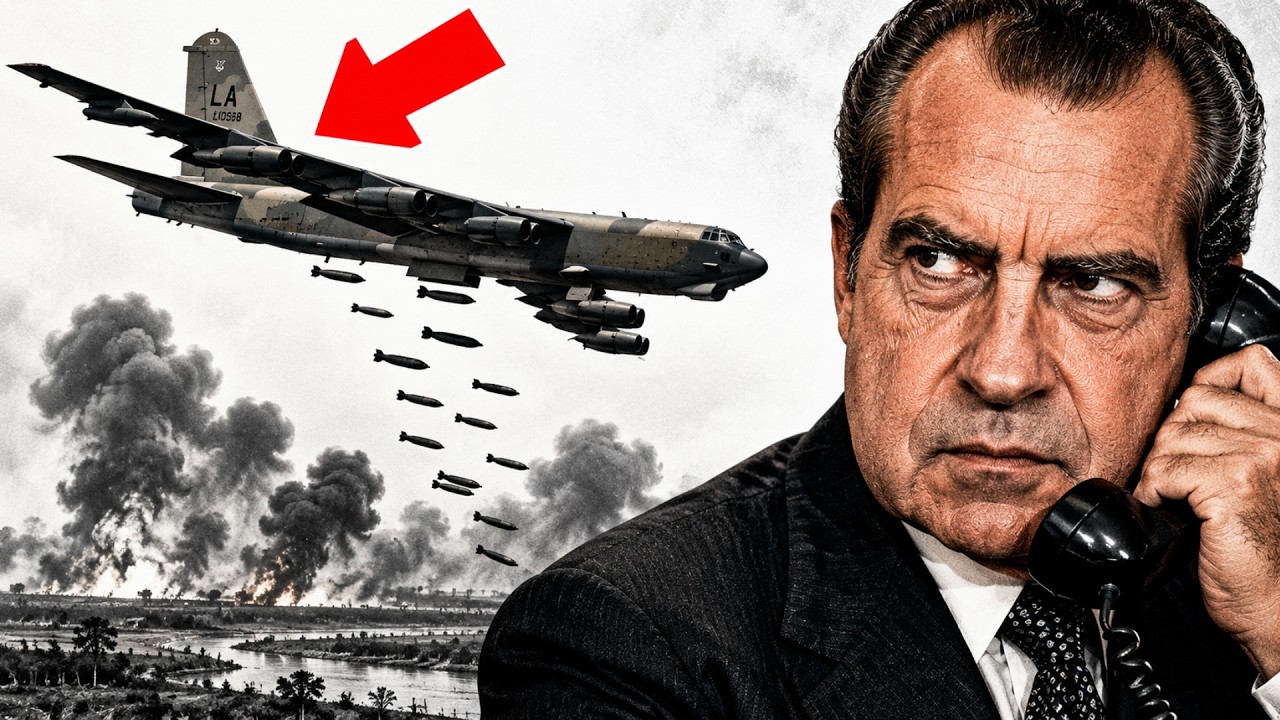 The first waves of bombers lifted off from Andersen Air Force Base on Guam and from bases in Thailand on the night of December 18, their bomb bays loaded with approximately 30 tons of conventional ordnance per aircraft. The target set was unlike anything the war had seen: rail yards, storage facilities, military installations, power generation plants and the transportation infrastructure that sustained North Vietnam’s war effort.
Gone were the restrictions that had defined earlier campaigns. The dikes, civilian residential areas and diplomatic quarters that graduated escalation doctrine had carefully excluded were no longer shielded by the same operational constraints. This was unrestricted bombing of the Hanoi and Haiphong areas, and the Nixon administration intended it to be felt.
At its peak, the operation involved approximately 129 B-52s in a single night’s operation — a formation whose combined destructive output represented the most concentrated bombing of the entire Vietnam War. The eight-hour round trip from Guam to Hanoi and back required precise coordination of departure times, flight paths and aerial refueling that planners had developed since the negotiations collapsed.
The decision to bomb emerged from a diplomatic crisis that had been building since October. On October 26, just two weeks before the presidential election, National Security Adviser Henry Kissinger announced to the press that “peace is at hand,” following months of secret negotiations with North Vietnamese representative Le Duc Tho in the private residences of Paris suburbs.
The October draft agreement was real, and the progress was genuine. But the announcement proved premature. South Vietnamese President Nguyen Van Thieu rejected the accord, objecting specifically to its “in-place ceasefire” provision that would allow North Vietnamese forces to remain in South Vietnam after signing.
For Thieu, accepting that provision meant accepting the continued presence of enemy forces as a military fact — an acknowledged threat to his government’s survival. He communicated his rejection with a directness that reflected his understanding that the American election’s conclusion had reduced, not increased, his leverage.
Nixon won reelection on November 7 by the largest electoral college margin in American history, carrying 49 states. The mandate included public acceptance of the “peace is at hand” narrative, but the negotiations that resumed in Paris in November failed to produce an agreement.
The Nixon administration assessed the North Vietnamese positions in November and December as deliberate stalling — a negotiating partner that had concluded American domestic political pressure would eventually force concessions, allowing Hanoi to improve upon the terms it had accepted in October simply by waiting.
Whether that assessment was accurate remains contested. Historical analysis of North Vietnamese negotiating records, made available through opened Vietnamese archives in subsequent decades, has produced evidence consistent with both the stalling interpretation and a genuine reassessment interpretation, without definitively confirming either.
What is documented is the administration’s assessment and the decision it produced. On December 14, Nixon ordered Linebacker II.
The North Vietnamese air defense system that awaited the B-52s was the most sophisticated American aircraft had been required to penetrate in the entire war — one of the most advanced in the world. Since 1965, North Vietnam had been continuously adapting its defenses, developing tactics against the most technologically advanced air force on Earth.
The system included Soviet-supplied SA-2 Guideline surface-to-air missiles, whose radar and missile performance American electronic countermeasures were designed to defeat, and MiG interceptors operating in roles their performance envelopes allowed. The B-52, designed for nuclear deterrence missions against Soviet targets, was not the invulnerable strategic bomber its size suggested.
The aircraft was vulnerable to radar-guided interception, and particularly vulnerable during the banking turn after bomb release — a maneuver that disrupted electronic jamming of SA-2 radar for the duration of the roll. Planners assessed that duration as insufficient for enemy radar to acquire and guide missiles to their targets. For some aircraft, in some circumstances, that assessment proved wrong.
Three B-52s were shot down on the first night. Strategic Air Command had not anticipated losing three aircraft in a single operation. The losses accumulated: six on the second night, 15 aircraft within the first three nights.
Each B-52 carried a crew of six.
The crews flying these missions were men whose training and professional commitment had maintained operational readiness for the peacetime nuclear deterrence posture, augmented by combat experience since 1965. They flew into Hanoi at night at 37,000 feet in formations whose geometry attack plans specified with a predictability that proved deadly.
The specific problem identified in early analysis was the predictability of attack profiles. The plans specified altitudes, approaches, bomb release points and egress routes flown with a consistency that reflected Strategic Air Command’s institutional culture. North Vietnamese air defense operators were learning the profiles, allowing them to preposition radar acquisition and missile launches.
 The response was a learning process driven by unacceptable loss rates. Attack profiles were varied. Altitudes, approaches and egress routes changed.
The variations introduced unpredictability that prevented enemy prepositioning. Losses declined: two on December 20, two on December 21, fewer thereafter as tactical adjustments reduced SA-2 effectiveness.
The domestic political environment during the operation was the most volatile context a major military operation could be conducted within. The Christmas Day pause implemented December 25 extended the operation to 11 days but did not prevent its Christmas week conduct from becoming a moral target for critics.
Congressional reaction was fiercely adversarial. Senators and representatives called the bombing a “stone age tactic” and a “resumption of massive bombing.” They called for hearings and funding cutoffs — legislative instruments of congressional authority that would eventually find expression in the War Powers Act, passed over Nixon’s veto in November 1973.
International reaction was equally severe. The Swedish prime minister compared the bombing to historical atrocities of World War II. The Vatican expressed concern.
The British Parliament debated the campaign. The diplomatic cost was substantial.
Nixon absorbed the criticism. He did not stop the bombing.
The campaign ended December 29 when North Vietnam communicated its willingness to return to negotiations in Paris. The communication was precisely what the bombing had been designed to produce — an assessment by Hanoi that continued bombing’s costs made resuming talks preferable.
 Negotiations resumed January 8, 1973. The Paris Peace Agreement was signed January 27, 1973.
The agreement’s terms, when compared to the October 1972 draft, reveal that the bombing produced remarkably little change in the provisions the Nixon administration had identified as its objective. The in-place ceasefire remained. North Vietnamese forces remained in South Vietnam.
The specific provision Thieu had refused was in the January agreement he ultimately accepted.
The bombing brought North Vietnam back to the table. The agreement that emerged substantially resembled the October draft. The South Vietnamese government accepted it.
American prisoners of war returned. American military presence in Vietnam ended. South Vietnam fell two years later.
The 15 B-52s shot down during Linebacker II carried crews of six each. Not all died — some ejected, some were captured, some were killed. They flew the most intense strategic bombing campaign in Vietnam War history in aircraft designed for nuclear deterrence missions.
They flew the missions. The missions produced the agreement. The agreement produced the end of American military presence.
That end produced the fall of South Vietnam two years later. The B-52 crews who died flew for an outcome that subsequent events reveal as the very outcome the bombing was supposed to prevent.
Whether the agreement’s insufficiency lay in its terms or in the American support for South Vietnam between signing and the fall of Saigon remains debated since April 1975. What the record requires is an honest assessment: the biggest B-52 bombing campaign of the Vietnam War produced an agreement not substantially different from one that could have been signed in October 1972 — an agreement insufficient to preserve the government it was supposed to protect.
It is not a comfortable assessment. It is what the record requires.


