The twilight that settled over the Château de Saint-Germain-en-Laye on the evening of July 1st, 1944, was not a gentle descent into night, but a suffocating blanket of despair. For four years, the grand royal palace west of Paris had been the beating heart of the German occupation in the West, a nerve center of order and control. Now, it was a mausoleum of shattered hopes.
Inside, the air was thick with the acrid stench of cigarette smoke and the sour tang of nervous exhaustion. Field Marshal Gerd von Rundstedt, the Commander-in-Chief West, stood over a massive map table, his 68-year-old frame hunched over the cartographic evidence of his own doom. A heavy drinker and chain smoker, he was the most senior soldier in the German army, a relic of a Prussian era that valued cold, hard military logic above all else.
 He looked down at the map, and he saw not a battlefield, but an infection. Twenty-five days had passed since the Allies had stormed the beaches of Normandy, and the red markings of their advance were spreading like a terminal disease across the French countryside.
The deep-water port of Cherbourg had fallen, a catastrophic blow to German logistics. The British were grinding their way toward the pivotal city of Caen, engaging the best German Panzer divisions in a brutal war of attrition they could not win. The German 7th Army was being pulverized by relentless naval gunfire and aerial bombardment, bleeding manpower and equipment that the Reich could not replace.
At approximately 5:40 p. m. , the jarring ring of the telephone shattered the tense silence.
On the other end of the line, calling from the Wolfsschanze headquarters in the forests of East Prussia, was Field Marshal Wilhelm Keitel. Keitel, the Chief of the High Command, was known derisively behind his back as “Lakeitel,” a pun on the German word for lackey. He was Hitler’s mouthpiece, a man who had built a career on the art of nodding his head in agreement.
But tonight, Keitel was not nodding. He was panicking, his voice trembling as he received the latest reports of failed counterattacks. The illusion of control was shattering.
He asked the question that the entire Nazi hierarchy was terrified to answer. “Herr Field Marshal,” Keitel stammered, “the situation is critical. What shall we do?”
The room went silent. Von Rundstedt held the receiver, his face a mask of stone. He did not offer a tactical adjustment.
He did not ask for more Tiger tanks. He did not promise a turnaround. He delivered a verdict that would echo through history, a blunt, furious diagnosis of a terminal illness.
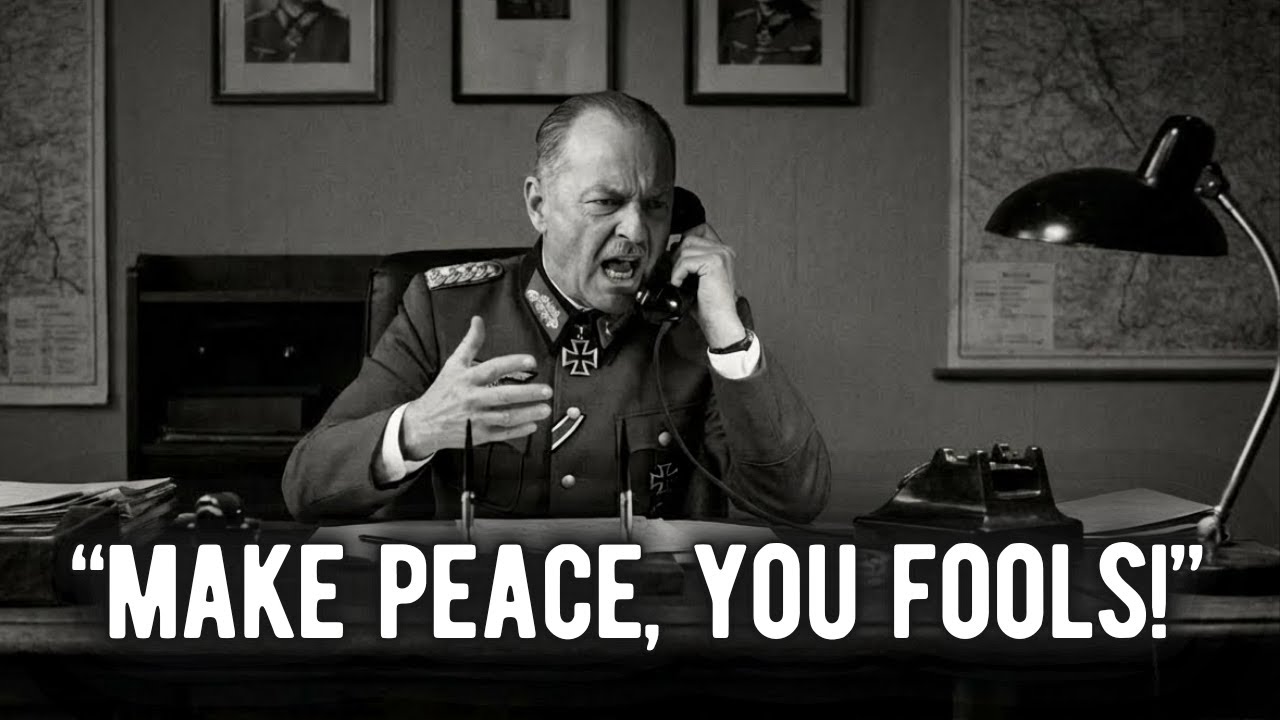
He barked into the phone, “Make peace, you fools. What else can you do?” He slammed the phone down, the line going dead.
With those words, von Rundstedt did more than insult his superiors. He became the first man at the very top of the German military hierarchy to admit, out loud, that the war was no longer a contest of strategy. It was a mathematical impossibility.
But the fools did not make peace. Instead, they fired the man who told them the truth, and the war would burn for another ten months, consuming millions of lives in a final, senseless conflagration.
To understand why this happened, why a system chose suicide over reality, one must look at the man who made that call and the broken machine he was trying to fix. Gerd von Rundstedt was not a Nazi. He was something much older and, in some ways, much colder.
He was a Prussian, born in 1875 into an aristocratic family that had produced officers for 800 years. He was a relic of a bygone era, wearing the uniform of the German Empire before Hitler was even born. He viewed the Nazis with a mixture of professional distance and aristocratic contempt, privately referring to Hitler as the “Bohemian Corporal,” a derogatory jab at the dictator’s low rank in the First World War and his non-German origins.
To Rundstedt, Hitler was a chaotic amateur playing with soldiers he didn’t understand. He was a classic military realist, caring not about ideology but about competence, logistics, supply lines, and the mathematics of war. And by the summer of 1944, the math was horrific.
For months before D-Day, Rundstedt had been warning Berlin. He was officially the Commander-in-Chief West, but he felt more like a warden of a crumbling prison. He commanded an army that was a shell of its former self.
His best divisions were bleeding to death on the Eastern Front against the Soviet Union. The units left in France were often understrength, filled with old men, young boys, or Osttruppen, conscripts from the East who had no desire to fight for the Reich. But the biggest problem wasn’t the men; it was the system.
By 1944, the German command structure had become a dysfunctional nightmare. In a normal army, a commander-in-chief calls the shots. In Hitler’s army, no one could move a division without permission from the Wolfsschanze.
Rundstedt famously complained to his staff that his sole authority was to change the guard at the gate. This paralysis was driven by one man, Adolf Hitler, and it brought us to the core conflict that defined the disaster of Normandy.
While Rundstedt looked at the war through the lens of a professional soldier, Hitler looked at it through the lens of a gambler. Hitler believed in the triumph of the will, that fanaticism could overcome physics, that if his soldiers simply refused to retreat, they would eventually win. He was obsessed with holding every inch of ground.
This wasn’t strategy; it was delusion. The clash between these two worldviews came to a head over the defense of France. Rundstedt knew he couldn’t stop the Allies on the beaches.
The Atlantic Wall was a propaganda myth, little more than concrete bunkers and barbed wire in many places. He knew that once the Allies landed under the cover of their massive naval guns, the German infantry on the coast would be pulverized. His plan was classic maneuver warfare: hold the Panzer divisions back, keep them deep inland near Paris, wait for the Allies to land, identify their main thrust, and then launch a massive, coordinated counterattack to drive them back into the sea.
It was a cold, calculated plan. Let them land, then 𝓀𝒾𝓁𝓁 them.
But there was another voice in the room, Field Marshal Erwin Rommel, the famous Desert Fox. Rommel disagreed. He had fought the British and Americans in North Africa and knew something Rundstedt didn’t fully grasp: the power of Allied air superiority.
Rommel argued that if they left the tanks inland, they would never reach the battle. The Allied fighter-bombers would destroy them on the roads before they even fired a shot. Rommel wanted the tanks right on the beaches.
 So, you had two of Germany’s best generals proposing two completely different strategies. Rundstedt wanted a mobile defense. Rommel wanted a static defense.
A competent supreme commander would have chosen one plan and committed to it. Hitler did neither. He chose a compromise that was worse than both.
He split the Panzer divisions, giving some to Rommel, keeping some inland, and crucially, he placed the four strongest SS Panzer divisions under his own personal command. This meant that in the critical opening hours of D-Day, the only tanks that could have turned the tide were locked behind a bureaucratic wall. They could not move without Hitler’s direct approval.
On the morning of June 6th, as the Americans were dying on Omaha Beach, Adolf Hitler was asleep. His staff, terrified of his temper, refused to wake him. They valued their own safety more than the safety of the Normandy front.
For Rundstedt, watching from his headquarters in Paris, this was the ultimate betrayal of military logic. He was fighting a war with one hand tied behind his back, and the other hand being held by a madman sleeping in the Bavarian Alps. This was the context of the phone call on July 1st.
Rundstedt wasn’t just reacting to a bad day on the battlefield; he was reacting to years of systemic incompetence. He was watching the inevitable result of a system that had replaced truth with faith. And 25 days after D-Day, the bill for that faith had finally come due.
To understand the sheer frustration that forced those words out of von Rundstedt’s mouth, we have to walk through the 25 days that preceded the phone call and see the battlefield through his eyes. For the German soldier in Normandy, the period between June 6th and July 1st wasn’t a battle; it was a slow-motion execution.
When the sun rose on June 7th, the day after the landings, Rundstedt expected the authorization to launch a massive, coordinated counterstroke. This was German military doctrine 101: wait for the enemy to commit, then hit them with everything you have. But the authorization never came.
The Panzer divisions, the iron fist of the Third Reich, remained scattered and frozen. The reason they were frozen wasn’t just indecision; it was the most successful intelligence operation in human history. Adolf Hitler was obsessed with the idea that the Normandy landings were a trap.
He was convinced that the real invasion was going to happen at the Pas de Calais, the narrowest point of the English Channel. Allied intelligence had spent months feeding this delusion. They had created a ghost army, the First United States Army Group, stationed in southeast England, complete with inflatable tanks, 𝒻𝒶𝓀𝑒 radio traffic, and a very real commander, General George S.
Patton. Hitler feared Patton and assumed the Allies would give their best general the main job. So, while American GIs were fighting and dying in the hedgerows of Normandy, Hitler kept his most powerful reserve army sitting idly in Calais, waiting for an invasion that would never come.
Rundstedt saw through this. He realized within days that Normandy was the main event. The sheer scale of the logistics, the Mulberry harbors being towed across the channel, this wasn’t a diversion.
But he couldn’t convince Berlin. Every time he asked to move the reserve south, he was told to wait. By the time the reserves were finally released, it was too late.
This brings us to the second reality that broke Rundstedt’s spirit: the air war. For the first time in the war, the German army was operating without a roof. The Luftwaffe had effectively ceased to exist as a strategic force in the West.
The Allies flew 12,000 sorties on D-Day alone; the Germans flew less than 500. This total air supremacy changed the fundamental physics of the battlefield. In Poland, in France in 1940, and in Russia, the German Blitzkrieg relied on speed.
Tanks moved fast. Trucks moved supplies constantly. But in Normandy, movement became death.
Allied fighter bombers, the Typhoons and Thunderbolts, which the German soldiers terrifiedly called “Jabos,” were prowling the skies 24/7. Anything that moved on a French road in daylight was essentially committing suicide.
Rundstedt watched as his elite Panzer divisions, which should have been racing to the front in hours, took days to arrive. They had to crawl at night, hiding in forests during the day. By the time they reached the front line, they were exhausted, low on fuel, and had already lost significant equipment to air attacks.
They were being fed into the battle piecemeal, plugging holes in the line rather than launching a decisive blow. Then there was the supply situation. The French resistance, coordinated by the Allies, had waged a war on the French rail network.
Bridges were blown, tracks were twisted metal. The logistical artery that fed the German army had been severed. Rundstedt was losing 2,500 men a day, but he was only receiving a trickle of replacements.
He was doing the math. You cannot win a war of attrition when the enemy has infinite supplies and you have almost none. On June 17th, 11 days after the invasion, Rundstedt and Rommel finally got a chance to present this reality to Hitler face-to-face.
Hitler flew to France for a meeting at the Wolfsschlucht bunker near Soissons. It would be the last time the dictator ever visited the Western Front.
The meeting was a study in contrast. Rundstedt and Rommel arrived dusty and exhausted from the front. Hitler arrived looking pale, hunched, and jittery, playing with his glasses, his hands trembling from the early signs of Parkinson’s disease.
 Rommel spoke first. He was brutal. He laid out the catastrophe, telling Hitler that the front was about to break, that the troops were fighting with courage but without hope.
He essentially asked the political question: has the war been lost? Hitler exploded. He dismissed the reports.
He didn’t want to hear about tank losses or fuel shortages. He wanted to talk about the V-1 flying bombs. The first V-1s had just been launched against London, and Hitler was ecstatic.
He believed that these pilotless drones would terrorize the British into surrendering. He spent hours monologuing about the technical specifications of the V-2 rockets that were coming next. He believed that technology would save him from strategy.
Rundstedt sat there, silent and stone-faced. He realized then that the man in charge had completely detached from reality. Hitler wasn’t listening to his generals; he was listening to his own desperate need for a miracle.
The irony of that meeting was sharp. While they were arguing, a stray V-1 flying bomb malfunctioned and crashed near the bunker. The explosion sent the entire German High Command scrambling for cover.
It was a perfect metaphor. The wonder weapon that Hitler was pinning his hopes on had nearly killed him.
The meeting ended with no change in strategy. The order remained the same: hold. Not a single step back.
Rundstedt returned to his headquarters knowing that the end was inevitable. But why couldn’t the High Command see what was happening? The answer lies in the organizational filter of the Third Reich.
By 1944, the German military reporting system had become a machine for manufacturing lies. It started at the bottom. A battalion commander who lost a key village didn’t want to report a retreat because that sounded like cowardice.
So he reported a “straightening of the front.” The corps commander received this report. He didn’t want to tell Army Group that he was losing.
So he reported that the enemy was being “contained.” By the time the report reached Field Marshal Keitel and General Jodl at the Supreme Command, a catastrophic breakthrough had been polished into a minor defensive adjustment. Keitel and Jodl were the ultimate gatekeepers.
They knew that bringing bad news to Hitler resulted in rage, dismissal, or worse. So they filtered the intelligence. They showed Hitler maps where German divisions still existed as potent fighting forces, even though those divisions had been reduced to a few hundred men with rifles and no heavy weapons.
Hitler was moving phantom flags on a map, issuing orders to units that no longer existed, to attack objectives they couldn’t reach, with ammunition they didn’t have. This closed loop of information meant that Berlin and Normandy were fighting two different wars. In Berlin, the war was still winnable if everyone just tried harder.
In Normandy, the war was a slaughter.
The breaking point came with the fall of Cherbourg. Hitler had ordered the fortress port to be held to the last cartridge. He envisioned a heroic last stand that would deny the Allies a port for months.
Instead, the German commander, General von Schlieben, surrendered on June 26th. He surrendered because he had thousands of wounded men, no food, and no hope. When news of the surrender reached Hitler, he didn’t see it as a military necessity.
He saw it as a betrayal of will. He ranted about honor and cowardice. But for Rundstedt, the fall of Cherbourg was the final proof.
The Atlantic Wall was gone. The Americans now had a deep water port to flood France with millions of tons of supplies. The British were grinding the best German Panzer divisions into scrap metal around Caen.
And so, on July 1st, when Keitel called asking, “What shall we do?” he was asking for a tactical solution to a strategic apocalypse. He wanted Rundstedt to suggest a counterattack or a new defensive line.
Rundstedt had no tactics left. He had used them all. He had done his duty.
He had tried to hold the line, but he refused to participate in the delusion any longer. When he said, “Make peace, you fools,” he was breaking the filter. He was bypassing the yes-men and shouting the raw, ugly truth directly into the receiver.
He knew it would cost him his job, and frankly, he didn’t care. Being fired by a madman was preferable to leading an army to senseless slaughter.
 But the tragedy of the German system was that the removal of one man didn’t fix the machine. The machine simply replaced the broken part and continued grinding on. The response to Rundstedt’s outburst was swift.
On July 2nd, the very next day, a courier arrived at his headquarters with a letter from the Führer. It was polite, wrapped in diplomatic euphemisms citing age and ill health, but the message was brutally clear: you are finished. Rundstedt packed his bags without protest.
He reportedly told his staff, “I am glad to be leaving this sinking ship.” He returned to Germany, to a sanatorium, to nurse his heart condition and drink away the memory of Normandy. To replace him, Hitler sent Field Marshal Günther von Kluge.
Kluge was known as “Clever Hans,” a capable commander from the Eastern Front who Hitler believed still possessed the necessary fighting spirit. Kluge arrived in France strutting with confidence, even lecturing Rommel’s staff on the importance of optimism and energy. He believed that Rundstedt had simply been a tired old man and that the situation could be fixed with willpower.
It took Kluge exactly two weeks to realize that Rundstedt had been right about everything. Once Kluge saw the shattered divisions, the empty fuel depots, and the skies black with Allied planes, his optimism evaporated. He found himself writing the exact same reports Rundstedt had written, asking for the exact same withdrawals, and predictably, receiving the exact same rejection from Berlin.
The tragedy of the German High Command was now playing out in a grisly loop. The system would fire a realist, hire an optimist, watch the optimist become a realist, and then destroy him. By August, Kluge was dead.
He committed suicide with a cyanide capsule on the road to Metz, terrified that Hitler was about to arrest him for the failed July 20th plot to assassinate the dictator. He left behind a suicide note urging Hitler to end the war. “Show yourself now to be great,” he wrote, “and put an end to this hopeless struggle.”
Hitler read the note, reportedly sneered, and continued the war. Rommel fared no better. The Desert Fox, the most popular general in Germany, was forced to swallow poison in October to save his family from the Gestapo.
Think about that for a moment. Within 3 months of D-Day, the three top commanders in the West, Rundstedt, Kluge, and Rommel, were either fired or dead by their own hand. They were the men who knew the most.
They were the professionals. And because they saw the truth, the system purged them.
This brings us to the terrible price of that silence. When Rundstedt said, “Make peace, you fools,” on July 1st, the war was lost. That is a fact.
But the fighting continued for another 10 months. And those 10 months were the bloodiest of the entire conflict. Because the German High Command refused to accept the mathematics of defeat, they refused to retreat from Normandy when they still could.
The result was the Falaise Pocket in August. Hitler ordered his armies to stand and fight in a position that was strategically impossible. The Allies wrapped around them like a noose.
What followed wasn’t a battle; it was a massacre. Tens of thousands of German soldiers were trapped in a narrow corridor, pounded by artillery and aircraft. The roads became so clogged with dead men, dead horses, and burning vehicles that Allied pilots reported they could smell the stench of death from hundreds of feet in the air.
The German 7th Army was effectively erased from existence. If Rundstedt’s advice had been taken, those men might have been saved. But the destruction didn’t stop there.
By refusing to end the war, Hitler doomed the German cities to total annihilation. The Allied strategic bombing campaign intensified. Dresden, Hamburg, Berlin, they were turned into moonscapes of rubble and ash.
In December 1944, Hitler gambled his last reserves in the Battle of the Bulge, an offensive that Rundstedt, who had been grudgingly recalled to duty, privately called nonsensical. It was a suicide mission that wasted the last of Germany’s fuel and its best remaining soldiers.
Between the phone call on July 1st, 1944, and the final surrender in May 1945, millions of people died. American GIs, British Tommies, Soviet troops, German conscripts, and countless civilians. They died not to determine the outcome of the war, which had been decided on the beaches of Normandy, but to satisfy the delusions of a leadership that had built a bunker against reality.
History often focuses on the evil of the Nazi regime, the concentration camps, the racism, the brutality, and rightly so. But there is another lesson here, a lesson about how organizations fail. The Third Reich was a system designed to 𝓀𝒾𝓁𝓁 the truth.
It was a hierarchy where loyalty was valued over competence, where good news was rewarded, and bad news was punished. It created a bubble of comfort for the leadership, protecting them from the harsh facts of the world. But facts are stubborn things.
You can ignore the fuel shortage, but your tanks will still stop. You can ignore the enemy air force, but your supply trucks will still burn. You can fire the general who tells you the war is lost, but the war is lost all the same.
Gerd von Rundstedt was a man of the old world. He was not a moral hero. He served a criminal regime until the very end.
But in that moment of frustration on a secure telephone line in July 1944, he became the voice of reality. Make peace, you fools. It was the only rational order left to give.
And because they wouldn’t listen, the fools burned everything to the ground.