The surrender documents had not yet dried when the first blows fell, not on the man himself, but on the family he had built. On May 23rd, 1945, British troops stormed the Flensburg government compound and arrested Karl Dönitz, the man Adolf Hitler had anointed as his successor just three weeks earlier. The arrest was swift, clinical, and absolute, stripping the seventy-year-old admiral of his command, his authority, and any pretense of legitimacy.
But even as Dönitz was hauled into captivity, his family was already shattered by a loss that cut far deeper than the collapse of the Third Reich. For the admiral who had orchestrated the most brutal naval campaign in history, the war had begun at home, in the cold waters of the Atlantic, where both of his sons had perished serving under his own command. The story of the Dönitz family after 1945 is a harrowing account of total defeat, where the patriarch returned from prison an old man, and the surviving women were left to rebuild every brick of a life that had exploded around them.
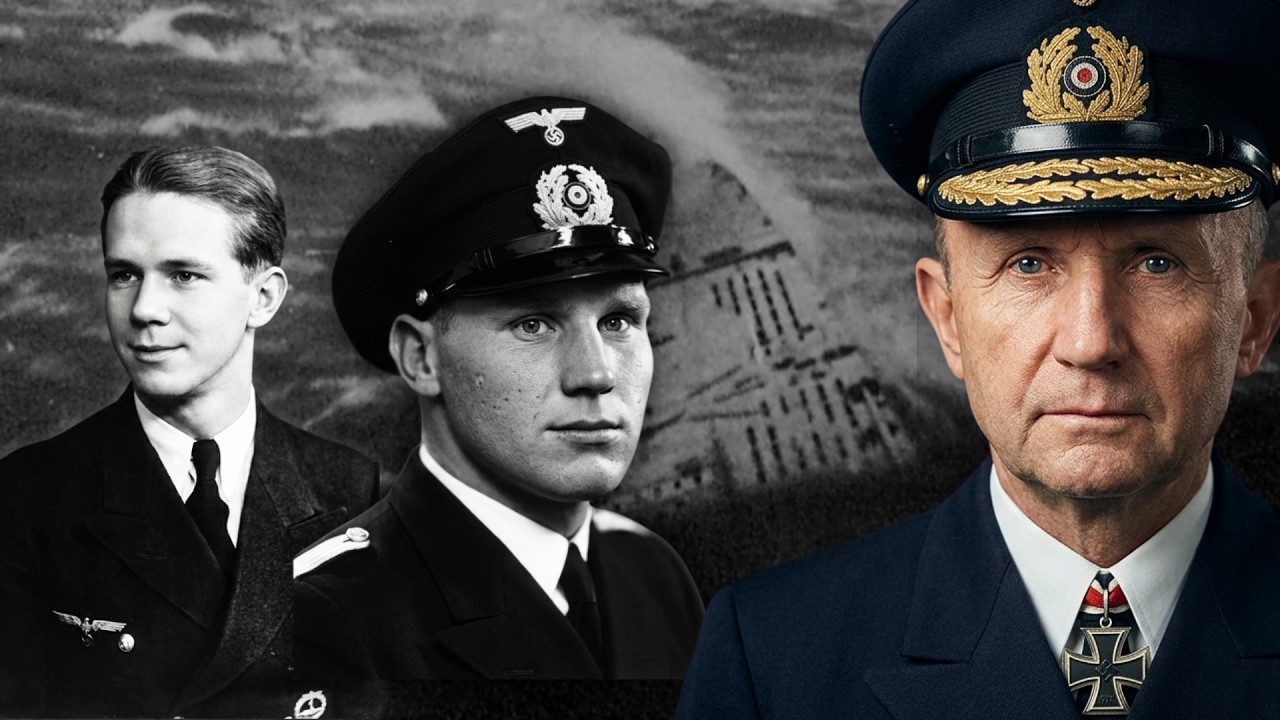 The first breach in the family’s armor came on May 19th, 1943, in the early morning hours of Black May. The younger son, Peter, had followed his father’s path into the U-boat fleet, serving as a watch officer aboard U-954. The boat had been hunting convoys in the North Atlantic when it sent its final transmission.
The Royal Navy responded with a barrage of depth charges that broke the hull. U-954 sank in minutes, and with it went Peter Dönitz, twenty-one years old, and all forty-six men aboard.
The death was a fatal blow to Karl Dönitz, but it was not the final one. The war refuse to let the family go. In the aftermath of Peter’s death, the elder Dönitz, bound by Navy regulations he had helped design, ordered his remaining son Klaus out of the frontline.
Klaus was transferred to a naval doctor training program, kept alive by a bureaucratic rule that protected the last heirs of senior officers. But Klaus, restless and fiercely loyal, chose his own path on his birthday, May 13th, 1944.
On the morning of that day, the Flotilla commander had been invited to board a fast attack boat leaving the French coast, but he declined. Klaus Dönitz, who had no official posting, talked his way into the empty space on the boat S141, eager for one last taste of combat against the British transports crossing the English Channel. The boat never returned from its raid.
The Free French destroyer La Combattante hunted the S141 down and sank it.
Klaus Dönitz’s body was pulled from the wreckage but was not among the six survivors dragged from the sea. He died at 24, leaving his father with the brutal mathematics of a generation of German leadership that had now been completely depleted. The father of the U-boat war had lost both heirs.
For Karl Dönitz, the grief was only partially circulated in public. After receiving the devastating news, he sat through his morning staff meeting, and those present noted he carried on with a slightly lessened precision, inside the meeting, the stoic command of a man so accustomed to counting losses at sea.
By the time of his arrest in 1945, Dönitz had been thrown into the legal machinery of Nuremberg. There, he was not charged with war crimes regarding unrestricted submarine warfare, a claim mitigated by the testimony of American Admiral Chester Nimitz, who acknowledged that the U. S.
Navy had used the same methods in the Pacific. He was convicted on two counts of aggression and cruelty against the rules of war, and sentenced to ten years in Spandau Prison in Berlin.
While the Lion sat in his cell, his surviving family was flattened into obscurity. Ingeborg Dönitz, the general’s daughter who had been the matriarch of the naval household, was now a widow-adjacent, separated from her husband by stone and barbed wire. She had trained as a nurse before her marriage, and in 1945, at the age of fifty-three, she left the elite world of the shipyards and returned to the wards.
She took a job as a receptionist at a doctor’s practice outside Hamburg in Reinbek.
She stood in the waiting room of that clinic, not as the admiral’s wife but as a greeter, processing the medical files of the very people who had been bombed by the regime her husband served. She was the anchor for the strongest public function of her life. For the entire decade of his incarceration, Ingeborg bore the weight of the family’s survival on her own.
She had lost two boys to the Atlantic and the Channel, and now she paid the absolute cost for the remaining legacy of her husband’s privileged decisions.
 When Karl left Spandau in 1956, the man who walked into Aumühle was 65 and a ghost. The command room was closed to him; his medals were prohibited; he had no honor in the rigid social landscape of new. Dönitz settled in the small town near Hamburg, but the years of integration were short.
Ingeborg, frail and exhausted wіthastening, maintained their household for only six more years before the heart failure took her down in 1962.
The death of Ingeborg Dönitz closed the second chapter for the family. She had lost her sons to the war, lost her husband to the Nuremberg Tribunal, and she had worked at a reception desk until the moment of her death, upholding the domestic sanctuary that looked her face in the prisoner’s glass. In the same stroke, her departure severed the Dönitz lineage from its deepest roots, leaving the legacy to the only remaining descendants, which now pivoted on a single surviving child, Ursula.
Ursula Dönitz became the only flagship of the entire family’s custody of the past. She was the daughter who married Günther Hessler, a U-boat commander who would become the highest-scoring patrol officer in European waters. Hessler did not sink a couple of small fish; on U-107, he sailed out on a single patrol that destroyed more than fourteen Allied ships, claiming the record for the heaviest tonnage in a single patrol of the war.
But after the defeat, Hessler did something extraordinary. In 1947, the Royal Navy, determined to understand the enemy that had almost severed its Mercant Marine, made a fleet decision. They hired Günther Hessler, the son-in-law of Karl Fou, to write the history of the war against them.
Hessler spent four years being read by the Allied navy, producing a three-volume study, “The U-Boat War in the Atlantic,” which became the standard forensic reference for the campaign.
The hire was a secret combination of paternal and geological study. For the British, they needed its knowledge; for the rest, it was an act of work that aided the architect’s family. Ursula carried the burden of the memory: in public, she watched her father go to prison, watched her husband disgraced and then proud, and she tried to resurrect the ordinary life out of the German rubble.
They had three children, including a daughter named Uta, and two sons who were given the names Peter and Klaus, eternal mirror images of the dead uncles.
The fate of the Hessler home secured the family’s procreation. But the story of the Dönitz family after the war is not only about the survivors; it is the dedication of the patriarch to the pursuit of apology. Karl Dönitz spent his last years not in silence but in a struggle for redemption.
He wrote “Ten Years and Twenty Days” to explain the naval war and his legacy, refusing to renounce the Nazi tenets. He sat in his small house in Auhühle, spelling out his defense.
The memoir was a primary source for historians, but it also kept him frozen in time. People saw him not just as an admiral but as the man who had conceded the final German state, the flensburg government, on behalf of all of them. He denied the horror, the broader matter of a brutal, genocidal regime; he focused only on naval practice, on the men who died from under him.
He spent the rest of his life honoring your own son’s death by building a monument to the exclusion of all other Nazi crimes.
The childhood widow Ursula was the last red thread. She outlived her husband, who died in 1968, and her father, who died on December 24th, 1980, at eighty-nine years old. The death of the last surviving Nazi leader was marked by a strange public ceremony.
 Thousands of former U-boat sailors came to the Forest Cemetery in Aumühle. They wore their medals, even though the post-war German government had forbidden them, and they mourned the man they called Der Löwe, the lion.
The family’s entanglement with the war had an inverse echo for a moment: the grandsons who bore the dead uncles’ names. The death carried the ones of a father and mother, but the mothers did not break. Ursula was a survivor, more than the German nation itself, and when she died in 1990, she left behind a family that had rebuilt itself not in the grand halls of Leippe, but in the quiet domestic shadows.
The sons of Karl Dönitz were dead, but the line survived.
The final years of the Admiral’s life were intertwined with a persistent denial that, for many, remains the final condemnation. He was the wicked leader of the fleet that had fed his sons to the same war. Yet asked about the lessons of the war, he was reported to have insisted that they would not have been able to win the war otherwise.
He was proud to be a symbol of that old German Navy. He never once acknowledged the greater responsibilities.
After Ingeborg died and Ursula lived, the Dönitz name, no longer carrying lands, widowed into a private mythology. The house became a place of pilgrimage. Submarine veterans traveled there every year to pay respects to their commander, to lay wreaths and organize a day of memory for the dead sailors.
The successive news of them partially tried to forget the dead ward. The grandchildren’s story is the last of the Dönitz story.
The family carried the weight of a war they had lost and a world that had not forgiven them. Ursula continued to live in the same country that had tried her father, and she walked with the knowledge that her husband had written a study for the 𝓀𝒾𝓁𝓁, for the Royal Navy. When she died, she did so as the child of a commander who had surrendered the country.
She died after seeing the Great collapse, after seeing the new Germany rise, and after holding the memories of the boys she had never known.
The whole tragedy of the Dönitz post-war existence is in the primal scene of the two graves: the water of the North Atlantic and the English Channel. The father, locked in his own victory and his own grief, ended his days unable to escape the collision of his roles. He was the one who brought the nation to its knees, and the one who was left alive at Christmas, which is when he died in 1980, just before the turn of a new decade.
In the ancient documented records, the name Dönitz carries only the classification of the systematic idiom: the cold, merciless submarine commander, the last Führer. But the human data has a grain in it—a family’s total collapse. When the Allies arrested him, they didn’t just arrest Karl Dönitz; they unseated the entire edifice of the household.
The wife was left to work the hospital, the son-in-law was hired to define the war of the enemy, and she had the quiet assurance to survive.
And in the fog of the postwar, the family accomplishes a kind of subtle achievement. It wanted to leave the disgrace, but the death of the sons underneath, the mother’s stoic endurance, and the father’s obdurate memoir have come together to form a picture that forces the historian to pause. Dönitz could not separate the family from the war, and they did not separate either.
 The descendants, the grandchildren, grew up in the shadow of the lion’s final Shroud.
United, their inheritance was not the aquamarine high seas of the monarch but the obscure fever of a defeated adult. They walked with the names of their dead uncles. They they were marked by the memories of the redemoration that had been carried out from the nursery rooms.
The family’s trauma is a portrait that’s not marked in the annals of official history, enshrined in the registry of the downturn.
The saga ends, not with a triumphant reconciliation, but with an echo. The last Dönitz died quiet in 1990. The widow Ursula, the reserved receptionist, and the admiral had been buried with unofficial medals.
In the subsequent excursions and through the years, their family became a footnote in the huge of life. But this footnote is an archive of grief that keeps asking a question about the human cost of the most sacred engagement.
Once the smoke was cleared, the Allies had a measure of the man. A high court at Nuremberg had sentenced him to ten years. Upon his release, he presented the portrait of himself as a professional, bearing the entire responsibility of the Navy, but they refused the burden of the regime.
He never acknowledged his son’s death as a consequence of his own strategic vision. He made it as the sacrifice of the soldier. The widows knew the difference, but they survived it.
The final measurable worth of the Dönitz family is taken in the forest after the French and the British. The memorial stands in the restrictive Forest Cemetery in Aumühle, a ground not far from the Hamburg Line. On the edge of 1980, the rain fell on the black throng of old sailors.
Their commander’s coffin, wrapped in the Imperial flag, was lowered to a salute given not by a Führer but by a grieving father. The death gave a closure to the years of absence.
Now, the reader in the memory of all that has been said: the story of the family after WW2 is the sonic training and survival. It is a chronicle of two dead boys, the internal female fortitude, and the slow decay. It is a break between the familial accounts and the absence of official records.
The men who survived him took the past to their graves. The remaining German naval camp never it back to the world.
The end of the Dönitz line doesn’t mirror the Nazi elite itself in the top of the regime. Instead, she collapses into a rear distract of grandchildren, professionals, ordinary life. They did not become adherents to the cause.
They lived as ordinary citizens, but the father’s shadow, the heavy rain throw, never stop covering them. The investor of the family name, then, becomes water ash into the vastness of a Atlantic, and the case is closed.


