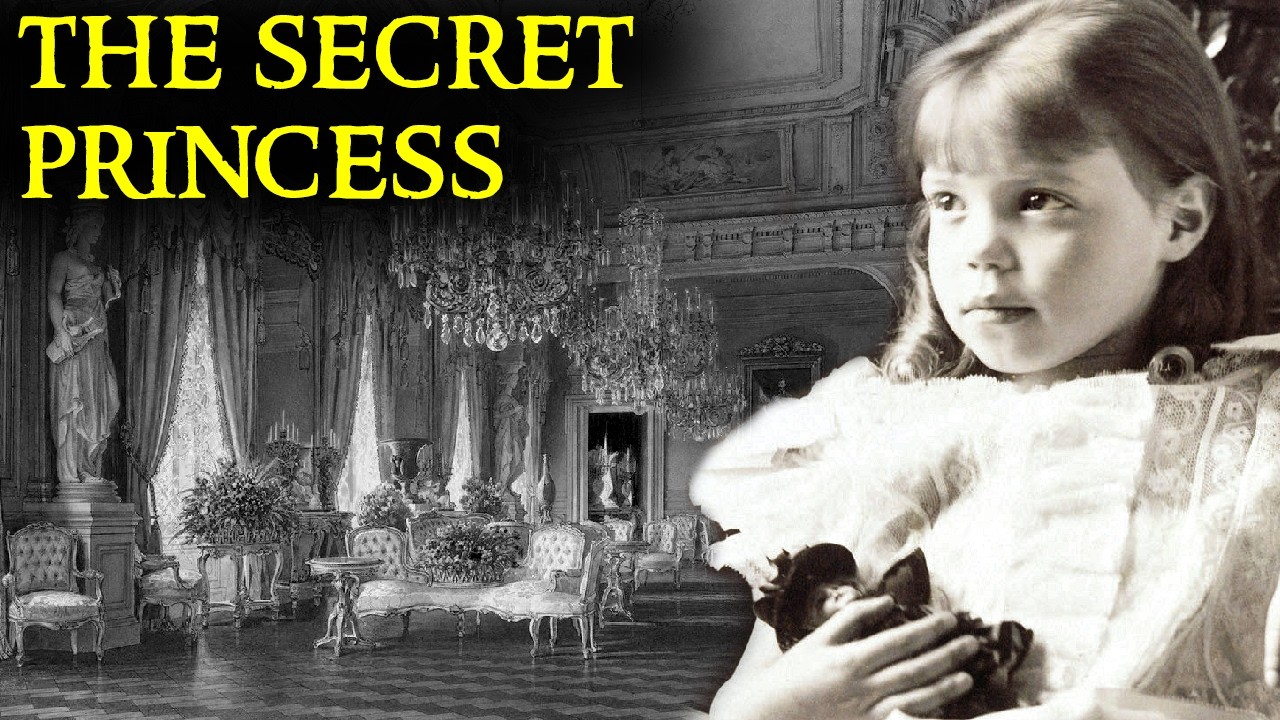
In 1918, Bolshevik forces executed Tsar Nicholas II and his immediate family in Yekaterinburg, and in the brutal years that followed, much of the Romanov dynasty was either killed or driven into exile. Yet one of Nicholas II’s sisters, Grand Duchess Olga Alexandrovna, survived the fall of the empire, the slaughter of relatives, war, and displacement, eventually dying in Canada in 1960 as the last surviving child of a Russian tsar. Born on June 13, 1882, at the Peterhof Palace near St. Petersburg, Olga was the youngest daughter of Tsar Alexander III and Empress Maria Feodorovna, the former Princess Dagmar of Denmark.
Her family was connected to royal houses across Europe, ties that would later shape her fate. Her early childhood was marked by tragedy. In October 1888, the imperial train derailed near the small town of Borki, killing 21 people, though the royal family survived. Witnesses later claimed Alexander III held up the crushed roof to free others, though more reliable accounts credit Empress Maria with tearing up her clothes to bandage the wounded.
When Alexander III died of kidney disease in 1894, Olga was just 12 years old and deeply traumatized. She described her father as everything to her, while her relationship with her mother remained more formal and distant. As a young woman, Olga entered Russian society reluctantly and was courted by Duke Peter Alexandrovich of Oldenburg, a man known more for his love of gambling than for interest in women. Their 1901 marriage surprised society, as Peter was in his 30s and had shown no previous interest in marrying.
The marriage was believed to remain unconsummated, with the couple living in separate bedrooms at opposite ends of their 200-room St. Petersburg palace. Olga later described the arrangement as deeply unhappy, leading to depression and even temporary hair loss. She asked for a divorce in 1903 but was refused.
During those years, she grew close to her brother Nicholas II and his family, adoring her nieces and especially devoted to her goddaughter, Grand Duchess Anastasia. The marriage finally ended in 1916, after Olga began an affair with Nikolai Kulikovsky, a Russian military officer from a landed family. Her brother the tsar had long refused to accept a marriage to someone from a lower social station, but he eventually relented. Olga divorced Peter on grounds of non-consummation and married Nikolai within weeks.
The couple had two sons, Tikhon and Guri, born in 1917 and 1919. Those births came amid profound crisis. The First World War had broken out in 1914, and Russia’s disastrous involvement severely damaged the tsar’s authority. Nicholas II was overthrown in March 1917, followed by a radical communist revolution in October of that year.
In the early hours of July 17, 1918, Nicholas II, his wife, and all five of their children were executed by Bolshevik forces in Yekaterinburg. In the aftermath, other members of the Romanov dynasty and the aristocracy were hunted down, killed, or driven into exile. Olga, her husband, and her sister Xenia were placed under house arrest in the Crimean Peninsula. As the revolution turned into civil war, rumors of impending execution spread, and their fate seemed destined to mirror that of Nicholas II and his family.
They survived only because a sudden shift in power brought Crimea under White Army control, and foreign intervention carried them away just ahead of the Bolshevik advance. In November 1919, the family fled through a collapsing Russia, finding last-minute shelter at the residence of the Danish consul. They moved through Constantinople and the volatile Black Sea region for months before finally reaching safety, settling first in Belgrade and then continuing north to Denmark, where they arrived during Easter 1920 and reunited with Olga’s mother, who had been evacuated earlier with help from her British relatives. They spent the next 28 years in Copenhagen, initially at Amalienborg Palace before moving to a country estate.
After Olga’s mother died in 1928, the estate was sold and profits divided among surviving family members. With her share, Olga bought a small farm called Knudsminde at Ballerup outside Copenhagen. There, the sister of a former tsar embraced a life of hard physical work, laboring in the fields, looking after the house, and painting to support the family. She also hosted members of the Russian exile community who had fled to Denmark, France, and Britain after the Bolshevik victory in the civil war.
In 1925, Olga became involved in the early saga of a woman who would become famous as Anna Anderson. A young woman calling herself Franziska Schanzkowska had begun claiming she was Olga’s niece, Grand Duchess Anastasia. Olga traveled to Berlin to meet her and was not convinced, noting that the woman spoke German rather than Russian or English, and that even nearly a decade apart could not explain how different she looked. Olga concluded not that the woman was an impostor, but that she was psychologically disturbed.
Schanzkowska spent much of her life in asylums and later lived in the United States as Anna Anderson. In April 1940, Nazi Germany occupied Denmark after a brief military operation. Olga’s two sons, by then soldiers in the Danish army, were captured and held as prisoners of war for a time. As the war ended in May 1945, Soviet forces occupied the Danish island of Bornholm in the Baltic Sea.
Fearing that Denmark might fall into the Soviet camp during the developing Cold War, Olga decided to leave. In the summer of 1948, the family traveled to Britain, where they were hosted at Hampton Court by her cousin King George VI. A few weeks later, they sailed to Canada. They initially settled in Toronto, later buying a farm near Campbellville, Ontario.
The move proved difficult, as Olga and Nikolai were nearing their 70s, and a postwar labor shortage meant workers were scarce. By 1952, they sold the farm and returned to Toronto. In her final years, Olga received visits from old relatives and supporters of the Romanov dynasty. She was invited to attend when her cousin Queen Elizabeth II visited Canada in 1959.
Nikolai Kulikovsky died in August 1958 after years of ill health. Olga’s own health declined, and she moved with friends to a small apartment in East Toronto. She died on November 24, 1960, at age 78, after falling into a coma a few days earlier. Her funeral was crowded with mourners, and she was buried beside her husband in York Cemetery, Toronto.
She painted relentlessly to the end, producing more than 2,000 works over her lifetime. Through frugal living, she left an estate of over $200,000 Canadian dollars. Her sister Xenia had died in England seven months earlier, making Olga the last surviving child of any Russian tsar.
Her passing marked the end of an era, severing the last living link to the old Russian Empire of the 19th century.