On the afternoon of July 19, 1940, Adolf Hitler transformed the Kroll Opera House in Berlin into a stage for one of the most extraordinary military ceremonies in modern history. The Führer gathered his assembled Reichstag, not for legislation, but to anoint 12 senior generals with the rank of field marshal—Germany’s highest military honor. It was a spectacle of power and pageantry, a single, dazzling afternoon that marked the zenith of Nazi military dominance.
Yet, within the triumphant glow of the ceremony, lay the seeds of a collective fate that would see these twelve men scattered across the landscape of betrayal, defeat, and justice. In less than five years, the elite cohort Hitler was honoring would be reduced to a collection of survivors that faced execution, imprisonment, and outright dishonor. Not one of these men ended their careers at the place that ceremony was meant to cement.
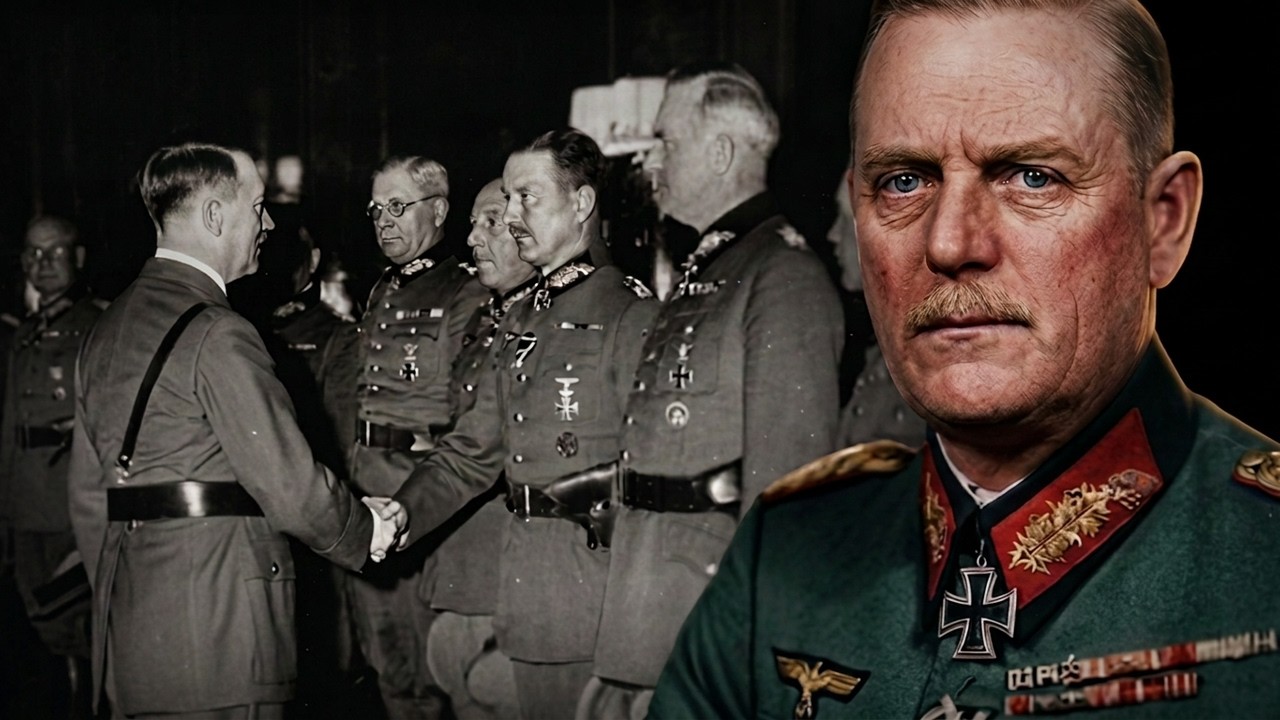 The event came against the backdrop of startling, lightning-fast victory. In just six weeks, the German Wehrmacht had crushed the combined forces of the Netherlands, Belgium, and France, a nation believed to possess the most invincible army in continental Europe. Poland had been overrun the previous autumn, with Denmark and Norway falling that spring, cementing a sense of infallibility around the Führer.
The contrast across the war was perhaps the greatest in modern military history: a power, in the summer of 1940, stood at the absolute apex of its strength. Hitler wanted to codify this domination with a ceremony of unprecedented scale, showcasing to the world and to the old aristocratic officer corps that he was the master of destiny.
Each of the twelve received an ornate, jewel-encrusted baton, symbolizing their new office, and an immense privilege that was tied to their new rank. Immediate tangible rewards awaited them: a tax-free salary of 36,000 Reichsmarks, and the fact that a field marshal was never retired—remaining on active duty for the rest of his life. This was not merely a gift; it was a calculated maneuver of political subjugation.
The rank itself carried profound historical weight, having been abolished after the humiliation of 1918 and resurrected only under the Nazi regime. Hitler deliberately promoted commanders who demonstrated loyalty or who were considered malleable, elevating them over other generals he mistrusted, thereby tightening his iron grip over the officer corps that held aristocratic traditions and remained distant from the party’s radical core.
The ceremony saw nine army commanders step forward: Walther von Brauchitsch, Fedor von Bock, Wilhelm Keitel, Günther von Kluge, Wilhelm Ritter von Leeb, Wilhelm List, Walther von Reichenau, Gevon von Rundstedt, and Erwin von Witzleben. The air force was represented by three figures: Hugo Sperrle, Albert Kesselring, and Erhard Milch. From that stage, one man, Hermann Göring, was elevated to a realm above them all.
Already a field marshal, he was promoted that same day to the unprecedented rank of Reichsmarschall—Reich Marshal of the Greater German Reich—placing him above every officer in the armed forces and formally cementing him as Hitler’s designated successor.
In the moment’s consequence, the ceremony was far bigger than a simple military promotion. It was a message to the world of German invincibility, a declaration that these men was an unbreakable aristocratic elite. However, the trajectory of history would invert this testament almost immediately.
The 1941 descent into Russia and the following global war shattered the illusion. The first man to fall from the ranks of those fifteen generals was a man who became an instrument of the state’s own legal machinery. Wilhelm Keitel had been placed at the top of the military structure as chief of the armed forces high command, directly under Hitler, but he did greater in training as a demigod.
Keitel is best understood as a man whose path was defined not by brilliance but unquestioning obedience. He put his signature to criminal orders, stripping legal protection from prisoners and civilians in the occupied territories. He remained loyal to the Führer to the bitter end, though the regime was crumbling around him.
In May of 1945, it was not a deliberate choice but Hitler’s own shot to a sudden fear: Keitel, alone among the surviving when they were his commanders, signed Germany’s surrender. The signing was not a release but a warrant. At Nuremberg, the International Military Tribunal found him guilty on all four counts—crimes against peace, war crimes, crimes against humanity, and conspiracy—and rejected his defense that he had merely followed proper orders.
On October 16, 1946, he was hanged.
 Von Witzleben, another of the twelve, did not die at the hands of the Allies. He traveled the opposite road—a road from which he had been protected by iron fidelity. He had become but disenchanted with Hitler and active hostility.
He was one of the central plotters behind Operation Valkyrie, the July 20, 1944, assassination plot against the Führer. He was to become operational commander of the entire armed forces if the bomb had successfully killed Hitler. The Bomb failed.
V It took Witzleben only hours to be arrested, stripped of his rank and expelled from the army to face the People’s Court in Berlin. The notorious judge Roland Freisler, robbing him of any dignity in his court appearance, froze him as an unworthy soldier sent to be executed by a hanging. He died on August 8, 1944, at Plötzensee Prison in Berlin.
Two of the twelve were therefore hanging within two years of each other—one by the victors for serving Hitler, the other by Hitler for trying to remove his own master.
But those who died on the gallows were not the only of the 12 to carry out their own dramatic secession. Two of the field marshals never lived to face any formal reckoning. Walther von Reich cation has been one of the most political of Hitler’s commanders, fully committed to the regime and, crucially, to its ideological war in the East.
At the end of 1941, he had issued a directive that explicitly tied the army to the atrocious security and political crimes being committed on the Eastern Front. On January 1942, after suffering a stroke, he collapsed in the extreme cold. He was sent by air back to Germany for treatment and died during the transport journey on January 17, 1942, before any judgment could be reached.
Fedor von Bock was perhaps the most violent of his kind in terms of trappings. He commanded an army group in the invasion of the Soviet Union, performing with steady hardline competence until his removal by Hitler in 1942 Posterior to that, he was forced into permanent retirement. On May 3, 1945, in the final days of the war, the Brie was attacked by a British RAF fighter as his open car was driving on a road in Northern Germany, near Lübeck.
The RAF pilot shelled the car, killing his wife and daughter instantly. Bock died of his wounds the following day, and as a result, he became the senior man of the these twelve to be killed by enemy fire.
Perhaps the most poignant silhouette of betrayal among the twelve was that of Gunther von Kluge. I know about the July 20th assassination plot in advance but had given tentative encouragement to the conspirators, never committing to abandon the Führer. When the attempt failed, his lack of will left him in exile.
By August 1944, his armies in France were collapsing under Josef Allied, and Hitler grew suspicious. On August 17, 1944, he relieved Khuge of his command, ordering him back to Berlin. On the 19th, a road near Metz, he took the final step into the dark, committing a suicide by ingesting cyanide, leaving a final letter for Hitler.
 In it, he insisted he had done his duty to the last. By the time his death was handled, the collapse of his once-grandee force from outside was accelerating, and the elite from the opera house were literally eating itself.
But the story of these twelve men did not all end in a soldier’s death or a formal murderer’s grave. Five of them would be held to a more restrained semblance in the post-war period. The international legal travesty—Nuremberg—was more complex than a simple list of ten executions.
For these men, the verdicts were graded, evaded, and in many cases, tempered. After the 1947 trials, justice was often attenuated by the grim reality of a Cold War world and an emerging West Germany. The harshest sentence was not without end.
Albert He. Kesselring, who had been in Germany commander-in-chief in Italy during the war, was sentenced to death in 1947 by a British court in Venice. The latter went to the prisoner exchange, but the sentence was commuted to life imprisonment.
He was released in October 1952 from matters of “health.” He died a free man in 1960, not in a cell but a home.
Wilhelm List was the principal defendant in the prominent “hostages” trial for reprisal policies in occupied southeastern Europe. He was found guilty and given a life sentence in 1948, but Nazi leadership was not immune. He is also released for medical reasons in December 1952 and lived until 1974.
Erhard Milch, the air force production chief, was convicted in 1947 for his exploitation of forced labor. He was given a life sentence, which was reduced to 15 years, and he was set free in 1954. Wilhelm Ritter von Leeb and Hugo Sperrle were finally tried together in the High Command Trial, which was the last of the Nuremberg proceedings.
Leeb was convicted of passing a criminal order and was sentenced to time already spent on remand, effectively walking out of the courtroom as a free man. Sperrle was acquitted of every charge, despite the fact he had commanded air fleets in various theaters.
Within a decade of the original victory ceremony, all five of those survivors were out of prison. The once-chosen elite had no—echoed justice in the courtroom, had been pared down by behavior and time. Some never faced any tribunal at all.
Walther von BraunNeel, who as commander-in-chief of the army had been the most senior soldier of German Army, in the ceremony of July 1940, was removed from command in December 1941 after a heart attack and Hitler’s rage amid the failed drive on Moscow. At the end of the war, he was captured and held in British custody, intended to be a trial. He died in a Hamburg military hospital at 2357, on October 18, 1948, not by execution but a combination of his age and health, his case never coming to trial.
 Gerd von Rundstedt, the eldest and most elderly of them, was the most malicious in military service. Dismissed and then from service by Hitler multiple times, he was later given command again. He had also been given the task of presiding over the court of military honor in the aftermath of July 20th, the same court that expelled the conspirators without a trial, including Witzleben, bargaining them to the operations of the people’s court.
He was already captured; Rundstedt was charged with war crimes but, due to chronic states and failing health, the charges were dropped. He was released from prisoner-of-war status in 1949 and died in 1953, never having stood trial.
At the same time, what made the ceremony truly glaring was not entirely actual of the men who wore the pride of the baton, but the dramatic absence of one man. Johannes Blaskowitz. Blaskowitz had been placed in charge of the German army in Poland after the invasion.
He had repeatedly transmitted memoranda and reports to his superiors about the horrifically In 1940, the killing and mistreatment of Polish and Jewish civilians were the responsibility of the SS. His memoranda were not only morally charged but also militarily logical; these killings were strengthening resistance, damaging the army’s reputation, and undermining discipline. Hitler, was enraged by these officer, dismissed Blaskowitz’s concerns as “childish.”
Not only was he already under the authority of the Army High Command, just one rank below field marshal, but he alone was denied the promotion on July 19. He was the only colonel-general in the German of that rank not elevated. Though he would hold major commands, he would never receive a baton explanatory.
The legacy of that July afternoon in 1940 was not one of eternal greatness. It was a record of drastically shorter lives and extreme ends. There were a total of these twelve men later with the rise of war in front of their terrain.
One field had been carried out by the Allies, another by his own criminal master. Two died before any reckoning came. And the trials that were presumed to be a moment of justice for the crimes of the state were often gepped, weakened, and in some cases completely reversed with freedom due to age and health.
Only a decade after that event, the survivors who had been in the ceremony’s defining moment had been set free or lay buried, and the ceremony is seen as a moment not of the greatest the rise of any armies’ seams, but a permanent monument to hubris. The prisoner not honored on that podium, General Johannes Blascowitz, had the only path that showed more.
Those who had failed to learn the lesson of the ceremony that day were long thought to be proof that the instruments of military honor and political compromise over history would inevitably lead to their own destruction. Of the twelve, only one was singled out for a death sentence for these criminals by the new world court, and the rest walked out of the crime trials with time served or had their sentences commuted. The roads were, in the end, a dark side of the night.
But there was one notable general absent from the stage that July 19: Johannes Blaskowitz. He saw the inferno of the suffering of the SS in Poland, he protested, and he was rewarded with obscurity rather than batons. His fate and the fates of the 12 Field Marshals serve as a reminder that military glory is short-lived, and that the path to immortality, when etched in the wronged stone, bends to the enemy.