In September 1940, as London endured nightly bombing raids and the Royal Air Force battled German bombers overhead, Nazi intelligence officers in Berlin were studying maps of Britain and searching for weaknesses. Some believed victory might come not through force alone, but through politics. Files prepared by the SD, the Nazi intelligence service, explored how Britain might be divided from within, and they spoke of a former king living restlessly in exile who could be persuaded to return under German influence. Among the names of his former contacts were German officials, including Nazi foreign minister Joachim von Ribbentrop.
What interested the Germans most was that beside the former king stood the woman for whom he had given up his throne—a figure whispered to have met Ribbentrop years before, many times in private. In the midst of Britain’s darkest hour, her name became part of the plans drawn up by Nazi Germany. Her name was Wallis Simpson. Bessie Wallis Warfield was born on June 19, 1896, in Pennsylvania.
Her father, Teckle Wallis Warfield, was a merchant who died when she was still a baby. Her mother, Alice Montague, raised her in Baltimore with the help of relatives. Wallis received a good education, attending Oldfield School in Maryland between 1912 and 1914, where she made friends with girls from wealthy and well-known families. Teachers remembered her as determined and ambitious.
One pupil later said that Wallis was brighter than the rest and set her mind on reaching the top of the class. She dressed with care, never appeared untidy, and worked hard to stand out from the crowd. In 1916, at age 20, she married Earl Winfield Spencer Jr. , a US Navy aviator.
The marriage brought her more loneliness than comfort. He was dashing in uniform but drank heavily and was often away on long postings abroad. Wallis used her time alone for various romances, including one with Argentine diplomat Felipe de Espil. She also lived abroad, spending time in China, particularly in Beijing.
It was there that later gossip placed her in an affair with Count Galeazzo Ciano, the Italian diplomat who later became Benito Mussolini’s son-in-law and foreign minister of fascist Italy. Rumors claimed she had become pregnant by him and suffered a failed abortion that left her unable to bear children. No firm evidence was ever produced, but the gossip stained her public name. Due to these affairs, as well as her husband’s excessive alcohol consumption, they separated several times, and their marriage ended in divorce in December 1927.
By that time, Wallis had met Ernest Aldrich Simpson, an Anglo-American shipping executive. Simpson divorced his first wife to be with Wallis, and they married in July 1928. With Ernest, she crossed the Atlantic, leaving Baltimore for the larger world of London society. Though she lived comfortably and her new husband was kind, their paths grew apart as the years passed.
Wallis became known among the higher circles in England, while Ernest struggled with financial difficulties as the couple lived beyond their means. Their marriage ended in divorce in 1937, a casualty of her growing closeness with another man whose life was even more complicated than hers. That man was Edward, the Prince of Wales, heir to the British throne and the most eligible bachelor in Europe. Edward had natural charm, a soft voice, and a warmth that reached those who met him.
Yet he carried doubts about his life, and the duties of kingship pressed on him like a weight he had never chosen. With Wallis, he felt different, free of formality. Their friendship, at first one of dinners and weekends, deepened into love. For Wallis, however, it was also dangerous.
She was still married and had already been divorced once. The foreign press spoke openly of the affair, while the British newspapers, bound by restraint and loyalty to the crown, remained silent. In January 1934, Wallis allegedly became Edward’s mistress. Edward denied this to his father, King George V, despite royal staff seeing him in bed with her.
In January 1936, King George V died, and Edward became King Edward VIII. Almost at once, he made it clear that he wished to marry Wallis once her divorce from Ernest Simpson was final. But British law and custom blocked the way. The Church of England, of which the British king was supreme governor, opposed the marriage of divorced persons with living former spouses.
The government, led by Prime Minister Stanley Baldwin, told Edward that his marriage would not be accepted by Parliament or by the dominions of the British Empire. Across Britain, religious leaders warned of scandal. To the king’s family, the situation was unthinkable. By the autumn of 1936, the matter was no longer private.
Politicians, churchmen, and journalists at home and abroad all spoke of it. The government pressed Edward for a decision: abandon the marriage, marry against all advice and face the collapse of the government, or abdicate. In December, he chose abdication. Edward’s reign had lasted less than a year.
His farewell broadcast reached millions, as the king spoke in calm tones of the woman he loved, saying he could not carry the heavy burden of kingship without her by his side. To many, it was the most romantic gesture of the age. To others, it was reckless and selfish. For Wallis, the cost was immense.
She became the woman blamed for a constitutional crisis, scorned across the British Empire as the reason a king had thrown away his crown. Wallis married Edward, now titled the Duke of Windsor, in June 1937 in France. She became Duchess of Windsor but was denied the title of royal highness. That refusal cut deep, marking her as an outsider of the royal family.
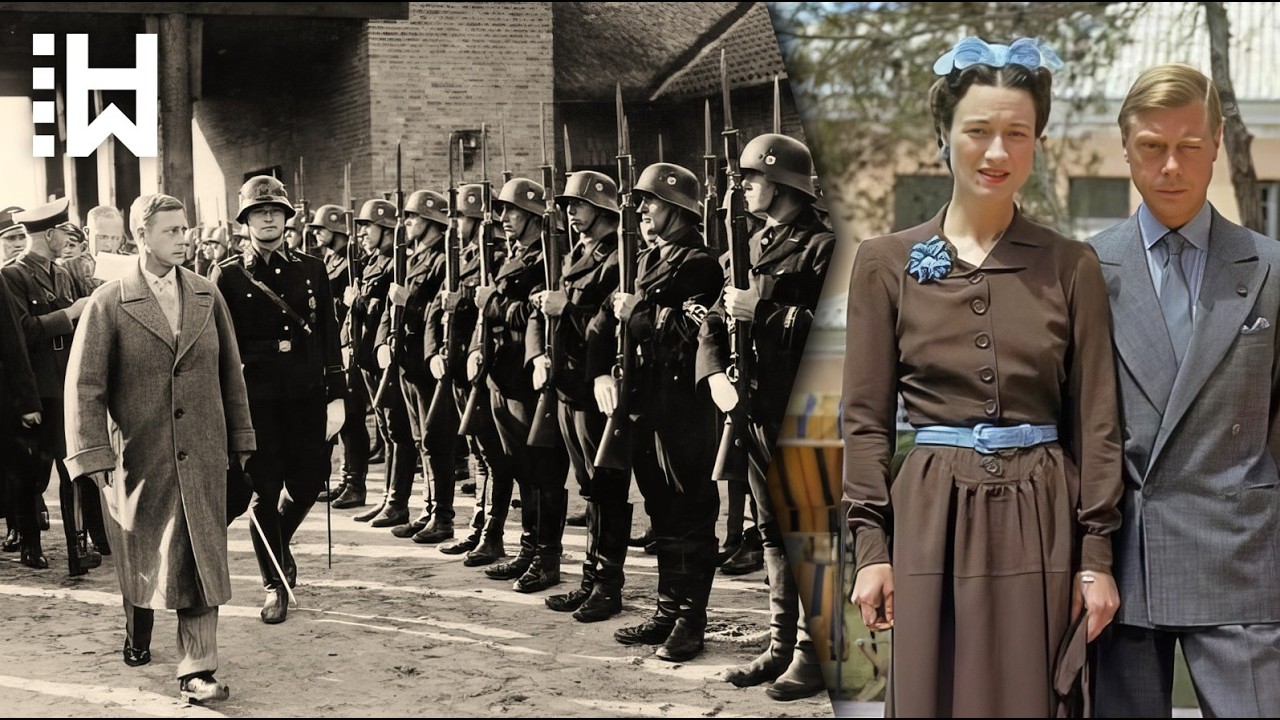
The couple lived in France, surrounding themselves with elegant furniture, photographs, and society friends. Yet Europe was uneasy, and war was drawing near. In October 1937, Edward and Wallis traveled to Germany at the invitation of Nazi officials. They toured factories and welfare projects, admired new highways, and were photographed.
The pictures showed them smiling, and those images never faded from public memory. Finally, they visited Adolf Hitler at the Berghof. The pair maintained ties to Joachim von Ribbentrop, the German ambassador to London and later Nazi foreign minister. Rumors circulated that Wallis and Ribbentrop had an affair in London, with claims that he sent her 17 carnations, one for each time they had slept together.
The FBI later noted that she was in constant contact with him, and MI5 worried she might pass on secret information to Nazi Germany. Wallis denied such stories, but the suspicion of intelligence offices remained. For Edward, Nazi Germany had a certain attraction. He admired its order and its opposition to communism, and he naively believed that Hitler might preserve peace in Europe.
German files captured after the war revealed that Nazi leaders considered Edward a potential ally during the Second World War, which began on September 1, 1939. When France fell after six weeks in 1940, German officials devised Operation Willi, a plan to lure or abduct the Duke and restore him to the throne as a puppet king once Britain was conquered. Whether Edward encouraged these ideas is unclear, but the mere existence of such plans deepened suspicion of him and his wife, who had connections to high-ranking Nazis. As German forces advanced in France in 1940, the former king and his wife fled south with crowds of refugees, first to Spain and then to Portugal.
There, German agents tried to lure Edward into their schemes. The British government grew alarmed. Prime Minister Winston Churchill himself sent sharp warnings to remove the danger of the capture or willing collaboration of the former king with the enemy. Edward was appointed governor of the Bahamas and sent across the Atlantic.
Life in the Bahamas, which was under British rule, was safe but dull. The city of Nassau was hot, quiet, and far from the European world they had known. Wallis worked with charities, schools, and hospitals, appearing in public with grace. She supported fundraising, visited classrooms, and tried to make a difference in the small colony.
They felt cast out and judged. Edward sometimes made remarks that praised German social order or echoed prejudices about Jews, which only increased mistrust in London and Washington. Wallis shared Edward’s sense of exile, and her bitterness was accompanied by racist remarks directed at the local Bahamian population. When the Second World War ended, the royal couple returned to France.
Their home in Paris became a gathering place for the fashionable and famous. Wallis appeared in magazines, her jewels sparkling, her gowns praised. Their rooms were decorated with fine furniture, family photographs, and gifts from visitors. Yet the shadow of the 1930s remained.
The discovery of the Marburg files, captured German documents containing information about Operation Willi, confirmed that Nazi officials had seen the Windsors as useful. Some thought this proved their dangerous sympathies. Others believed it showed only their foolishness. Wallis defended herself by saying she never supported Nazi dictatorship.
She claimed her only wish in the 1930s had been peace and a hope to avoid another bloodbath. Her later years were quieter. Edward’s health failed, and he died from throat cancer in 1972. Their marriage, which remained childless, left Wallis to face her own health problems in the final years of her life.
She developed dementia and lost her ability to speak in 1980. Toward the end of her life, she was bedridden and received no visitors apart from her doctor and nurses. Wallis Simpson, the woman for whom a king abdicated his throne, died on April 24, 1986, at age 89.