The silence was the first casualty of war that morning. It was not the quiet of a peaceful Bavarian dawn, but a heavy, unnatural stillness that smothered the railroad tracks leading into the complex outside Munich. The men of the US 45th Infantry Division, the Thunderbirds, had expected to find a factory or a supply depot.
Instead, they walked into a tableau of such profound horror that it would shatter the moral compass of every man who witnessed it, triggering a chain of vengeance that would end with American guns turned on German prisoners.
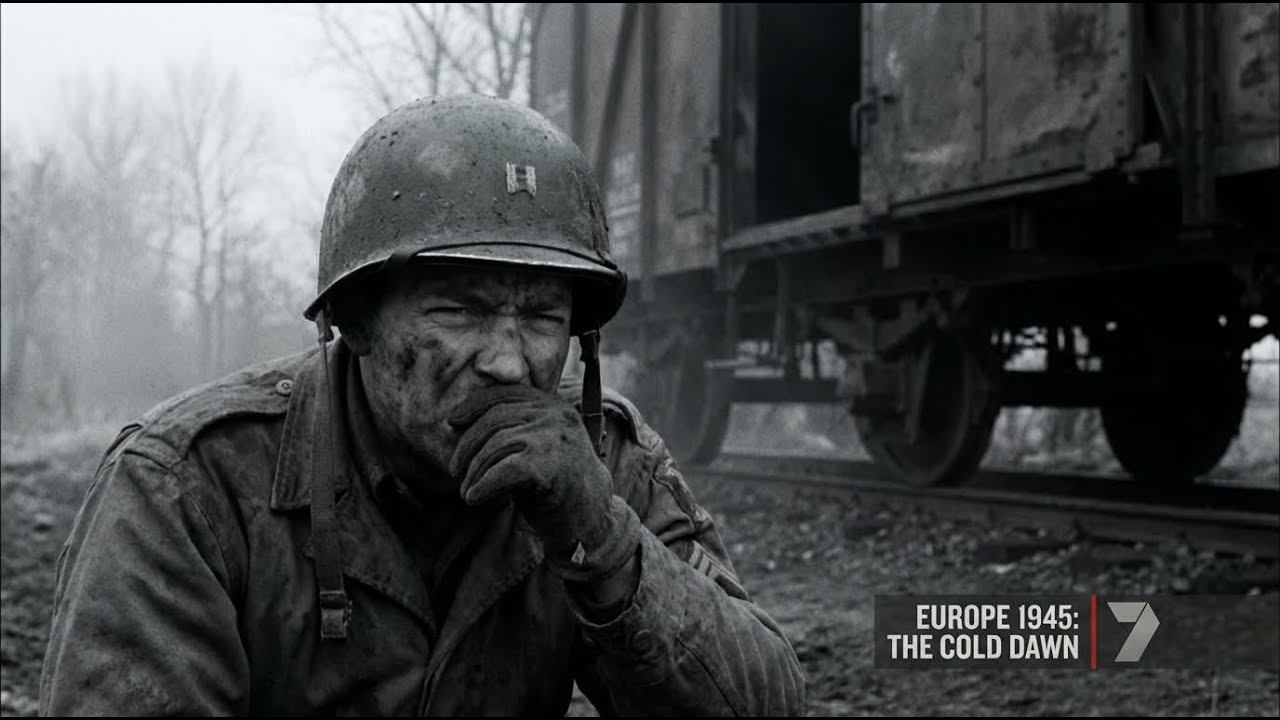 The stench hit them before the sight did. A thick, cloying wave of decay that cut through the crisp spring air, forcing hardened combat veterans to gag and cover their faces with handkerchiefs. Sitting motionless on the tracks was a train.
Thirty-nine cattle cars, rusted and silent, stood as a monument to a journey from hell. A young lieutenant signaled his men forward, their boots crunching loudly on the gravel, a sound that seemed to violate the sacred silence of the dead.
With a gloved hand, a soldier unlatched the heavy iron door of the first car. The sound of metal grinding on metal echoed through the morning mist like a death knell. He slid the door open and looked inside.
For a moment, his brain refused to process the image. Inside were bodies. Thousands of them.
Men, women, and children stacked on top of each other like firewood, tangled in a macabre embrace of death, their limbs intertwined and their eyes staring vacantly at the open door.
These were not soldiers killed in battle. These were skeletons wrapped in skin, stripped of their dignity, their humanity, and finally their lives. As the Americans moved down the line, opening car after car, the scale of the atrocity became impossible to comprehend.
The victims had been passengers on a three-week journey from Buchenwald, crammed into these metal boxes for a trip that was supposed to take 24 hours. Allied air strikes and damaged rails had stretched it to 21 days. Twenty-one days without food.
Twenty-one days without water.
The soldiers noticed details that would haunt them for the rest of their lives. They saw claw marks on the wooden walls where prisoners had tried to scratch their way out. In the corner of one car, the bodies bore jagged bite marks.
The living had been forced to consume the flesh of the dead just to survive another hour. Of the roughly 5,000 people shoved onto that train, nearly half were dead on arrival. The rest were barely clinging to existence, too weak to even cry out for help.
To understand why these soldiers were about to lose their minds, you must understand who was standing on that railroad track. These were the Thunderbirds, a National Guard unit from Oklahoma, Arizona, Colorado, and New Mexico. Many were Native Americans with a warrior heritage running deep in their blood.
They were tired, suffering from severe combat fatigue after fighting for over 500 days. They had fought through Sicily, slogged up the Italian peninsula, invaded southern France, and breached the German border.
They had seen friends blown apart by artillery and endured freezing winters in foxholes. They were professional soldiers who thought they had seen everything war could throw at them. But nothing in those 500 days prepared them for the 39 cattle cars of Dachau.
The transformation happened in real time. A 19-year-old private from Oklahoma, a boy who had stormed machine gun nests without flinching, sat down in the snow and began to weep uncontrollably. Another veteran doubled over and vomited until there was nothing left in his stomach.
As the initial shock wore off, the tears began to dry. In the vacuum left by the sadness, something else rushed in: a cold, shaking, murderous rage. For months, rumors had circulated about the Malmedy massacre, where SS troops had gunned down American prisoners of war during the Battle of the Bulge.
Until today, that was just a story. But looking at the skeletal remains in these boxcars, the soldiers realized the stories were not only true, but they were also an understatement.
The people who did this, the SS guards who locked these doors and let these children starve, were not soldiers. They were not an enemy army entitled to the protections of the Geneva Convention. In the eyes of the Thunderbirds, the SS had forfeited their right to exist.
Lieutenant Colonel Felix Sparks tried to maintain order, shouting at his men to keep moving, to get away from the train. “Don’t look at it,” he yelled. “Just keep moving.”
But you cannot not look. The image of the death train burned itself into their retinas.
Leaving the railroad tracks behind, the soldiers crossed the narrow bridge over the Amper River and approached the main entrance of the complex. They reached the iron gate woven with the infamous phrase “Arbeit macht frei” — work sets you free. To the Americans standing there fresh from the sights of the boxcars, the slogan was a sick joke, a final insult from a regime that had industrialized murder.
The camp was not entirely secure, and the tension was palpable as they moved along the perimeter.
At one of the guard towers, Tower B, a few SS guards were spotted attempting to descend. There was no shout for surrender, no warning shot. The American response was immediate and lethal.
A volley of rifle fire erupted, knocking the guards off the ladder and sending them plunging into the moat below. The soldiers then walked to the edge of the water and emptied their magazines into the floating bodies. It was a clear message: the time for hesitation was over.
But the true breaking point, the moment that sealed the fate of the remaining guards, happened when the camp’s acting commandant made his appearance. With the camp commandant Martin Weiss having fled days earlier, command had fallen to a young SS Obersturmführer named Heinrich Wicker. Wicker was 23 years old.
He knew the war was lost. He knew the Americans were at the gate. But Wicker made a calculation that revealed just how disconnected he was from reality.
He believed that if he followed standard military protocol, he would be treated as an officer and a gentleman.
 Wicker prepared for his big moment. He put on his finest dress uniform, polished his tall black boots until they gleamed like mirrors, and ensured his collar was stiff and his insignia perfectly aligned. He gathered a small entourage and walked out toward the American lines carrying a white flag, projecting an air of arrogant professionalism.
He expected a salute. He expected a formal exchange of pleasantries. He expected to hand over the camp and be escorted to a comfortable officer’s holding area.
What Wicker didn’t understand was that the men he was walking toward had just spent 30 minutes looking at the death train. The confrontation was jarring. On one side stood the American GIs, filthy, unshaven, covered in mud and the grime of battle, their eyes hollowed out by the horrors of the last hour.
On the other side stood Heinrich Wicker, immaculate, smelling of soap and leather, looking like he just stepped out of a propaganda poster. This visual contrast acted as a psychological detonator.
To the Americans, Wicker’s cleanliness was an obscenity. It was proof that while the people in the boxcars were eating their own dead to survive, this man was sleeping in a warm bed, eating hot meals, and polishing his boots. His pristine appearance wasn’t a sign of discipline; it was a confession of his complicity.
An American officer stepped forward to meet him. Wicker began his rehearsed speech, surrendering the camp to the United States Army. He waited for the reciprocal respect due to his rank.
Instead, the American officer looked at the clean, well-fed Nazi, then looked past him toward the piles of emaciated corpses rotting in the sun just yards away. The officer didn’t salute. He spat in the German’s face.
The illusion of a gentleman’s war shattered instantly. Wicker was shoved, struck with the butt of a rifle, and forced into the dirt. The Americans were done with protocol.
They stripped the SS officers of their dignity just as quickly as they had stripped the prisoners of their lives.
As Wicker was dragged away, shouting about the Geneva Convention, the soldiers watching felt a dark consensus forming. They realized that a trial was too good for men like this. A courtroom was too civilized.
The spark that finally ignited the powder keg was struck in a secluded area of the camp known as the coal yard. Here, a group of about 50 SS guards had been rounded up. These were the men who didn’t flee, who had been captured hiding in barracks, pulling off their uniforms or trying to blend in.
They were herded together and marched toward a long brick masonry wall that ran along the edge of the yard. The atmosphere was suffocating. The air was thick with coal dust and the lingering stench of the crematoriums located just a few hundred yards away.
That detail was crucial. Before reaching this wall, many of the American soldiers had passed by the ovens. They had seen the piles of clothes and the human bones still smoldering inside the furnaces.
The heat of the genocide was literally still radiating from the brickwork.
Lieutenant Jack Bushyhead, a Native American officer from Oklahoma, looked at the men lined up against the wall. He wasn’t seeing prisoners of war. He was seeing the monsters who shoveled people into those ovens.
Bushyhead was a Cherokee, a man from a people who knew the history of displacement and suffering. He stood there, his Thompson submachine gun resting in his hands, his knuckles white. He was shaking, not from fear, but from an adrenaline overdose caused by rage.
The Germans, sensing the shift in the atmosphere, began to panic. They realized that the gentleman’s agreement of surrender wasn’t holding. Desperate to save themselves, a few of them threw their hands up and started chanting the only phrase they thought might work: “Hitler kaput.
Hitler kaput.” They thought this magic phrase would absolve them. They thought that by denouncing their leader at the last possible second, they could wash the blood off their hands.
But to the Americans watching, this display was the final insult.
It was cowardly. It was pathetic. It confirmed that these men had no honor.
They were willing to be mass murderers when they were winning, but the moment the tables turned, they became sniveling cowards. A heavy machine gunner, a soldier nicknamed Bird Eye, set up his . 30 caliber machine gun on a tripod facing the wall.
The metallic clack-clack of the bolt being pulled back echoed through the yard. There was no formal order given. No judge read a verdict.
No jury deliberated.
History is still hazy on exactly what happened next. Whether a German moved, whether someone shouted, or whether the tension simply snapped like a dry twig, Lieutenant Bushyhead didn’t stop it. He looked at his men, looked at the Germans, and the dam broke.
Fire. The air erupted. The sound was deafening, a mixture of the heavy rhythmic thumping of the machine gun and the rapid chatter of rifles and Thompsons.
 It was a wall of lead. The shooting lasted for perhaps 10 or 15 seconds.
In the warped time perception of combat, it must have felt like an eternity. The SS guards against the wall danced the macabre jig of death as bullets tore through them. They crumpled into a heap at the base of the wall.
The chanting of “Hitler kaput” was replaced by screams and then by silence. When the smoke cleared, the snow and the black coal dust were stained a bright, violent red. Most of the 50 men were dead.
Others were twitching in the dirt.
Lieutenant Colonel Felix Sparks heard the roar of the machine gun and came running from the center of the camp. He sprinted into the coal yard, seeing his men preparing to fire again into the pile of bodies. “Stop it!”
Sparks screamed, pulling out his service pistol and firing it into the air to break the trance. “What the hell are you doing?” The machine gunner, Bird Eye, looked up at the colonel.
His face was streaked with tears. He wasn’t acting like a cold-blooded killer. He was hysterical.
He was a 19-year-old boy whose mind had been shattered by what he saw in the boxcars. “Colonel,” he sobbed, pointing at the dead SS men. “They tried to get away.”
It was a lie, and they both knew it. They didn’t try to get away. They were executed.
But in that moment, looking at the crying soldier, Sparks realized the terrifying truth of Dachau. These men hadn’t just killed prisoners. They had executed the architects of the death train.
The rules of civilization had been suspended.
While the gunfire at the coal yard echoed off the camp walls, a different kind of violence was erupting in the main compound. The electrified barbed wire fences, which had defined the boundaries of their existence for years, were finally breached. Out of the barracks poured a tide of humanity that defied medical explanation.
These were men who, by all biological rights, should have been dead. They were walking skeletons, their skin translucent, their legs no thicker than broomsticks.
They were starving, typhus-ridden, and weak. But in this moment, they were fueled by a 𝒹𝓇𝓊𝑔 more potent than any ration: pure, unadulterated vengeance. They didn’t have Thompson submachine guns or M1 Garands.
They grabbed shovels used for digging graves. They picked up heavy sticks, rocks, and metal pipes. Some used their bare hands, hands that were nothing more than bone and tendon.
They swarmed over the grounds, hunting for anyone wearing an SS uniform.
In one instance, a German guard was spotted trying to hide near a watchtower. He was quickly surrounded. The prisoners didn’t just attack him.
They tore at him. The rage was absolute. It was the release of years of torture, years of watching their families burn, years of being treated like vermin.
They dragged the guard to the ground and beat him with a ferocity that stunned the American onlookers. This is where the liberator narrative gets complicated.
American soldiers stood by and watched. In some cases, they leaned against jeeps, lighting cigarettes, observing the carnage with a detached, cold interest. When a young private asked his sergeant if they should intervene, if they should stop the prisoners from beating a man to death, the sergeant reportedly shook his head.
“No,” he said. “Let them finish. They’ve earned this.”
There are even accounts verified by veterans years later of American GIs tossing their own bayonets or pistols into the crowd of prisoners.
After seeing the death train, the Americans felt they had no moral authority to deny these victims their retribution. They became spectators in a coliseum of revenge. But the prisoners’ wrath wasn’t reserved solely for the SS.
There was another target, a group arguably hated even more than the Germans: the Kapos. The Kapos were prisoners themselves, often violent criminals or political dissidents who had been recruited by the SS to police their fellow inmates. In exchange for extra food and better clothes, they became the camp’s enforcers.
They beat their own people. They selected their own people for the gas chambers. To the average prisoner, the Kapo was the ultimate traitor.
 Now, with the SS gone, the Kapos were left unprotected. The reckoning was medieval. In one horrifying scene, a group of prisoners cornered a notorious Kapo near the camp latrines.
They didn’t shoot him. They dragged him to the open waste pit and shoved him in. As he struggled to climb out, screaming for mercy, they pushed him back down with poles and shovels.
They held him under the filth until the bubbles stopped rising. For one terrifying hour, Dachau ceased to be a military operation. It became a lawless zone where the hierarchy of predator and prey was violently inverted.
The victims became the judges, the juries, and the executioners. The line between civilization and savagery had vanished completely. Eventually, the madness had to end.
The frenzy of killing burned itself out, replaced by the cold reality of military discipline.
Lieutenant Colonel Felix Sparks, realizing that his men were on the verge of losing their souls alongside their enemies, took decisive action. He rushed back into the chaos, firing his service pistol into the air, the sharp cracks cutting through the noise of the mob. He physically shoved soldiers away from the prisoners, ordering them to lock down the remaining German guards.
Order was restored, but the secret could not be contained. In the days following the liberation, the adrenaline faded and the magnitude of what happened began to sink in.
Photos had been taken. Graphic, undeniable black-and-white photographs of American soldiers standing over piles of executed Germans in the coal yard. The US Army, concerned about the political fallout, launched an immediate investigation.
Lieutenant Colonel Joseph Whitaker led the inquiry. He interviewed the soldiers, collected the testimony, and compiled the photographs. His final report was damning.
It concluded that the men of the 45th Infantry Division violated international law. It recommended courts-martial for the officers involved.
The report moved up the chain of command until it landed on the desk of the most feared and revered man in the European theater: General George S. Patton. Patton was a strict disciplinarian.
He was a man who once slapped a soldier for having shell shock. He fined men for unpolished boots. But when he picked up the Whitaker report, he didn’t just read the legal jargon.
He looked at the attached photographs. He looked at the pictures of the executed SS guards. Then he looked at the pictures of the death train.
He stared at the images of the starving children, the skeletal corpses, the evidence of a crime so vast it defied human language. Patton realized that the law was written for wars between men, not for a war against monsters. He reportedly looked at his staff and dismissed the investigation with a wave of his hand.
“Hell no.” Patton effectively decided these men were overwrought. They had nervous trigger fingers.
It happens in war. In a legendary act of command, Patton refused to sign the courts-martial papers.
Depending on which historical account you believe, he either tore the report up, burned it, or ordered it buried in the deepest, most top-secret clearance file in the Army archives. His logic was simple and brutal. The SS got exactly what they deserved.
He would not destroy the lives of American heroes for killing the architects of hell. The charges were dropped. The investigation was quashed.
Lieutenant Jack Bushyhead, the man who gave the silent order at the wall, returned home to Oklahoma.
He never faced a trial. He melted back into civilian life, becoming a quiet, respected member of the Cherokee Nation. He never spoke publicly about that day in the coal yard.
He took the memory of the smell, the screams, and the gunfire to his grave when he died in 1977. Today, if you visit the Dachau memorial site, you will see monuments honoring the 30,000 victims who suffered and died there. You will see the preserved barracks and the crematoriums, but you will not find a monument for the 50 SS guards who died against the wall.
Their bodies were buried in unmarked graves, unmourned and largely forgotten. History has rendered its verdict. They were the devil.
And on April 29th, 1945, they met their match. But the story of the Dachau reprisals leaves us with a haunting legacy. It forces us to confront the uncomfortable truth that the line between a hero and a killer is thinner than we like to admit.
It reminds us that there is a breaking point for every human being.
Picture yourself back on that railroad track. The air is cold. The smell of death is choking you.
You have just looked inside a cattle car and seen a child who starved to death over 21 days. You turn around and you see the man responsible for it standing there in a clean uniform, smiling, asking for your respect. Be honest with yourself in that moment with a rifle in your hand.
Would you remain a professional soldier, or would you become an avenger?