In 1885, a 22-year-old woman challenged a famous gunslinger to a duel in the middle of the street. She won, and he died. Her name has been largely forgotten, and according to historians, that erasure was deliberate. The Old West is typically remembered through stories of male outlaws, sheriffs, and cowboys.
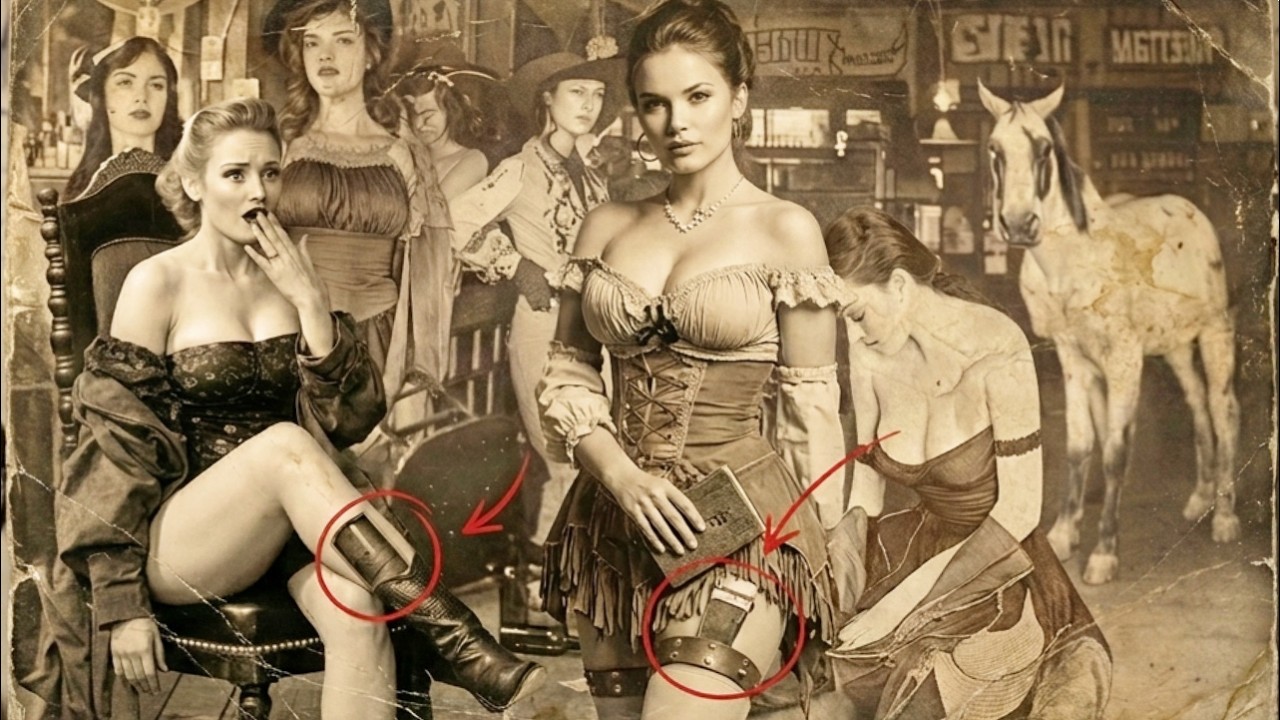
But archival records, store ledgers, and court documents tell a different story. Women owned saloons that controlled entire towns, ran successful businesses, and carried weapons as routinely as men did. Store records from Dodge City and Tombstone show that women bought revolvers almost as often as men. Small derringers were commonly hidden in purses and corsets.
In isolated areas where law enforcement barely existed, knowing how to shoot was a matter of survival, and many women were better marksmen than their husbands. The women who owned saloons often wielded more real power than the sheriff. These establishments were where men spent money, made deals, and discussed politics. The women in charge heard everything, controlled the flow of money and information, and were courted by politicians before elections.
History books often dismissed women in the sex trade with a single label. In reality, many owned properties, lent money at high interest, and accumulated significant wealth. Some helped fund schools and churches in the same towns that publicly condemned them, while the most influential men in those communities had little interest in publicizing that part of the story. Annie Oakley is often presented as the only female sharpshooter of the era, but she was far from alone.
Lillian Smith joined Buffalo Bill’s show at 15 and competed directly with Oakley. Many other women entered official shooting competitions and beat experienced men. Wild West show promoters recruited female sharpshooters because audiences paid to see what they believed was impossible. Some women went beyond competition and crossed into outlaw territory.
Pearl Hart carried out the last stagecoach robbery in American history in Arizona in 1899. She cut her hair, dressed as a man, and took $430 from passengers with a . 38 revolver. The press coverage focused less on the crime than on the fact that a woman had committed it.
At her trial, she said no man had the right to judge her because women could not vote. She was sentenced to five years but served only a year and a half. The official reason given was that prison was no proper place for a lady. Horse thief Flora Quick operated in Indian Territory, wearing men’s clothing and changing routes so often that no posse could catch her.
She repeatedly escaped custody, making local lawmen look inept. Records indicate she had a network of contacts across the territory who helped hide horses and throw off pursuers. Belle Starr led men who were outlaws, ran a horse-stealing network, hid fugitives, and was said to have connections to Jesse James. She married Sam Starr, a Cherokee, and together they became one of the most wanted couples in Indian Territory.
In February 1889, two days before her 41st birthday, she was shot in the back on a dirt road near her ranch. No one was ever convicted, and the main suspect was her own son. It remains one of the Old West’s oldest cold cases. Laura Bullion was the only woman accepted into Butch Cassidy’s Wild Bunch.
She took part in train robberies and passed counterfeit money before being arrested in 1901. After her release in 1905, she lived quietly and died in 1961, having survived two world wars and lived to see the beginning of the space age. Etta Place appeared alongside the Sundance Kid, traveled with him and Butch Cassidy to Argentina, and helped with bank robberies there. After 1906, she vanished completely.
No death certificate, grave, or record of her exists. Some claim she returned to the United States under a false name; others believe she died in Patagonia. Her fate remains unknown. Some women violated the era’s gender rules entirely.
Charley Parkhurst was one of the most respected stagecoach drivers in California, known for drinking, smoking cigars, and facing down bandits. In 1868, he voted in a presidential election, something no woman could legally do. When he died in 1879, the examining doctor discovered that the person the town had known for decades was actually Charlotte. It was also discovered that Charlotte had given birth at some point, leaving a hidden story that will never be known.
Mountain Charley was Elsa Jane Guerin, a 15-year-old widow who cut her hair, put on men’s clothing, and worked in mines and drove mule teams for 13 years without being discovered. She published an autobiography in 1861, but society largely ignored it. The book was forgotten for decades, not because it was false, but because it was too true for comfortable reading. Lozen, sister of Apache Chief Victorio, fought in real battles against the United States Army.
Apache warriors said she had an almost supernatural ability to sense enemies before any scout could. She never married and refused domestic roles. After Victorio was killed, she fought alongside Geronimo until she was captured and sent to Florida, where she died of tuberculosis. American history books made little mention of her for decades.
Frontier records contain dozens of cases of women living as men. Some were only discovered when doctors prepared bodies for burial; others were never discovered. Mountain Charley fought in the Civil War undetected, and Little Joe Monahan worked on ranches in Idaho for years. The rules of that society were so restrictive that some women concluded the only way to have freedom was to give up their own identity.
Mary Fields stood over six feet tall, smoked cigars, and carried a revolver and a rifle. She was the first Black woman to work for the U. S. Postal Service, delivering mail on one of the most dangerous routes in Montana.
When her horses froze to death in a blizzard, she carried the mail sacks over her shoulders and walked miles in the dark rather than miss a delivery. She became known as Stagecoach Mary, a nickname based on a reputation that reportedly intimidated even sheriffs. Nellie Cashman made real money in mining in Alaska and Arizona at a time when women could barely open bank accounts. She invested in mines, ran restaurants, and paid for hospitals out of her own pocket.
When journalists asked why she never married, her answer was always the same: she did not have time for a husband. She died at 73, single, wealthy, and independent. Ah Toy arrived in San Francisco in 1849 during the Gold Rush. A Chinese woman alone in a city of miners and outlaws, she built one of the most profitable businesses in the city and became one of the richest women in California.
She personally went to court to fight for her rights at a time when Chinese immigrants could not even testify against white people under state law. She was sued and threatened but refused to back down. Alice Ivers was born in England and studied to become a teacher before her husband died in the Old West. She discovered a talent for poker, and in Deadwood she dominated tables full of men while keeping a .
38 revolver in her lap. She never played on Sundays, but from Monday to Saturday she routinely won what would amount to hundreds of thousands of dollars today. She became known as Poker Alice. Gertrudis Barcelo, known as Doña Tules, ran the biggest gambling house in Santa Fe.
Politicians, military officers, and merchants passed through her establishment, and she knew their secrets. When the American army invaded New Mexico in 1846, they went to negotiate with her, not the governor, because everyone knew who really ran the town. She financed campaigns and decided who rose and fell in local politics. After her death, the American press largely reduced her to a stereotype, erasing her political and economic power.
Sally Skull traded horses in South Texas, spoke fluent Spanish, and shot better than most men in the region. She was married five times, and two of her husbands died under circumstances that were never explained. No sheriff ever opened an investigation. Her fifth husband disappeared with her in the 1860s, and neither was ever seen again.
Martha Jane Canary, known as Calamity Jane, worked as a military scout and drank heavily. Hollywood turned her into a romantic heroine and invented a love affair with Wild Bill Hickok that likely never happened as portrayed. She spent her last years in poverty, struggling with alcoholism and performing in cheap circus shows. She died practically forgotten in a boardinghouse in Deadwood.
In 1851, a Mexican woman named Josefa Segovia was living in Downieville, California, when a drunk miner kicked in her door. She defended herself with a knife and killed him. The next day, a makeshift court was assembled in the town square with no lawyer, no real jury, and no genuine chance to defend herself. She was hanged that same afternoon in front of a crowd of 2,000 men.
She is considered the first woman executed by lynching in California. In the late 1800s, a woman ran a theft and fencing operation in the heart of Dallas. Records from the time called her the Bandit Queen. She coordinated thieves and handled stolen goods for years without being caught, largely because police could not accept that a woman was in charge.
Investigators followed leads that pointed directly to her and dismissed them. Her operation rivaled any male gang in the region. The 20th-century publishing and film industries rewrote the Old West deliberately. Editors and screenwriters made a conscious choice to portray women as damsels, prostitutes, or background characters.
Manuscripts with female leads were rejected, biographies were rewritten, and the achievements of women who ran ranches and led businesses were cut down to footnotes. The erasure was not forgetfulness but a systematic editorial decision. Thousands of records of armed women in the Old West exist in museum and university archives. Rifles, revolvers, and documented histories are all there.
But when images did appear, captions often read merely “Rancher’s wife” or “Unidentified woman,” stripping names and stories away. Curators and editors decided these women were not worth remembering for their own actions, only for the men beside them. Pearl Hart, who carried out that final stagecoach robbery in 1899, told the jury at her trial that no man had the right to deny freedom to a woman. The jury acquitted her.
The judge, reportedly furious, found another charge to keep her locked up. In jail she became a national sensation, and after her release she disappeared completely, her final whereabouts and the date of her death unknown. Billy the Kid became a legend taught in schools, while Pearl Hart’s name was deliberately left out of the record.