The public knew her as the “poor little rich girl,” the seven-times bride, the dollar princess who danced in diamonds while America starved. But long before the headlines turned cruel, Barbara Hutton was a lonely child in a gilded cage, born into one of the greatest fortunes in American history and starved of the one thing money could not buy: love. Barbara was born in New York on November 14, 1912, the only child of Edna Woolworth and Franklin Hutton. Her grandfather, Frank Winfield Woolworth, had built a retail empire of five-and-ten-cent stores that made the family name synonymous with wealth.
Her mother, the prettiest of the three Woolworth daughters, was shy and solitary. Her father was a restless, hard-drinking Wall Street broker who chased women with a compulsion that strained the marriage to its breaking point. When Barbara was just four years old, her mother died under circumstances the family tried to bury. The official explanation was mastoiditis, but the police and nearly everyone else believed Edna had taken her own life.
Barbara was the one who found her. The coroner’s files later went missing, and it was widely assumed that Frank Woolworth had paid to keep the matter quiet. After her mother’s death, Barbara was sent to live with her grandparents at Winfield Hall, a 60-room marble palace on Long Island. Meals were eaten in silence.
Her grandmother, once a seamstress from a poor Canadian family, sat all day in a rocking chair, catatonic and unrecognizing. Her grandfather, paranoid and melancholic, played his pipe organ for hours until the walls seemed to shake. Barbara found refuge only in her playroom, with its velvet-backed rocking horse and a four-foot-tall dollhouse fitted with crystal chandeliers and a brass nameplate engraved with her name. Frank Woolworth died in 1919.
When her grandmother died in 1924, the estate was divided among three heirs. At 11 years old, Barbara inherited more than $26 million, adjusted for inflation, making her one of the richest children in the world. She was not yet a teenager and already belonged to no one. She was passed from relative to relative, from California to New York, raised by nannies, governesses, and tutors.
Her father appeared like a storm, violent and unpredictable. At a Christmas Eve dinner, he stood up mid-meal and drunkenly declared he had never wanted a child. One acquaintance remembered that nothing she did pleased him. She was scared to death of him, wanted to impress him, and hated his guts.
At school, she was mocked for her expensive clothes and her silence. Her diary from her teenage years reveals a girl consumed by fear of rejection. “I long for a friend,” she wrote. “Somebody to understand me and intimate with whom to share my innermost thoughts and terrors.
Deep down I feel inadequate. I am ugly, fat, awkward. I shall be an old maid. Nobody can ever love me.
For my money, yes, but not for me. ”
Her debut in 1930 was a three-act spectacle: a tea for 500, dinner and dancing for another 500, and a formal ball at the Ritz-Carlton with a thousand guests, four orchestras, 10,000 roses, and 2,000 bottles of champagne, prohibition notwithstanding. A ballroom ceiling was draped in blue gauze to mimic the night sky, complete with an artificial moon and stars. Maurice Chevalier greeted guests dressed as Santa Claus.
Yet even there, under diamonds and moonlight, Barbara noticed how people looked at her, not with affection, but with calculation. She began calling herself the “plague princess. ”
Her first marriage, to Prince Alexis Mdivani in 1933, was a disaster from the start. Alexis, a Russian exile whose nobility was largely imagined, proposed after a scandalous affair that broke up his marriage.
Barbara’s father fought the union, but she petitioned the court to be declared a legal adult at 19 and got her way. On their wedding night, Alexis told her she was too fat. She was five-foot-four and weighed 148 pounds. By morning, she had begun what she called her “Gandhi diet”: three cups of coffee a day, cigarettes, and no food.
The marriage collapsed within years. Alexis spent her money freely, and the couple drifted apart. When they finally divorced, the newspapers ran a single line: “The prince is dead. Long live the count.
”
Barbara married Count Kurt Reventlow in 1935, days after the divorce was final. He was a Danish aristocrat, a decorated war veteran who believed in work, sobriety, and control. But the marriage turned cruel. He micromanaged her life, struck her when he found letters from another man, and forced her to watch a degrading show at a Parisian club before assaulting her in their hotel suite.
She fled to London and filed a complaint. A warrant was issued. Facing scandal, she dropped the charges. “I don’t want a scandal,” she said.
“I want quiet. ”
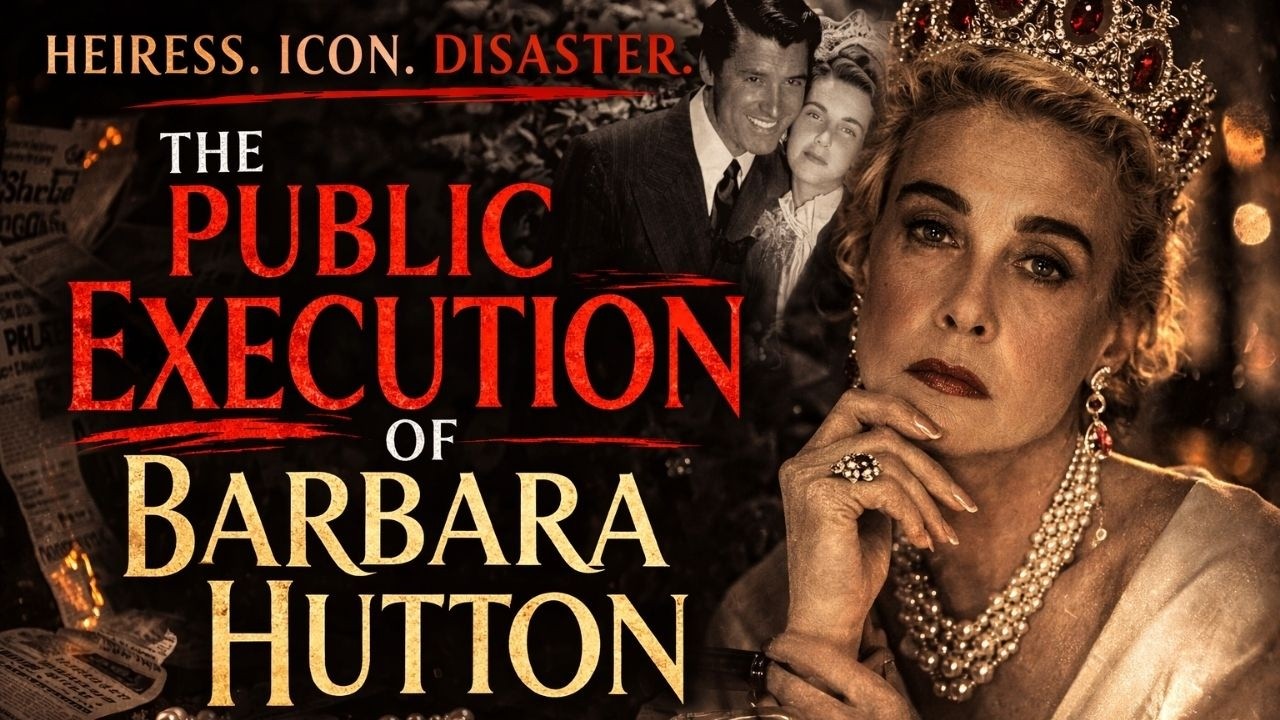
Her third marriage, to the actor Cary Grant in 1942, seemed like a chance at stability. Grant signed a waiver forfeiting any claim to her wealth. But the marriage soured over her spending and his obsessive frugality.
He counted Cokes in the pantry and clipped buttons from discarded shirts. They slept in different rooms and dined at different times. It ended in divorce in 1945. Her fourth husband, Prince Igor Troubetzkoy, lasted from 1947 to 1951.
She had hoped to find peace, but she was already slipping into a cycle of pills, drinking, and sleeplessness. She collapsed, underwent surgery to remove ovarian tumors, and woke believing the doctors had betrayed her by leaving her unable to have more children. She described herself as a hollow sea shell washed ashore, a trinket to amuse, then discard. Her fifth marriage, to the Dominican playboy Porfirio Rubirosa in 1953, lasted just 53 days.
He demanded $2 million paid on the day of the marriage. She agreed. When they separated a few weeks later, he had taken millions in cash and gifts. “I feel as though I’ve been hit over the head,” she said afterward.
“I’ve only just begun to realize what happened. ”
Her sixth husband, Baron Gottfried von Cramm, a German tennis star who had once opposed Hitler and been imprisoned for it, married her in 1955. Barbara insisted she had waited 18 years for him. “No more lonely nights,” she said.
The marriage was never consummated and ended in 1959. Her seventh and final husband, Prince Pierre Doan, was bought a title for $50,000. They married in 1964. He wore robes, called himself a mystic, and was known to her staff as “the chimpanzee.
” The marriage ended in separation, with a $3 million payout. Throughout her life, Barbara’s son Lance was her anchor. She fought bitter custody battles with Reventlow across continents. At one point, she cut off Lance’s trust funds after a bitter clash.
She later mourned, “I was a bad mother. I failed him. ” On July 4, 1972, Lance, then playing polo, racing cars, and flying planes, died when a private plane crashed into a mountainside. Barbara refused to believe it.
She spoke of him in the present tense, as if death were a lie she could outlast. The final years were a long decline. She believed the hotel was bugged, that agents were watching her, that her lawyer was plotting to dispose of her. She heard sobbing in the closet and made staff open the door again and again, though it was always empty.
She stopped eating, stopped changing clothes, stopped sleeping. She lined her windows with aluminum foil because bright light hurt her eyes. Mirrors were covered. She could no longer bear her reflection.
Her fortune had been drained by decades of spending and by trusted advisors who stole from her. Her lawyer, Graham Madison, had been siphoning money for years. By the end, he had five homes and two Rolls-Royces while Barbara drifted through hotel corridors, paying men $1,000 a night just to sit beside her and talk. On March 26, 1979, she was admitted to Cedars-Sinai hospital.
She was skeletal. She refused intravenous drips and tore needles from her arms. One afternoon she muttered, “It takes so damn long. ” When someone asked what, she said, “Dying,” and turned away.
When Madison visited to speak of finances, she told him, “I think you’re the biggest piece of [con artist] I’ve ever met. Now get out of here and let me die in peace. ”
She died on May 11, 1979, at the age of 66. The headlines called it what it had always been: a tragedy.
Her funeral was held at Woodlawn Memorial Cemetery in the Bronx. Ten people attended. There was no priest. A single poem was read.
She was buried beside her mother and beside her son.