In the summer of 1968, a 24-year-old fire lookout named Corbin Mayhew vanished from a remote tower in Washington’s Olympic National Forest. Despite a weeks-long search by rangers and dogs, no trace of him was ever found—not a boot, not a coat, not a single bone. For 40 years, Owen Brandt, the fire control officer who hired Mayhew, carried the young man’s logbook. It documents a slow, methodical psychological erosion and a series of four rules broken one by one.
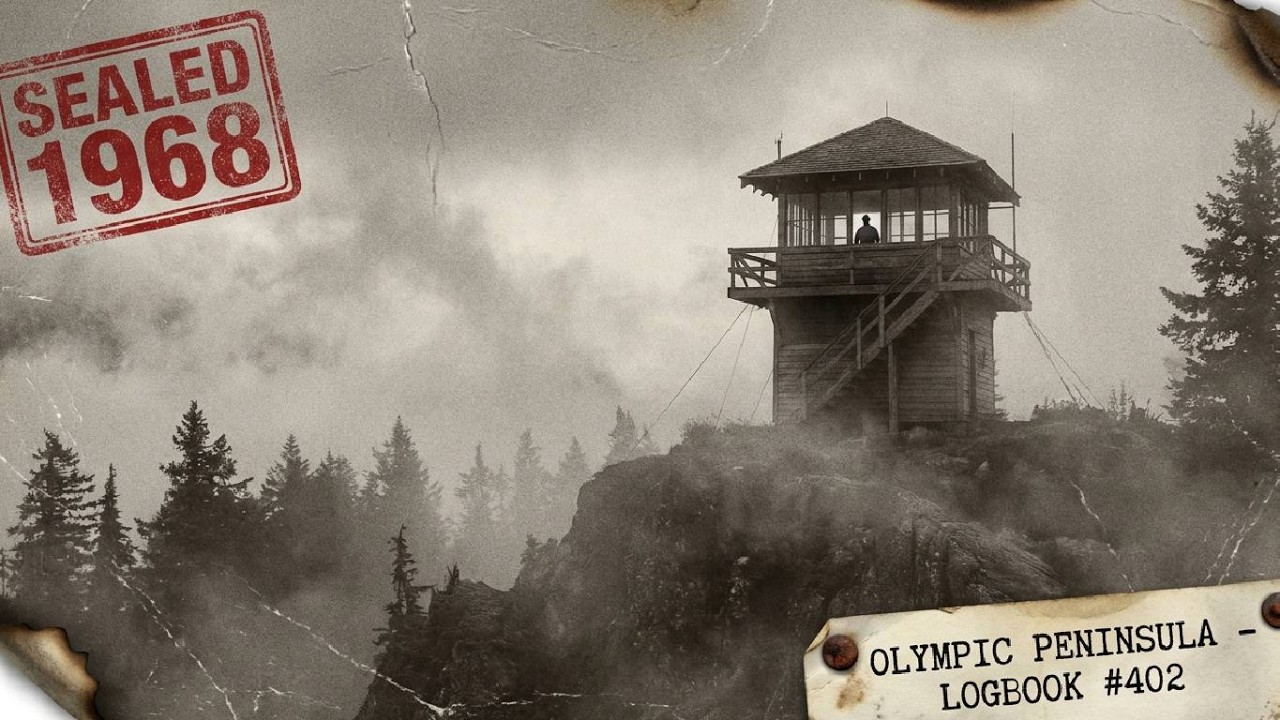
The rules, passed down among lookouts at that specific station and written in pencil on the first page of the logbook, were stark: Do not look after dark. Do not answer the radio. Do not go to it. Do not leave the tower.
Brandt writes that he always considered the rules an old-timer’s superstition. He read them to new lookouts like a ghost story, half-joking. He no longer finds them funny. Iver Solberg, the veteran lookout who wrote the rules years earlier, had based them on warnings from Lawrence Samson, an older Klickitat man who said the high, lonely places were not empty, and that whatever lived there had always been drawn to people who were alone.
Its only weakness was that it could not enter unless invited. Mayhew spent his first weeks alone in the tower recording ordinary weather reports and spotting the occasional fire. According to his logbook, the isolation began to change him by early July. He started talking aloud to hear a voice, and was disturbed by the sound of his own words.
On the night of July 9th, Mayhew wrote that he saw a light in the trees to the northeast, in an area where the map showed nothing at all. Over the following nights, he saw it again, convincing himself it was another lookout, a friendly neighbor across the dark. On the night of July 12th, he broke the first rule. He used the fire finder—a precision instrument intended for locating daytime smokes—to look at the light after dark.
Through the lens, he did not see a window. He described a tall figure standing where no human could stand, holding up a light. He wrote that it was already looking back along the line at him, waiting in the crosshairs for him, as if it knew he would look. A week later, he broke the second rule.
The radio, normally dead after the station closed each night, began emitting bursts of static. For four nights, he resisted. On the fifth, he heard a calm, friendly voice speak his name and ask if he was there. It told him it was a long night.
Mayhew, starved for human contact, keyed the microphone and answered with a simple “Hello. ”
According to the logbook, the night conversations became the center of his existence. He described the voice as the best company he had all summer, a friend who understood his loneliness better than anyone at the station ever could. He stopped recording what the voice said back to him, only his side of the conversations.
In late August, he noticed the third rule’s target: a thin curl of smoke at dusk, low in the trees to the northeast, gone by morning. He ignored it for a few days, but the voice on the radio had begun asking him to come and sit by its fire, just once. On the last week of August, Mayhew fixed the bearing of the dusk smoke and wrote the number down, just as he would a real fire. He did not go down that night.
He wrote that he wanted to, asking God for help, but wrote “not yet” as if making a promise. The logbook entries from his final days indicate the smoke moved a little closer to the tower each dusk, as if his friend were patiently moving the campfire to shorten his walk. By the end of August, Mayhew had stopped latching the tower door. His final entry, dated August 30th, 1968, was written in a steady hand.
He wrote that his friend was at the bottom of the stairs, that he had made him wait in the cold long enough, and that no one should have to be as alone as he had been. He ended the entry with three incomplete words: “I am not” followed by “I am not” and a full stop, leaving the sentence unfinished. He went down the stairs. He was never seen again.
Brandt found the door standing open two days later, Mayhew’s boots and coat missing, the lamp burned dry, and the logbook open to that last page. A search of the steep, dense rainforest found nothing. Brandt later learned from Solberg that two previous first-season lookouts had vanished from that same tower under similar circumstances, which is why the rules existed. Solberg had begged the district not to send another untrained young man there alone, but he was overruled by Brandt, who hired Mayhew.
Mayhew’s official radio reports during his final days were calm and correct. The dispatcher, Hazel, later admitted that twice in August, long after the station had closed, she returned late at night to find the base radio lit up with incoming transmissions from Mayhew’s tower on a dead channel. She never answered, and she was the only one connected to the station who kept the rule. Brandt concludes that the danger was not a monster that terrifies, but a patient presence that offers comfort, waiting for a lonely person to open the door themselves.
He warns those listening: if something in the dark knows your name and asks you politely to come outside, do not answer it, and wait for the daylight.