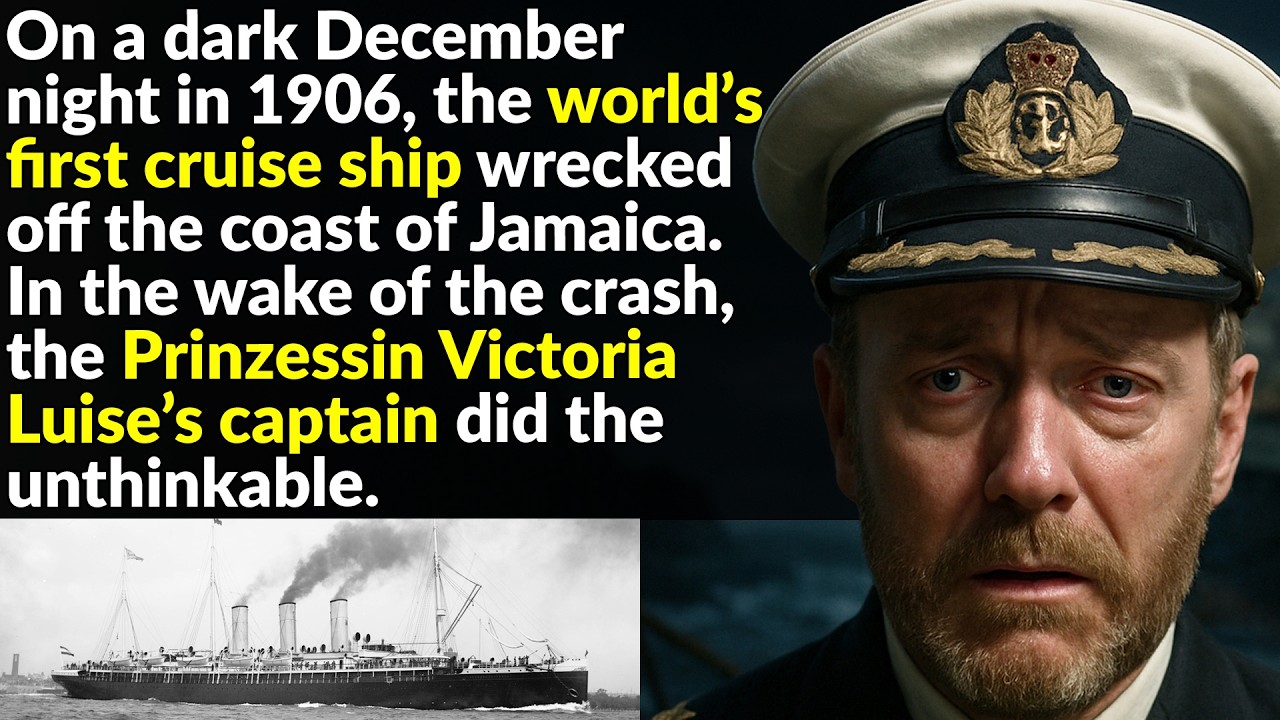
The first cruise ship ever built also became the first cruise ship disaster. On December 16, 1906, the SS Prinzessin Victoria Luise ran aground off the coast of Jamaica, ending the promising career of a vessel that had launched the modern cruise industry. But the tragedy was made even more haunting by what its captain did in the aftermath. The ship was the vision of Albert Ballin, a managing director at the Hamburg-America Line (Hapag).
In the early 1890s, Ballin noticed that Hapag’s transatlantic business slowed during winter months, leaving many of its ocean liners idle. In 1891, he tested a new idea by sending one of the company’s liners, the Augusta Victoria, on a 58-day Mediterranean cruise. The voyage was a commercial success, but it also revealed a problem: the ship was built for crossing the cold Atlantic, not for leisurely vacations. Ballin concluded that a vessel designed specifically for cruising was needed.
He commissioned the Hamburg shipbuilder Blohm & Voss to construct the world’s first purpose-built cruise ship. Named after Princess Victoria Louise of Prussia, the only daughter of Kaiser Wilhelm II, the ship was relatively small by ocean liner standards. It measured about 401 feet in length with a gross registered tonnage of roughly 4,500. It could carry 200 first-class passengers and 161 crew members, a ratio designed for attentive service.
The interiors reflected Ballin’s ambition to rival Europe’s finest hotels. Amenities included opulent staterooms, a ballroom, a social hall, a smoking room, a gymnasium, a library, and an art gallery. The ship was painted white and designed with a sleek profile intended to resemble a private yacht rather than a commercial liner. There were no steerage passengers and no cargo aboard.
This was a vessel strictly for the elite. The original plan called for an ambitious 135-day maiden voyage from Hamburg to San Francisco, with stops at exotic destinations and a passage around Cape Horn. Shipyard delays, rumored to have been caused by labor issues, forced the company to scrap that itinerary. Instead, the ship departed Hamburg on December 5, 1900, making stops in France and Plymouth, England, before crossing the Atlantic to Hoboken, New Jersey.
From Hoboken, the ship began its first cruise, a 35-day voyage around the West Indies. Stops included Port-au-Prince, Santo Domingo, San Juan, St. Thomas, Port of Spain, Kingston, and Havana. A sample menu from the maiden voyage featured delicacies such as roast turkey and green turtle ragout.
Tickets ranged from $75 to $175, the equivalent of roughly $2,300 to $5,400 today, making the experience accessible only to the wealthy. The first cruise was completed successfully on March 2, 1901. A week later, the ship sailed again, this time for a Mediterranean and Black Sea voyage. The vessel quickly became a symbol of German engineering and luxury, earning admiration from Kaiser Wilhelm II.
Hapag continued expanding its offerings, adding winter cruises from Hoboken to the Caribbean and summer voyages from Hamburg to Arctic and Baltic destinations. The company even planned a 1904–1905 world cruise that would take passengers through the Suez Canal and onward to India, Asia, and San Francisco. The ship’s success, however, did not protect it from catastrophe. On the evening of December 12, 1906, the Prinzessin Victoria Luise departed from Hoboken bound for Jamaica under the command of Captain Henrik Brunswig.
The voyage was mostly uneventful until the night of December 16, when the ship neared Jamaica’s southern coast. A dense fog limited visibility, winds picked up, and the seas grew rough. Still, the officers kept to their course, relying on charts and lighthouses. The problem was that the charts were outdated.
Seismic activity in the region over several months had changed local water levels, and the nautical maps had not been updated to reflect the shifts in depth. In the fog, Captain Brunswig mistook the Plumb Point Lighthouse at the eastern end of the island for the beacon marking the entrance to Port Royal, Jamaica’s main harbor. Acting on that mistaken identification, he steered the vessel toward it at full speed. The ship ran hard aground on a reef just off the coast.
The hull shuddered on impact, and the engines were quickly cut. Passengers were initially told the ship had suffered a mechanical malfunction and that there was no cause for alarm. The officers and crew, however, understood the gravity of the situation. Captain Brunswig, overwhelmed by the weight of his error, retreated to his quarters.
By the early hours of December 17, he had taken his own life. His death went unnoticed by the passengers, who spent the rest of the night aboard the stranded vessel, uneasy from the rocking waves and the sound of water against the hull. At dawn, a rescue operation began. Crew members formed a line of small boats to ferry passengers to shore, and all passengers were safely evacuated.
The ship itself was beyond saving. Salvage efforts were hampered by storms and rough seas, which caused the vessel to list and take on water. By December 19, Hapag declared the ship a total loss. Maritime courts in Hamburg later found Captain Brunswig guilty of negligence.
Officials cited his failure to reduce speed in the fog and his misjudgment of the lighthouse’s location. The exact death toll of the disaster was never fully documented, adding a layer of uncertainty to the tragedy. The loss of the Prinzessin Victoria Luise foreshadowed a series of maritime disasters that would soon shake public confidence in sea travel. The Titanic sank in 1912, and the Lusitania was lost in 1915.
These events, combined with the disruptions of World War I, set back the cruise industry for decades. Ocean liners were repurposed for military use or eventually overshadowed by the rise of air travel. Cruising did not regain its former popularity until the mid-20th century. A revival was fueled in part by cultural influences, including the television series “The Love Boat,” which aired in the late 1970s and early 1980s and romanticized life at sea.
Today, modern mega-liners such as Royal Caribbean’s Wonder of the Seas carry more than 7,000 passengers and crew, offering amenities that would have been unimaginable at the turn of the 20th century. Those vast ships owe their existence to the pioneering vessel that came before them — and to the bold vision that ended in tragedy just five years after the ship first set sail.