The children of Heinrich Müller inherited something more elusive than guilt. They inherited uncertainty, a peculiar form of torment that would define their entire lives.
Their father was known as Gestapo Müller to distinguish him from another SS general with the same common name. He was the last chief of Nazi Germany’s secret state police, and he was one of the most wanted war criminals never captured.
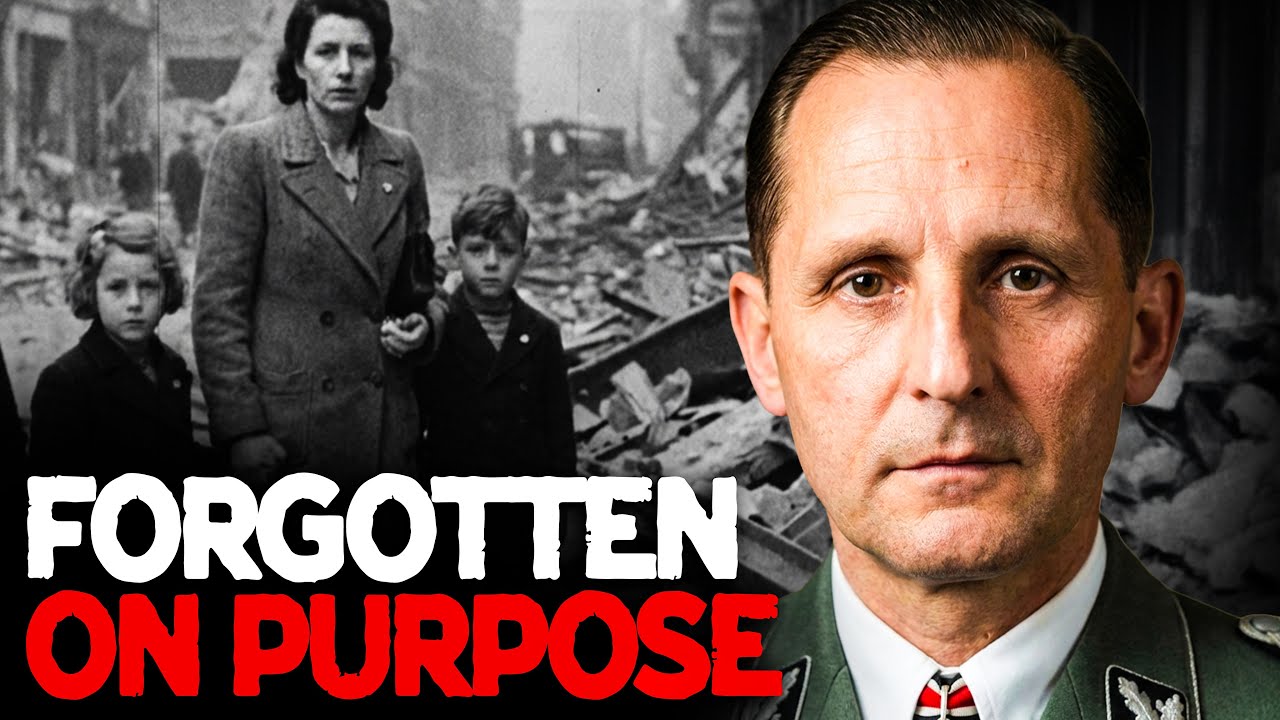 Unlike the families of Heydrich, Speer, or Dönitz, who at least knew their father’s fate with certainty, Müller’s widow and children faced decades of speculation, false sightings, conspiracy theories, and the slow erosion of hope that accompanies an unsolved disappearance.
They lived in a peculiar limbo, neither widowed nor abandoned, neither orphaned nor reunited, forever waiting for a resolution that never came. The silence surrounding their fate has become as profound as the mystery of the man himself.
Heinrich Müller married Sophie Dischner on July 17th, 1924, when both were 24 years old. Sophie came from a respectable Munich family. Her father, Otto Dischner, owned a publishing company and edited the Voralbo newspaper in the Munich suburb of Pasing.
It was a solid middle-class marriage between a young policeman with ambitions and the daughter of a businessman. They had two children, a son, Reinhardt Müller, born March 4th, 1927, and a daughter Elizabeth Müller, born September 30th, 1936.
The marriage began to fracture after Elizabeth’s birth. The daughter was born with Down syndrome, a condition that in the late 1930s Germany carried particular stigma under the Nazi regime that Müller served.
The regime he helped build classified people with disabilities as life unworthy of life and subjected them to forced sterilization and eventually systematic murder under the T4 euthanasia program. Between 1939 and 1945, the regime murdered an estimated 200,000 to 300,000 disabled people, including thousands of children.
Müller, who ordered mass killings as routinely as other men signed routine paperwork, came home to a daughter whom his own government deemed defective. How did he reconcile this contradiction?
Did he arrange special protection for Elizabeth? Did he simply compartmentalize, keeping his professional and private lives so separate that he never confronted the inconsistency? Or did Elizabeth’s existence gnaw at him, creating a cognitive dissonance he resolved by distancing himself from his family entirely?
The historical record offers no answers. What is known is that by the late 1930s, Heinrich and Sophie were living essentially separate lives, remaining married in name but emotionally and often physically apart.
The emotional coldness appears to have predated Elizabeth’s birth. Müller was a man consumed by work, driven by ambition, dedicated to duty regardless of duty’s content. He joined the Bavarian police in 1919 after serving as a decorated World War I pilot, specializing in surveillance of communists.
He was politically flexible. He had actually advocated using force against the Nazis during their 1933 takeover of Bavaria. But his opposition was professional rather than moral, the reaction of a policeman to disorder rather than a citizen to injustice.
When the Nazis consolidated power, Müller’s expertise in communist networks made him valuable. Reinhard Heydrich recruited him in 1934, bringing him to Berlin as part of the so-called Bavarian Brigade that helped establish Gestapo dominance.
Müller rose rapidly, not through ideological commitment but through ruthless competence. A 1937 Nazi party evaluation noted he had never been a party member and had never actively supported Nazi organizations. He did not join the party until 1939, and even then, primarily to advance his career.
Colleagues described him as a bureaucratic technician, a man in love with files and regulations and the machinery of power. He approached deportations and executions as administrative problems to be solved efficiently.
This quality, the utter absence of moral consideration in his work, made him extraordinarily effective and extraordinarily dangerous. For Sophie and the children, this meant living with a man who existed more as an official than as a husband or father.
Reinhardt remembered a stern figure who appeared occasionally, spoke of discipline and obedience, then disappeared back to Berlin. The boy was named after Reinhard Heydrich, Müller’s superior and patron, a naming choice that reveals much about where Müller’s loyalties lay.
When young Reinhardt asked about his father’s work, what answers did he receive? When Elizabeth, as she grew older within the limits of her disability, sensed her father’s discomfort with her presence, did anyone explain why?
The silence in the historical record suggests these questions were never satisfactorily answered, perhaps never directly addressed. Müller had a mistress, Anna Schmid, a railway official whom he saw regularly in Berlin.
The relationship was known to colleagues, tolerated in the way that powerful men’s indiscretions were tolerated in that world. Sophie remained in Munich with the children, while Heinrich devoted himself entirely to his work, the relentless, meticulous, utterly conscienceless work of running the Gestapo.
He attended the Wannsee Conference in January 1942 where the administrative machinery of the Holocaust was finalized. He signed orders sending tens of thousands to death. He authorized torture, ordered executions, pursued resistance members with methodical brutality.
He was, in the assessment of historians, a functionary motivated less by ideological fervor than by ambition and a belief in serving the state regardless of the state’s moral character. His family barely knew him.
Reinhardt was 10 when the war began. Elizabeth only three. Their father was an absence punctuated by brief visits, a stern figure who spoke of duty and discipline when he spoke at all.
He never took vacations, never relaxed, never seemed to exist outside his function as Gestapo chief. For the children, especially Reinhardt, this absence defined their experience of fatherhood, not cruelty or affection, but simply a void where a parent should have been.
As Berlin collapsed in late April 1945, Heinrich Müller was still at his post. Witnesses saw him in the Führerbunker on April 29th, 1945, the day before Hitler’s suicide, still interrogating suspects, still working.
He was seen again on the evening of May 1st, 1945. Hitler’s pilot, Hans Baur, later reported that Müller said he knew Russian methods too well to allow himself to be captured alive. Another witness quoted him saying that the regime has fallen and so have I.
After that, nothing. Heinrich Müller vanished into the chaos of burning Berlin as completely as if the earth had swallowed him. In Pasing, Sophie and the children waited.
Pasing was in the American occupation zone, and American investigators immediately began searching for Müller, one of the most wanted Nazi fugitives. The search was complicated from the start.
Heinrich Müller was one of the most common name combinations in Germany, the German equivalent of John Smith in America. Hundreds of Heinrich Müllers were investigated, detained, questioned.
Every unidentified body found in the ruins had to be checked against Müller’s description. Every prisoner in Allied hands with a similar name or appearance became a potential lead. Sophie was questioned repeatedly.
 American investigators searched the house in Pasing, examined correspondence, interviewed neighbors. She insisted she knew nothing of her husband’s whereabouts and had received no contact since before Berlin fell.
Was this true? Almost certainly. Müller had been in Berlin during the final siege while his family remained in Bavaria.
Communication between Berlin and the outside world had collapsed by late April.
Even if Müller had survived and escaped, reaching out to Sophie would have been extraordinarily risky and likely to lead investigators directly to him. But investigators could not be certain.
Sophie’s position was uniquely difficult. She was simultaneously suspected of hiding information and pitied as an abandoned wife with two children. Neighbors whispered.
Former friends distanced themselves.
Being married to Gestapo Müller, even if the man was dead or vanished, marked the family indelibly. Reinhardt, 18 years old, had to navigate this atmosphere while figuring out how to support his mother and sister in devastated postwar Germany.
The family’s financial situation was precarious. Unlike families of other high-ranking Nazis who had accumulated wealth through corruption, there is no evidence Müller enriched himself significantly.
He lived modestly, obsessed with work rather than luxury. Whatever assets the family possessed would have been limited, and all property connected to senior Nazis faced potential seizure.
Yet somehow Sophie managed to obtain a widow’s pension, a fact that became controversial and remains mysterious. German law required proof of death to declare someone deceased and allow widows benefits.
No such proof existed for Müller. The body found in August 1945 was not officially connected to him at the time. Yet Sophie received a pension, suggesting some administrative determination was made that Müller was presumed dead.
The files documenting this decision remain sealed until December 31st, 2026. An unusually long restriction period that has fueled conspiracy theories.
What is in those files? Probably nothing dramatic. Just the bureaucratic paperwork of a widow’s claim.
Noteworthy only because the widow’s husband was Heinrich Müller. But the secrecy creates suspicion where perhaps none is warranted.
The theories multiplied wildly during the 1950s and 1960s. Walter Schellenberg, Müller’s rival who had headed SS foreign intelligence, claimed in memoirs published after his 1956 death that Müller had been recruited by Soviet intelligence and escaped to Moscow.
Schellenberg had an axe to grind. He and Müller had been competitors for Himmler’s favor, and Schellenberg was trying to rehabilitate his own image by suggesting others had been worse.
He said Müller had been in friendly radio contact with the Soviets and quoted supposed verbatim statements from 1943 in which Müller praised Stalin’s superiority to Hitler as a leader. But others close to Müller dismissed these claims as absurd.
Ernst Kaltenbrunner, Müller’s direct superior as head of the RSHA, insisted under Allied interrogation that Müller could never have embraced the Soviets.
Heinz Panwitz, Müller’s subordinate who ran the Rote Kapelle counterintelligence operation against Soviet spies, called the notion that Müller had turned absolutely absurd in a 1959 CIA interrogation.
Panwitz had spent years in Soviet captivity himself and reported that during his interrogation, Soviet officers repeatedly told him Müller was dead. Still, the rumors persisted.
In 1961, Lieutenant Colonel Michael Golinfki, Deputy Chief of Polish military counterintelligence, defected to the United States. During his extensive debriefing, he claimed that Soviet officers had told him between 1950 and 1952 that they had picked up Müller and taken him to Moscow.
A West German prisoner of war allegedly saw Müller in Moscow in 1948 and died shortly after, conveniently unable to provide further testimony. These thirdhand reports were impossible to verify but impossible to completely dismiss.
The Soviets had recruited some former Nazis for intelligence purposes. Was Müller among them, or was this Cold War disinformation designed to embarrass the West by suggesting a major Nazi criminal was working for the other side?
Other theories sent investigators to South America. Müller had been seen in Argentina, Paraguay, Chile, even Albania and Romania. Each rumor required investigation, and each investigation led nowhere.
The file grew massive with dead ends, false identifications, and conspiracy theories. Reports placed Müller in Panama in 1967. A man named Francis Willard Keith was detained there.
West Germany demanded his extradition for trial, convinced they had finally found Gestapo Müller. West German police intercepted two Israeli intelligence operatives while they tried to break into Sophie Müller’s Munich apartment, presumably looking for evidence that might confirm Keith’s identity or reveal whether Sophie had been in contact with her husband.
The case became an international incident. Sophie then identified Keith as her husband based on photographs provided by investigators, but fingerprint analysis proved Keith was not Heinrich Müller.
Sophie’s identification had been wrong, whether from genuine mistake, desperate hope, or some more complex motive no one knows. The incident showed how thoroughly uncertainty had corroded even basic facts.
 For Reinhardt and Elizabeth, childhood and adolescence unfolded against this bizarre background. Their father was reported in Moscow, Albania, Romania, South Africa, Argentina, and Paraguay.
And yet, he was also nowhere. Each rumor brought investigators back to their door, renewed media attention, and the stares of neighbors who wondered what the Müller children knew or did not know.
The family lived in a peculiar limbo, silenced, scrutinized, and denied closure. Reinhardt was 18 when the war ended, old enough to remember his father but young enough that most of his memories were of absence rather than presence.
He had grown up as the son of an increasingly important Nazi official, enjoying whatever privileges that brought while the war went well, then experiencing the collapse and its aftermath.
Unlike the children of some other Nazi families who vocally rejected their father’s crimes or actively worked toward reconciliation, Reinhardt chose silence. No interviews, no memoirs, no public statements of any kind.
He built whatever life he could build while being known as Gestapo Müller’s son, perpetually suspected of hiding secrets he almost certainly did not possess. This silence was probably protective.
The only way to maintain any semblance of normalcy was to give no information that could be analyzed, questioned, and used to fuel further speculation. Better to say nothing.
Better to disappear into the population, to become as unremarkable as possible, to hope that time would eventually let the name Müller become common again rather than infamous.
Whether he married, had children, pursued a career, none of this is publicly known. He managed to vanish from history as thoroughly as his father vanished from Berlin.
Elizabeth’s situation was even more isolating. A young woman with Down syndrome in postwar Germany faced enormous barriers to begin with. Medical understanding of the condition was limited.
Social support systems were underdeveloped. Many families institutionalized disabled children, sometimes permanently. The fact that Elizabeth apparently remained with her family suggests Sophie maintained some commitment to her daughter despite everything else.
Despite the strain of uncertainty about Heinrich, despite financial pressures, despite social stigma. But Elizabeth also existed in a particular kind of double jeopardy.
She was both disabled and the daughter of one of the most wanted Nazi war criminals. Born into a marriage that fractured partly because of her condition, she lived a doubly marginalized existence.
In a certain terrible way, her disability might have offered some protection. She was not expected to account for her father’s crimes the way Reinhardt was.
People did not ask her the impossible questions because they assumed she could not answer them. But this same protection was a form of invisibility that imprisoned her in silence and isolation.
Almost no information about Elizabeth’s adult life has emerged publicly. She lived quietly, presumably cared for by Sophie and perhaps later by Reinhardt or other family.
The condition carried reduced life expectancy in that era, made worse by limited medical support and social stress. If she survived into middle age, she did so completely out of public view, invisible in a way that both protected and imprisoned her.
A 2017 forum discussion speculated she might still be alive at 81, though by then the likelihood was very low. If she lived that long, she would have experienced the entire arc of postwar German history while being in some sense absent from it.
Neither victim nor perpetrator, neither refugee nor citizen in any full sense, just a presence at the margins carrying a name that meant too much.
The evidence suggests Müller died in early May 1945, probably by suicide and possibly killed in the fighting. In August 1945, a body was found in a makeshift grave near the former Reich Air Ministry in Berlin wearing a general’s uniform.
An undertaker named Walter Lüders identified the corpse in 1963, saying he had seen identification documents on the body bearing Heinrich Müller’s name.
In 2013, Johannes Tuchel, director of the German Resistance Memorial Center, announced that contemporary documents confirmed Müller’s body had been found in August 1945, positively identified, and buried in a mass grave in the Jewish cemetery in Grosse Hamburger Strasse.
The SS had destroyed that cemetery in 1943. The bitter irony of Müller being buried alongside the people he helped murder was not lost on historians.
But for his family, even this evidence brought no closure. Too many years had passed. Too many false leads had been pursued.
Too many agencies with varying agendas had investigated and counterinvestigated.
The CIA released files in 2001 confirming they had never found Müller and believed he died in 1945, but conspiracy theorists dismissed this as disinformation.
Books appeared claiming Müller had worked for American intelligence and had died in California in 1982. These were hoaxes, but they demonstrated the hunger for resolution that the actual evidence could not satisfy.
Sophie Müller lived until March 3rd, 1990, dying in Munich at age 90. She spent 45 years as a woman whose husband might be dead or might be in hiding.
 Who might have died a Nazi loyalist or might have betrayed the regime to the Soviets. The ambiguity defined her entire adult life after 1945.
Whatever she believed privately, she never spoke publicly about it. Her files remain sealed, protecting whatever information or misinformation they contain.
Reinhardt Müller, born in 1927, would have been 63 in 1990 when his mother died. He maintained absolute silence about his father, his childhood, his family.
No interviews, no memoirs, no public statements. He disappeared into private life so completely that even basic biographical facts are hard to verify.
That silence was probably protective, the only way to escape perpetual interrogation about matters he could not answer.
Elizabeth’s life remains almost entirely obscure. A forum post in 2017 speculated that she might still be alive at 81, though the odds were low given life expectancy for people with Down syndrome in that era and the stresses the family faced.
If she survived into old age, she did so completely out of public view, protected or isolated, or both, by the obscurity that comes with being doubly marginalized, disabled, and connected to infamy.
The Müller family story differs fundamentally from other Nazi families because of the unresolved disappearance.
The Speer children could grapple with a father who was imprisoned, released, and spent his final decades constructing a false narrative of remorse.
The Dönitz family buried two sons killed in war and a father who remained unrepentant until his death.
The Bormann children eventually learned their father died by cyanide in May 1945, his remains found and identified by DNA.
The Heydrich children could at least visit a grave, however complicated their feelings about the man in it.
But the Müller family lived in permanent uncertainty. They could not mourn properly because they did not know what they were mourning.
They could not move forward because investigators kept pulling them backward. They could not construct any narrative, redemptive or otherwise, because the central fact remained unknown.
Their father was a shadowy Nazi, simultaneously dead and alive, simultaneously victim and fugitive, simultaneously buried with his victims and living free somewhere in the world.
This peculiar torture lasted until every direct participant died. By the 2020s, Sophie, Reinhardt, and Elizabeth were almost certainly all dead, taking with them whatever private knowledge or speculation they possessed.
The sealed pension files will open in 2026 but likely contain nothing revelatory, just the bureaucratic record of a widow’s payments, notable only for existing at all.
What can be said with confidence is that Heinrich Müller was among the worst criminals of the Nazi regime.
A man who attended the Wannsee Conference, who signed orders sending tens of thousands to death, who oversaw torture and execution with bureaucratic efficiency, who served evil so thoroughly that he became one of its most effective instruments.
And his family, a wife from whom he was emotionally separated, a son who barely knew him, a daughter whose existence conflicted with the regime’s genocidal ideology, inherited not just the moral burden of his crimes but the additional curse of never knowing his fate with certainty.
They lived in the shadow not just of guilt but of unknowing. Every Nazi family faced impossible questions about inherited responsibility, about loving a monster, about the relationship between the private person and the public criminal.
But Sophie, Reinhardt, and Elizabeth faced an additional question that had no answer. Was he even dead?
The question haunted them for decades, made them perpetual suspects, kept them from the thin comfort of closure that other families eventually achieved.
In the end, perhaps the most telling detail is how little we know about them. The Müller family accomplished what few Nazi families could.
They vanished from history almost as completely as Heinrich Müller vanished from Berlin in May 1945. If that was their goal, to disappear from scrutiny and speculation, they largely succeeded.
But the cost was living in a kind of permanent exile from both truth and peace. Forever tied to a man who may or may not have been buried in a mass grave with his victims.
Who may or may not have died as his regime died. Who remains even now somehow present in his absence.


