The message arrived on a plain sheet of paper, folded twice, carried by a corporal who would not meet anyone’s eyes. Inside the war room at 12th Army Group headquarters, General Omar Bradley set down his coffee and read the position report the way he read every position report that week, expecting nothing more than a blue pin moving forward on the map. Then he saw the map reference.
He read it again, slower this time, tracing the grid lines with one finger until the finger stopped somewhere it had no business stopping. An aide stood by the door, waiting for the explosion that always came when George Patton did something no one had authorized. Instead, Bradley just stared, jaw tight, eyes narrow, the paper trembling slightly between two fingers.
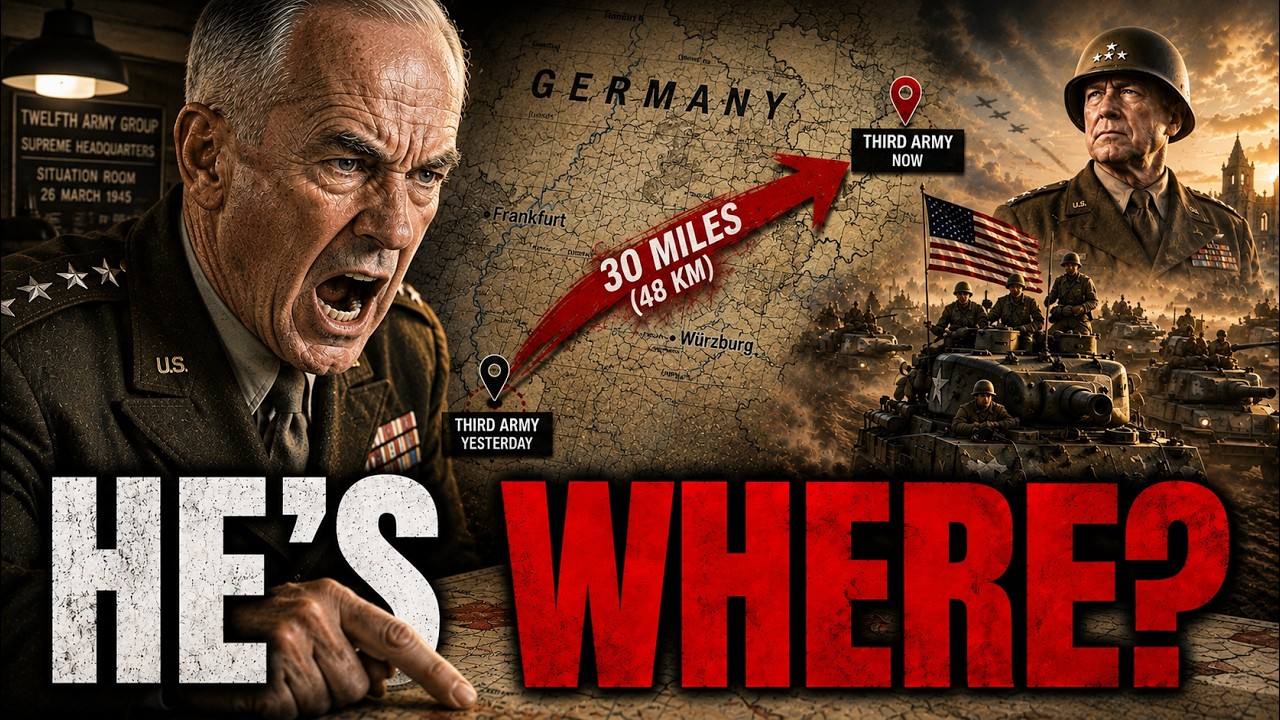 He looked up at his staff, and the question that came out of his mouth was not loud. It was almost quiet, almost disbelieving. The voice of a man being told something his own eyes refused to accept.
He’s where?
Nobody in that room had an answer. Somewhere east of that map pin, past every phase line, past every boundary drawn in ink the week before, an entire American army was moving through German territory that headquarters had not yet given it permission to touch. Bradley did not shout.
That was the strange part. Men who worked under him for years later said that when something truly alarmed Omar Bradley, his voice dropped instead of rising, as though the danger was too serious for volume. On that late morning in the closing weeks of March 1945, his voice had dropped almost to nothing.
He read the coordinates a third time, set the paper flat on the situation map, and placed one finger on the grid square where Third Army’s lead reconnaissance elements were now confirmed to be operating. Then he placed a second finger on the grid square where those same elements had been reported 24 hours earlier. The distance between his two fingers was not a matter of a mile or two of careful advance.
It was the distance of an army that had in the space of one day moved further than most divisions moved in a week.
To understand why that gap on the map felt less like a battlefield update and more like a small earthquake, you have to understand the two men standing on opposite ends of that command relationship and the war that had brought them to this exact moment. Omar Bradley was by 1945 one of the most trusted generals in the United States Army. A soldier’s soldier, methodical, careful with his men’s lives, allergic to unnecessary risk.
He had commanded First Army during the invasion of Normandy, and by the time winter fell over Europe, he had been elevated to command 12th Army Group, the largest concentration of American combat power the United States had ever fielded in a single theater. Under his authority sat First Army, Ninth Army, and Third Army, more than a million men, an administrative and logistical machine of staggering complexity. Bradley’s genius was not flash.
It was the unglamorous work of making sure fuel reached the front, that ammunition trains ran on schedule, that divisions did not outpace their own supply lines and starve in the middle of enemy territory. He was in every sense the manager of victory, the man who turned raw momentum into something sustainable.
George S. Patton was something else entirely. He was at that point in the war already a legend and already a headache, sometimes in the same sentence.
His reputation had been forged in North Africa, where his II Corps turned a demoralized, poorly led American force into a hardened fighting unit in a matter of weeks. It had been sharpened in Sicily, where his armored columns raced across the island in a campaign that stunned observers with its speed, and where his temper, most infamously in an incident involving two shell-shocked soldiers he struck and berated in field hospitals, nearly ended his career entirely. Only the intervention of Eisenhower, who valued Patton’s battlefield instincts too much to lose him, kept him in uniform.
By the time the Allies broke out of Normandy in the summer of 1944, Patton had been given command of Third Army, and he had spent the months since proving over and over that no one else in the European theater could move armor the way he could. Bradley and Patton were not strangers. In fact, in one of the quieter ironies of the war, Bradley had once served under Patton in North Africa before their positions reversed, and Bradley found himself by 1944 as Patton’s superior officer.
It was an arrangement that could have curdled into resentment on Patton’s side, and there were moments when it nearly did. Patton, older, more decorated in the interwar years, occasionally chafed at reporting to a man he had once outranked. But whatever friction existed between them personally, it rarely showed in their professional conduct.
Bradley respected Patton’s instincts for exploitation and maneuver. Patton, in his more honest, private moments, respected Bradley’s steadiness, even when he mocked it as excessive caution in his diary.
Their relationship worked most of the time because each man supplied something the other lacked. Bradley provided the discipline that kept an army group functioning. Patton provided the aggression that turned open flanks into shattered enemy formations.
By late March of 1945, that partnership was being tested in a way it never had been before because the war itself had entered a phase nobody had fully planned for. Two months earlier, Adolf Hitler had staked what remained of Germany’s mobile reserves on one final gamble in the West. The attack came through the Ardennes forest in December, catching Allied lines thin and undermanned, and for a handful of terrifying days, it appeared the German offensive might actually split the American and British armies apart, perhaps even force a negotiated settlement that would buy the collapsing Reich more time.
It failed. The bulge in the American lines, the one that gave the battle its name, was contained, then reversed, then crushed at a terrible cost in American lives during the coldest winter Europe had seen in years. But the cost to Germany was in the long run far worse.
The Panzer divisions thrown into the Ardennes were among the last truly capable armored formations the Wehrmacht possessed. The fuel burned chasing an impossible objective was fuel that could never be replaced. The experienced tank crews and paratroopers lost in the snow around Bastogne and St.
Vith were men Germany no longer had the training pipeline to replace. When the Battle of the Bulge ended, Germany had not simply lost a battle. It had lost its last reserve, its last true offensive capability, and in ways that were not yet obvious to the men making decisions in late winter, a good deal of its will to keep fighting in any organized way.
That mattered enormously for what came next, because it changed the fundamental shape of the war in the West. For years, Allied commanders had planned around the assumption that Germany would defend in depth, that every river line, every fortified town, every stretch of forest would be contested by an army still capable of coordinated resistance. That assumption was no longer entirely true.
German units in March of 1945 still existed. Many of them could still fight and fight hard when cornered or well-led. But the connective tissue between those units, the fuel, the communications, the reserves that allowed a broken line to be patched and held, had been gutted in the Ardennes.
What remained was not a solid wall. It was something closer to a row of doors. Some locked and defended fiercely, others already standing open with no way to know in advance which was which until you tried the handle.
General Dwight Eisenhower, commanding the entire Allied effort in Europe, understood this shift, and it shaped the strategy he pursued through the winter and into the spring. Eisenhower’s approach, often called the broad front strategy, called for Allied armies to advance together along the length of the Western Front. British and Canadian forces in the north, American armies in the center and south, each protecting the flanks of the other, each moving at a pace that logistics and coordination could sustain.
There were sound reasons for this caution beyond simple prudence. The Allied effort in Europe was at its core a coalition built on cooperation between nations with different priorities, different political pressures at home, and different generals who did not always trust one another. A broad coordinated advance kept that coalition intact.
It reduced the risk that any single army moving too far ahead of its neighbors would find itself 𝓮𝔁𝓹𝓸𝓼𝓮𝓭 on both flanks, cut off from supply, vulnerable to a counterattack that could turn a triumphant advance into a catastrophe overnight.
George Patton looked at the same battlefield and drew a very different conclusion. Where Eisenhower saw a wall that needed to be dismantled carefully, brick by brick, in step with the armies on either side, Patton saw a structure already cracked from foundation to roof, one that would come down entirely if someone simply kept hitting it fast, hard, and without pause. He had believed this about the German army for months, since the breakout from Normandy when Third Army had raced across France so quickly that fuel supplies, not enemy resistance, became the primary factor limiting his advance.
He believed it even more strongly now in the aftermath of the Ardennes. A defeated enemy, in Patton’s view, was at its most dangerous only for a brief window, the moment right after defeat, when panic and disorganization created chaos that a fast-moving attacker could exploit before the enemy had time to recover. Wait too long, hesitate to consolidate, give the beaten army even a few days to catch its breath, and that window closed.
Soldiers who might have surrendered in confusion instead found new officers, new orders, and a reason to keep fighting a little longer. This was the philosophy Patton carried into the final weeks of March, and it was about to produce the single boldest move of his career, one that would happen so quickly and be revealed so unexpectedly that it would leave even his own superiors scrambling to catch up with what he had already done.
For weeks, the attention of the Allied High Command and much of the American and British press had been fixed on a very different river crossing, one being prepared to the north with enormous care and enormous publicity. Field Marshal Bernard Montgomery, commanding the 21st Army Group, was assembling one of the largest set-piece river crossings of the entire war. A massive, meticulously planned operation to get British and American forces across the Rhine River near Wesel, complete with airborne drops, artillery barrages, and enough logistical buildup to move mountains.
It was scheduled for the final days of March, and it had been built up in military circles and in the newspapers as the crossing that would open the door into the heart of Germany. Reporters were already gathering. Correspondents had been briefed.
The operation carried a name, Plunder, and it carried with it an enormous amount of institutional and personal prestige for the man who commanded it. Patton had watched this buildup for weeks with barely concealed contempt. In his diary and in private conversations with his staff, he made no secret of what he thought of Montgomery’s caution, his need for overwhelming preparation before taking any risk, his apparent belief that only a carefully staged crossing with all the theatrical trimmings could get an army across a river as significant as the Rhine.
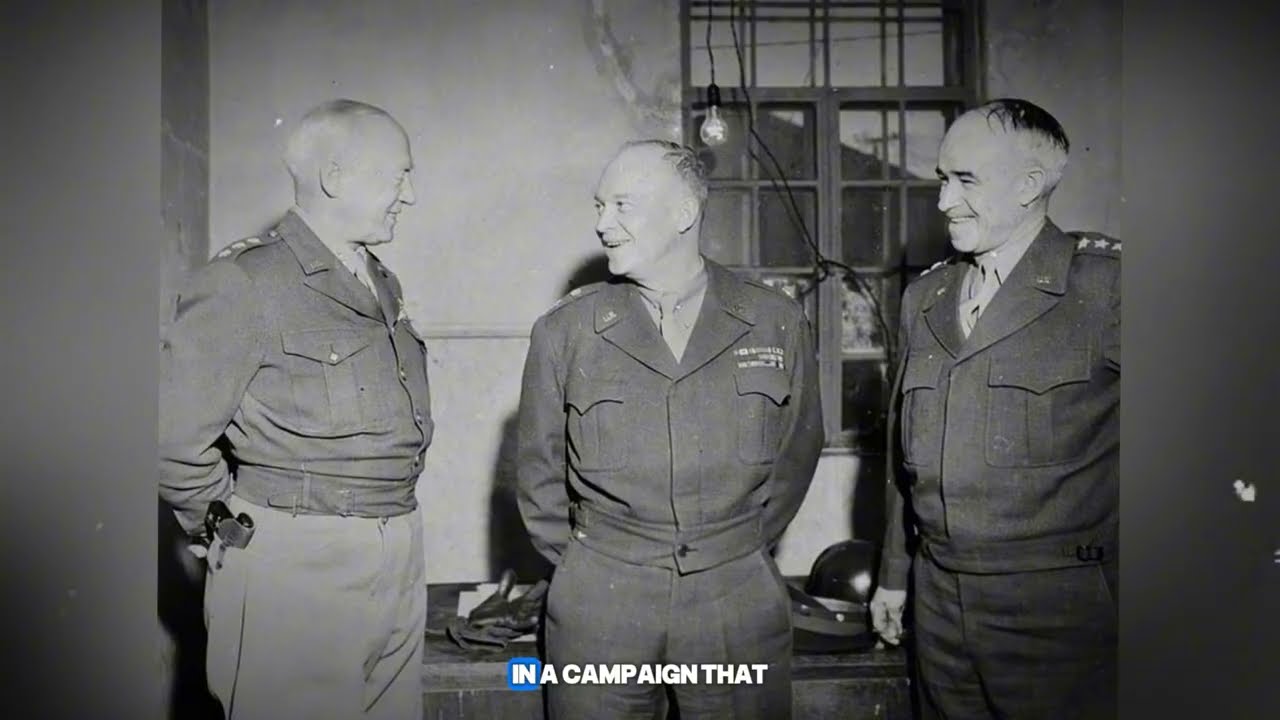 Patton believed the opposite. He believed that speed and audacity, not preparation and spectacle, were what actually won wars, and he intended to prove it in the most direct way available to him.
While Montgomery’s crossing was still being assembled to the north, Patton quietly ordered the 5th Infantry Division, supported by his own engineers, to force a crossing of the Rhine near the town of Oppenheim, well south of where anyone in Allied High Command was watching closely. It happened at night on the 22nd of March with minimal preparation, minimal fanfare, and almost no advanced warning to headquarters above him. Assault boats slipped into the water in darkness.
Engineers worked through the night constructing pontoon bridges under conditions far less controlled than anything Montgomery’s staff would have accepted for their own crossing. By the following morning, Patton had an entire division across the Rhine, a bridgehead established, and perhaps most satisfying to him personally, a full day’s head start on Montgomery’s much larger, much more publicized operation to the north. Only after the crossing was secured did Patton inform anyone above him what he had done, and he did it in a way that made clear he had timed the announcement for maximum effect.
He reportedly told Bradley over the telephone that Third Army had crossed the Rhine before Montgomery had even begun his preparatory bombardment, and asked, with evident relish, that this fact be kept quiet for the moment, so that when the news finally broke, it would land with the greatest possible impact. For Bradley, the news was, in a strange way, exactly the kind of thing he had learned to expect from Patton, and still never quite gotten used to. There was pride in it, genuine professional pride, because Patton had accomplished something remarkable, seizing a major strategic objective with a fraction of the preparation and publicity that the northern crossing required.
But there was also underneath that pride the first faint edge of a concern that would grow sharper with every day that followed. Patton had not asked permission for the Oppenheim crossing in any meaningful sense. He had informed his superiors after the fact, once the outcome was already secured, once there was nothing left for anyone above him to do but accept what had happened and adjust the broader plan around it.
It was a pattern Bradley recognized from years of commanding Patton, technically operating within the outer boundary of his orders, while in practice interpreting those orders as loosely as the situation allowed.
There was in the account that later reached Bradley’s staff a detail that stayed with the men who heard it. Along the riverbank at Oppenheim that night, the engineers worked almost in silence, boots sinking into cold mud, voices dropped to whispers, every man aware that a single flare going up over the water could bring German artillery down on the crossing before a single boat reached the far bank. There was no naval bombardment to announce the attempt, no wall of supporting fire the way Montgomery’s crossing would have to the north.
There was only darkness, the low slap of the current against the pontoons, and the quiet discipline of soldiers who had done this kind of work before and knew that speed was its own form of protection. When the sun came up over the eastern bank the next morning and German defenders realized an entire American division was already dug in on their side of the river, resistance in that sector was thin, disorganized, and short-lived. Exactly the outcome Patton had predicted it would be.
He had gambled that a fast, quiet crossing would catch the German defenders before they could properly man their positions, and the gamble had paid off almost exactly as he described it afterward to his staff, with something close to satisfaction. What Bradley did not yet know, standing in his headquarters in the days after the Oppenheim crossing, was that this was only the opening move. Patton was not finished proving a point.
He was just getting started. And the disciplined, coordinated advance that Eisenhower’s broad-front strategy called for was about to run headlong into an army that no longer had any intention of waiting for anyone.
In the days that followed the Oppenheim crossing, the war took on a rhythm nobody at headquarters had fully prepared for. The problem Bradley faced was not that Patton had disobeyed a specific order. It was something harder to pin down, harder to argue about in a formal complaint to Eisenhower, and in its own way, far more unsettling.
The problem was time itself, the simple, stubborn, physical fact that information could only travel so fast down a chain of command, and Patton’s army was now moving faster than the information meant to describe it. Third Army’s reconnaissance elements, light armored cars and jeeps pushing far ahead of the main body, would radio back a position report the moment they reached a crossroads or a town. That report had to travel up through division, then corps, then army headquarters before it was finally plotted onto the situation map at 12th Army Group.
Under normal conditions, in the kind of grinding contested advance the Allies had experienced through most of the previous autumn, that delay meant little. An army moving two or three miles a day did not outpace a report that took six hours to arrive. But Third Army in the final week of March was not moving two or three miles a day.
Spearhead units were sometimes covering 30, 40, even 50 miles between one confirmed position and the next, brushing aside what resistance they encountered, bypassing towns rather than clearing them, trusting follow-on infantry to mop up whatever pockets of Germans they left behind. By the time a report reached Bradley’s map table, the reality on the ground had already changed. He was not looking at where Third Army was.
He was looking at where Third Army had been, sometimes the better part of a full day earlier. This was the true meaning behind the moment that would later become famous. The moment when Bradley looked at the map, looked at the two positions marked barely 24 hours apart, and asked his staff where exactly Patton actually was right now.
It was not a joke, and it was not, despite how the story would later be told and retold, a simple expression of exasperation at a subordinate’s recklessness. It was a genuine, almost disorienting realization that the tools of command, the maps, the reports, the careful staff work that Bradley had built his entire career on mastering, were no longer keeping pace with the war they were supposed to be describing. He was not commanding Patton in any real-time sense.
He was commanding a version of Patton that had already ceased to exist by the time any decision about him could be made.
To his staff, Bradley reportedly said very little in that moment beyond the question itself. But those who worked closest to him understood what was passing through his mind. A commander’s authority rests in large part on the assumption that information flows upward fast enough for decisions to matter, that if something needs correcting, correcting it while there is still time to correct it is possible.
Patton had, without any deliberate act of defiance, broken that assumption simply by moving faster than anyone believed an army that size could move. He had not vanished. He had not gone silent.
Third Army was reporting regularly, dutifully, exactly as doctrine required. The problem was that dutiful reporting from a position an army had already abandoned told headquarters almost nothing useful about what to do next. From Patton’s own perspective, sitting in a forward command post that moved almost as often as his lead divisions did, the situation looked entirely different, and in some ways almost the mirror image of how it appeared to Bradley.
Patton did not see himself as outrunning anyone. He saw himself as the only man in the entire theater who correctly understood what kind of war this had become. He had believed since the collapse of the German counteroffensive in the Ardennes that the German army in the west no longer existed as a coherent fighting force.
Not in any sense that mattered strategically. Individual units still existed. Some of them stubborn, well-led and dangerous in the way any cornered soldier is dangerous.
But the connective tissue that had once allowed the German high command to shift reserves, patch broken lines, and mount coordinated counterattacks was gone, burned up in the snow around the Ardennes two months earlier. What remained in Patton’s assessment was not a defense in depth. It was a series of isolated strong points, some of which would fight to the last man, and many more of which would simply melt away the moment they realized no help was coming, and no one behind them was still fighting either.
He had seen this pattern before, and he trusted it completely. In North Africa, hesitation after a breakthrough had allowed battered German units time to regroup behind fresh defensive lines, turning what should have been a rout into another hard-fought battle. In Sicily, the armored dash across the island had worked precisely because Patton refused to slow down and wait for the situation to become fully clear before committing his forces forward.
In France, after the breakout from Normandy, the pursuit across open country had shattered German formations faster than anyone in Allied planning had projected, largely because Patton kept pushing even when fuel supplies, not enemy resistance, were the only real obstacle left. Momentum in his considered military judgment killed more efficiently than firepower ever could. A retreating, disorganized enemy, given even a single day to catch its breath, would use that day to establish a new line, call up whatever reserves remained, and force the attacking army to fight the same battle all over again at greater cost in men and time.
An enemy given no such day simply kept collapsing.
So Patton did not order his divisions forward in a single disciplined column, advancing carefully with flanks tucked in and neighboring units kept in constant contact, the way doctrine and caution both would have preferred. He pushed forward on multiple axes simultaneously, armor, motorized infantry, and reconnaissance screens all surging ahead at once, not as one spearhead, but as something closer to a spreading wave, each element exploiting whatever gap or weakness it happened to find directly in front of it. Some columns ran into stiff resistance, dug-in German paratroopers or SS formations who fought with the particular ferocity of men who believed, correctly or not, that surrender meant execution.
Other columns found nothing at all. Empty roads, abandoned equipment, and long lines of German soldiers already walking west with their hands raised, looking for the nearest American unit willing to take their surrender before some fanatic officer could order them to keep fighting. This was not, whatever it looked like from the outside, chaos.
It was a deliberate style of command built on trust flowing downward rather than control flowing upward. Patton relied on his corps and division commanders to read the situation directly in front of them and act on what they actually saw rather than waiting for instructions from a headquarters that by the time those instructions arrived would already be describing a battlefield that had moved on. It was in its own way a mirror of the very problem Bradley was wrestling with at 12th Army Group, except that where Bradley experienced the information lag as a source of anxiety, Patton had built an entire command philosophy designed to exploit it.
This divergence in thinking went far beyond simple tactics, and it put Patton on a collision course, not with the German army, but with the broader logic of how Eisenhower intended to win the war. Eisenhower’s broad-front strategy depended on synchronization. Armies advancing together, each protecting the 𝓮𝔁𝓹𝓸𝓼𝓮𝓭 flank of its neighbor, none of them so far ahead that a sudden German counterattack could cut off supply lines and isolate forward units in hostile territory.
 There were good reasons for this approach that went beyond simple caution. The Allied effort in Europe was a coalition built on cooperation between American, British, and Canadian forces, each with commanders who did not always fully trust one another, each answering to governments with their own political pressures and their own post-war ambitions. A broad, coordinated advance kept that fragile alliance functioning smoothly.
It reduced friction. It ensured that no single army’s glory came at the expense of another’s safety or another’s standing back home. Patton in his private judgment believed this entire framework had already become obsolete.
Germany, he argued, was no longer defending a continuous front that required a continuous synchronized Allied line to break through it. There was nothing left to synchronize against. What existed instead was a collapsing system, and the fastest way to finish collapsing it, in his view, was to never give it a single day to stabilize, regardless of what the army group on his flank happened to be doing at the time.
There was also underneath the purely military reasoning, something more personal in how Patton framed his own urgency, at least in conversations with the officers closest to him. Every additional day the war continued, he argued, meant more American soldiers killed in fighting that had, in his assessment, already been strategically decided. It meant more German cities destroyed, more civilians caught in fighting that served no purpose beyond delaying an outcome that was no longer in doubt.
It meant more prisoners of war, American, British, and increasingly Soviet, held in camps scattered across a collapsing Reich, at growing risk as German guards grew desperate and unpredictable. Speed, to Patton, was not recklessness for its own sake. It was, in the framing he genuinely seemed to believe, a form of mercy, the fastest possible path to ending a war that had already, in every meaningful sense, been decided.
While Third Army surged east and south across central Germany at a pace that stunned even experienced staff officers, the rest of the Allied line was advancing at a very different tempo. And that contrast only sharpened the concern building at Bradley’s headquarters. To the north, British and Canadian forces under Montgomery faced difficult terrain and determined German resistance, their progress steady and methodical, but costly, measured in a handful of miles per day rather than dozens.
In the center and south, other American armies advanced within the disciplined framework Eisenhower had set, coordinating carefully with their neighbors, moving fast by the standards of the previous autumn, but nothing like the pace Third Army was setting. The broad-front strategy was by every measure available to headquarters working as intended. The trouble was that Patton was no longer advancing with the plan.
He was advancing well ahead of it, and the growing distance between Third Army and the rest of the Allied line was becoming a problem that could not simply be resolved by drawing a new boundary on a map. For Eisenhower, watching all of this unfold from Supreme Headquarters, the concern went beyond simple battlefield risk, though that risk was real enough on its own. If Third Army continued to outpace the armies on either flank, it risked becoming isolated, a long, thin salient into German territory with dangerously 𝓮𝔁𝓹𝓸𝓼𝓮𝓭 flanks, vulnerable to exactly the kind of coordinated counterattack that a collapsing but not yet destroyed German army might still be capable of mounting in a moment of desperation.
But there was a second concern, one that had almost nothing to do with the Germans at all and everything to do with an ally advancing from the opposite direction. The Soviet Red Army was moving west across central Europe at a pace of its own, and by late March of 1945, the question of exactly where American and Soviet forces would eventually meet had become as much a political calculation as a military one. Zones of post-war occupation had already been discussed and in broad strokes agreed upon at earlier Allied conferences, but the precise line on the ground where advancing American and Soviet units would actually make physical contact remained far less clearly defined in practice than it appeared on paper in London or Washington.
An American army pushing too far, too fast into territory that had already been informally understood to fall within the eventual Soviet zone risked more than simple military confusion. It risked an unplanned, uncoordinated encounter between two massive, heavily armed forces that did not share a common language, a common set of procedures, or in many cases much trust in one another at all. A single moment of confusion at a chance meeting engagement, a nervous soldier on either side firing first, could create a diplomatic crisis at the precise moment the war was supposed to be ending in cooperation rather than chaos.
The peace, in other words, had not yet begun, even as the war was visibly ending. And Eisenhower understood that how the final weeks of fighting were managed would shape the shape of Europe for years afterward.
This left Eisenhower facing a genuinely difficult choice, one without a clean answer on either side. He could order Patton to halt, to bring Third Army back into careful alignment with the armies on its flanks, accepting the very real risk that doing so would give German forces time to regroup, prolonging a war that was by every visible measure already being won at a remarkable pace. Or he could allow Patton to continue, accepting the risk of overextension, of a costly counterattack, of an unplanned collision with Soviet forces, in exchange for an advance that was demonstrably shortening the war, and by Patton’s own accounting, costing fewer American lives per mile gained than any previous phase of the campaign.
Stopping Patton outright, even had Eisenhower fully decided to try, proved far harder in practice than in theory. Whenever headquarters attempted to impose tighter limits on Third Army’s advance, Patton found ways to comply with the letter of his orders while continuing to push forward in substance. He would report that his forces were clearing pockets of remaining resistance or consolidating a forward position, descriptions that were not technically false and that satisfied the requirements of his orders on paper, while the practical effect on the ground remained the same.
The front kept moving east regardless of what the map at headquarters currently showed. This was for Bradley in particular an uncomfortable truth to sit with. Patton was allowed to keep operating this way largely because he kept succeeding.
Casualties across Third Army’s sector were consistently lower than staff officers had projected for an advance of this speed and scale. German resistance, wherever Third Army encountered it, was crumbling faster than doctrine predicted it should. Cities that planners had expected to cost days of hard fighting were falling in a matter of hours, sometimes without a single shot exchanged as German garrisons surrendered en masse to American reconnaissance patrols that had arrived far ahead of the main body.
Every new report that finally reached headquarters, however delayed, confirmed the same underlying pattern. Third Army was winning and winning cheaply. To have ordered Patton to stop would have required solid evidence that his approach was creating unacceptable risk, and by the last week of March that evidence simply did not exist.
The gamble was working exactly as Patton had insisted it would. Bradley later described the experience of commanding Patton during this period in terms that stuck with the officers who heard him say it. It did not feel like issuing orders to a subordinate general, he said.
It felt more like standing near a force of nature and trying to hold on, adjusting, reacting, absorbing the consequences of decisions that had usually already been made and acted upon before headquarters ever learned they were being considered. You did not in any meaningful sense direct George Patton through the final weeks of the war in Europe. You reacted to him and you tried to keep the rest of the machine functioning around whatever he had just done.
That reactive posture was not comfortable, and it was not, in Bradley’s own judgment, a model anyone would ever want to build a peacetime army around. But at this specific moment, in the final collapsing weeks of a war that had already claimed so many lives, it was a force that no one in the Allied command structure could afford to waste, whatever unease it caused among the men whose job it was to keep it under some semblance of control.
Behind the maps and the staff briefings, the strain of keeping an army moving at that pace showed up in places the official reports rarely mentioned. Fuel officers at corps and army level worked in shifts around the clock, rerouting truck columns hour by hour as forward units burned through gasoline faster than any pre-war planning table had projected, diverting convoys originally intended for one division toward whichever spearhead had in the last few hours suddenly pulled furthest ahead. Communications units strung wire and relayed radio traffic across a front that seemed to redraw itself every few hours, often losing contact entirely with the most forward elements for stretches of time that would have been unthinkable earlier in the war.
Staff officers at 12th Army Group grew accustomed to issuing guidance they privately suspected was already outdated the moment it left their hands, a strange, unsettling way to fight a war, drafting orders for a battlefield that might no longer exist by the time those orders reached the units meant to follow them. Bradley absorbed this uncertainty the way he absorbed most things, quietly, methodically, without the kind of public complaint that might have undermined the confidence of the men beneath him. He adjusted supply priorities as fast as his staff could manage it, pushed fuel forward on faith as much as on confirmed need, and accepted that a certain amount of confusion was simply the price of allowing Third Army to keep moving at the pace it had set for itself.
What he could not do, no matter how carefully his staff worked, was fully close the gap between the speed of the war and the speed of the paperwork meant to track it. That gap was not a failure of anyone’s competence. It was a structural feature of a war that had in the space of a few weeks outgrown the command tools built to manage it.
The risk that worried Eisenhower most, the one that kept returning in conversations at Supreme Headquarters, even as Third Army’s advance produced one favorable report after another, was the question of where exactly the war in the West would end, and who would be standing on which side of the line when it did. The Red Army was advancing from the east with a speed and scale of its own, driving toward the Elbe River and the heart of what remained of the Reich. Broad political agreements about post-war zones of occupation had already been sketched out in earlier conferences among the Allied leaders.
But broad agreements on paper were a different thing entirely from a precise defensible line on the actual ground, especially in the closing days of a collapsing war when advancing units on both sides were focused on the enemy directly in front of them, not on a demarcation line drawn months earlier in a conference room thousands of miles away. Every mile Third Army pushed east without careful coordination increased the odds that American and Soviet forces would eventually run into each other unexpectedly in circumstances where a nervous soldier, a misidentified vehicle, or simple confusion in the dark could turn two Allied armies into something far more dangerous than either side intended. Eisenhower understood that the manner in which this meeting eventually happened would say something lasting about the kind of peace that followed the war, and that understanding weighed on every decision he made about how tightly to rein in a general who had already shown at Oppenheim and in every mile since, how loosely he interpreted the boundaries of a cautious plan.
It was against this backdrop, fuel officers working through the night, staff drafting orders for a battlefield that had already moved on, generals in Washington and London quietly worried about where exactly two Allied armies might collide, that a much smaller, far more personal story had been developing for weeks inside Patton’s own headquarters. One that had nothing to do with grand strategy and everything to do with a name Patton had been tracking since the earliest days of the war. Lieutenant Colonel John Waters was Patton’s son-in-law, married to his daughter Beatrice, and by the spring of 1945, he had already spent roughly two years as a prisoner of war since being captured by German forces in Tunisia in February of 1943, early in the North African campaign.
For most of that time, Waters had been held in camps far from the fighting. One prisoner among many thousands, his name appearing periodically in Red Cross correspondence that made its way back to the family, but otherwise invisible to the wider war. As the Eastern Front collapsed under the weight of the advancing Soviet army through the winter of 1944 and into 1945, German authorities had begun moving prisoners held in camps closer to Soviet lines further west, consolidating them into camps that were for the moment still safely behind German-controlled territory.
Through this slow, chaotic process of relocation, Waters had eventually been transferred to Oflag XIII-B, a prisoner of war camp near the town of Hammelburg in Bavaria, a camp that by March of 1945 held a growing population of Allied officers, including a substantial number of American prisoners who had been marched or transported west ahead of the advancing Red Army. Patton had followed reports of his son-in-law’s captivity as closely as the fragmented, delayed wartime intelligence system allowed, through Red Cross channels, through occasional intelligence summaries, and through his own personal network of contacts. As Third Army’s advance carried it deeper into Bavaria through March, and as intelligence reports began placing a significant population of Allied prisoners at a camp near Hammelburg, a location that, as the crow flies, sat a considerable distance beyond the current forward edge of Third Army’s advance, a question began to form in Patton’s mind that had nothing to do with the broad strategic considerations occupying Eisenhower’s attention at Supreme Headquarters.
It was a question no staff officer would have found written in any operational order, and one that Patton, for the moment, kept largely to himself, discussed only in guarded terms with a small circle of officers he trusted enough to bring into his confidence, long before that private question fully resolved itself.
The wider advance kept producing the same disorienting rhythm that had first prompted Bradley’s quiet, startled question at the map table. It happened again within days and then again after that until the pattern became almost routine among the staff at 12th Army Group, a running half-serious joke that nobody quite dared say out loud in front of Bradley himself. A report would arrive placing Third Army’s forward elements at one town.
Before the ink on the map was even dry, a follow-up report would place a different column operating on an entirely different axis. Dozens of miles beyond that same town, having bypassed it entirely in the night. Frankfurt fell to advancing American forces after days of disorganized, uneven fighting, its garrison split between pockets that resisted fiercely and others too aware of the hopelessness of the wider war to hold their positions.
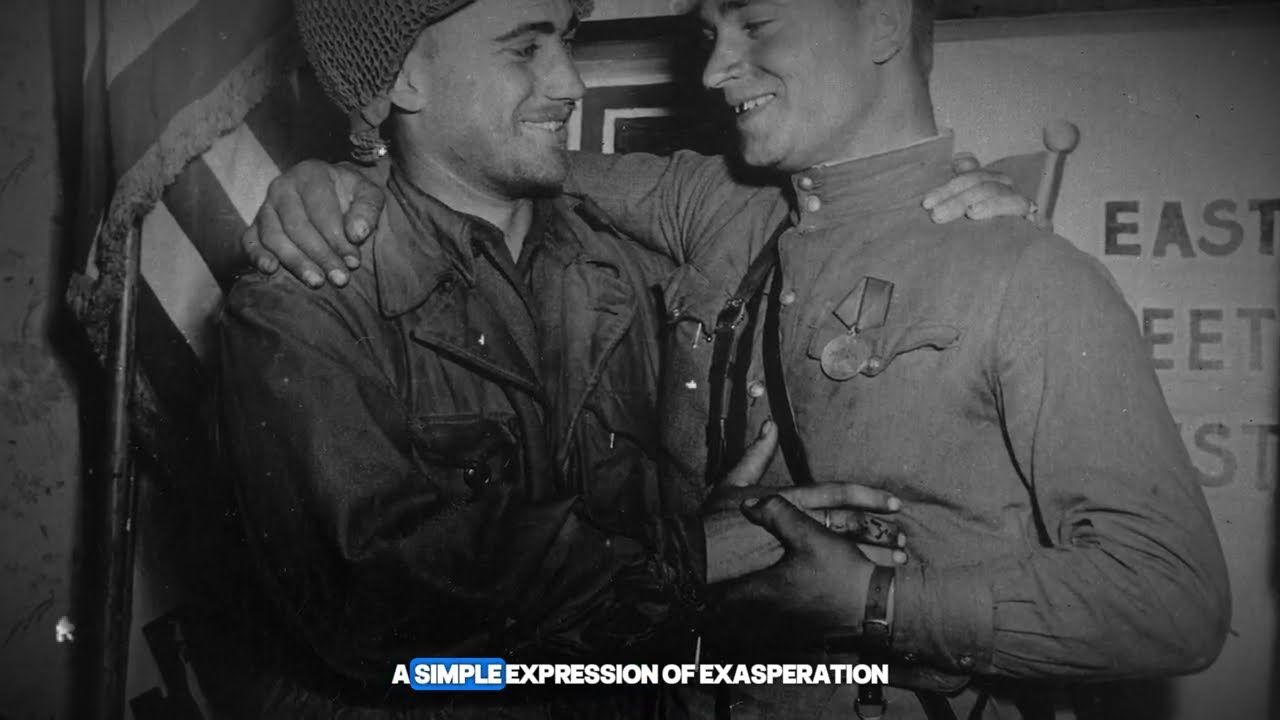 Further east, towns that staff officers had circled on their maps as likely strong points, expected to cost days of careful, costly fighting, surrendered instead to lightly armed reconnaissance patrols that arrived hours ahead of anyone capable of stopping them, town officials sometimes meeting the first American jeep at the outskirts with a white flag already prepared, having watched the collapse of German authority in the surrounding countryside for days and concluded that further resistance served no purpose beyond delaying the inevitable by a few more hours. For the ordinary soldiers making this advance, the experience bore little resemblance to the grinding hedgerow-to-hedgerow fighting of the previous summer in Normandy, or the freezing, desperate defense of the Ardennes only weeks earlier. Tank crews rode with hatches open more often than closed, watching farmland and shattered German villages roll past at a pace that felt, to men who had spent years fighting for every yard of ground, almost unreal.
Long columns of German soldiers, some still in formation under the command of officers marching them west to surrender in an organized fashion, others simply walking alone or in small scattered groups, lined the same roads Third Army’s tanks were using to advance, all of them heading in the opposite direction toward whatever captivity awaited them, relieved in many documented cases simply to have survived long enough to reach that point. Prisoners were processed in numbers far beyond what military police units had been staffed to handle. Entire fields converted into makeshift holding areas because the formal prisoner of war camps further to the rear could not absorb them fast enough.
Bradley, watching all of this unfold from behind his desk at 12th Army Group, found himself in the strange position of a commander whose primary daily task was no longer deciding what his subordinate should do next, but rather trying to understand after the fact what his subordinate had already done, and adjusting the machinery of supply and coordination around it as quickly as possible. He began, according to officers who served alongside him during this period, to treat Patton’s position reports less as instructions to be acted upon and more as historical documents useful for understanding the general shape and direction of Third Army’s advance, but never to be trusted as a precise current picture of where the front line actually stood at the moment the report was read. It was in its own quiet way an adaptation, a recognition that the traditional relationship between a commander and the information reaching him had broken down under the sheer velocity of the advance, and that clinging rigidly to the old model, waiting for confirmed, up-to-date reports before making a decision, would only leave 12th Army Group perpetually a full day behind a war that showed no sign of slowing down to accommodate anyone’s paperwork.
There was underneath Bradley’s outward composure a genuine tension between two competing instincts that never fully resolved itself during those final weeks of March. As a commander responsible for the safety and coordination of more than a million men, he understood every argument for caution, for keeping flanks protected, for not allowing any single army to race so far ahead that a sudden reversal could turn triumph into disaster. He had built his entire reputation on exactly that kind of careful, unglamorous competence.
And yet, as a soldier who had spent years watching this war grind through French hedgerows, Belgian forests, and German river crossings at enormous cost in American lives, he could not fully argue with the results Patton was producing. Fewer casualties per mile of ground gained than almost any previous phase of the campaign. German resistance crumbling faster than any staff projection had anticipated.
A war that by every visible measure was ending sooner because one general had refused to wait for the rest of the front to catch up with him. That tension between the discipline Bradley had spent a career building and the results Patton kept delivering by ignoring exactly that kind of discipline sat at the heart of everything happening at 12th Army Group in the final week of March, and it would soon be tested in a way far more personal and far more controversial than any question of miles gained or towns bypassed. The question Patton had been quietly turning over in his own mind about a prisoner of war camp near Hammelburg and the son-in-law being held somewhere inside its wire was about to stop being a private matter entirely, and the answer he chose would produce a twist that even his own most loyal admirers in the years that followed struggled to fully defend without qualification.
By the final days of March 1945, the question Patton had been carrying privately for weeks finally forced its way into a decision. Intelligence reports gathered through a mix of aerial reconnaissance, interrogated German prisoners, and liberated Allied airmen who had passed through the camp before escaping or being moved indicated that Oflag XIII-B near Hammelburg held well over a thousand American officers among a much larger population of Serbian and other Allied prisoners. Among them, according to the intelligence Patton had personally been tracking, was Lieutenant Colonel John Waters, his son-in-law, husband of his daughter Beatrice, a man Patton had not seen since before Waters’ capture in Tunisia more than two years earlier.
The camp sat well beyond Third Army’s current forward positions on the far side of terrain that remained, at least on paper, still contested by whatever German forces continued to operate in the region. A cautious, disciplined commander operating strictly within the framework Eisenhower’s headquarters expected would have flagged the camp’s location for a future properly supported advance once the front had caught up and a full division could secure the area without undue risk. Patton chose a different path entirely.
He ordered the formation of a small task force built around a company of medium tanks, a company of armored infantry, and a handful of supporting vehicles, roughly 300 men in total, placed under the command of Captain Abraham Baum, a young officer with a reputation for aggressive, capable leadership. The task force, which would become known in the histories that followed simply as Task Force Baum, was given orders to push deep behind what remained of German lines, well beyond 50 miles past the forward edge of Third Army’s confirmed positions, further than any reconnaissance element had been authorized to travel during the entire campaign, and reach the camp at Hammelburg before German guards could move the prisoners further east, or in the worst case, harm them as the front collapsed around them. Officially, the mission was framed to the small number of senior officers briefed on it as a raid to liberate a significant population of Allied prisoners of war before they could be lost in the chaos of Germany’s final collapse, a justification that carried real military logic on its own terms.
Unofficially, and this became clear almost immediately to the officers who executed the mission and later to historians who examined the surviving records, the scale of the force committed and the specific camp selected as its target among several that might have qualified for a similar rescue effort bore an unmistakable relationship to the fact that Patton’s own son-in-law was believed to be held inside its wire. It was an order that blurred, in a way that made even Patton’s most sympathetic officers uneasy, the line between military necessity and personal motive, issued by a commander who had spent his entire career insisting that sentiment had no place in decisions that cost soldiers their lives.
Task Force Baum set out on the 26th of March, 1945, moving through darkness and then through daylight, deep into territory that no friendly force had operated in previously. What followed over the next two days was by almost every measure available afterward a disaster. The column encountered scattered but persistent German resistance the entire route.
Small arms fire, anti-tank guns, and hastily organized defenders who, isolated from any coordinated command structure, fought with the desperate unpredictability of men who understood that organized surrender was no longer an option available to them in the middle of enemy-occupied ground. Vehicles were lost along the way to mines, to ambush, and to mechanical breakdown that could not be repaired so far from any friendly repair depot. Communication with Third Army headquarters, unreliable from the moment the task force departed, broke down almost entirely within the first day, leaving Patton and his staff with no real-time picture of whether the mission was succeeding, failing, or had simply vanished into the German countryside.
The task force did, against considerable odds, reach the camp at Hammelburg on the 27th of March, breaking through the perimeter and freeing the prisoners held inside. A moment that, for the men involved, briefly felt like the successful completion of an extraordinarily bold gamble. But the difficulty of the mission was only beginning.
The camp held far more prisoners than the task force had vehicles to transport. Several thousand men in total once every nationality held there was counted, against a rescue force that had arrived with perhaps 30 operational vehicles remaining after two days of fighting and mechanical attrition. There was no way to evacuate anywhere near the full population of the camp, and the task force, already reduced, already low on fuel and ammunition, and already deep inside territory still crawling with German units responding to the sudden, unexplained appearance of American armor so far behind their own lines, had no realistic path back to friendly territory carrying thousands of newly liberated men.
What followed was, by any honest accounting, the collapse of the mission. German forces, alerted and reinforced, surrounded the task force as it attempted to withdraw with as many prisoners as it could carry. In the fighting that followed, most of the task force’s remaining vehicles were destroyed or abandoned.
Captain Baum himself was wounded and eventually captured. The great majority of the American soldiers who had set out on the mission were killed, wounded, or taken prisoner themselves, a bitter irony for a mission launched specifically to free men from captivity. Among the confusion of the final hours, Lieutenant Colonel Waters, the very man the mission had been shaped around finding, was seriously wounded by German fire during the chaotic fighting around the camp and remained in German hands, now as a wounded prisoner rather than a healthy one, until Allied forces finally overran the area for good weeks later.
The military and human cost of the raid was almost impossible to reconcile with any reasonable calculation of the objective achieved. A force of roughly 300 men had been sent 50 miles behind enemy lines, and the great majority of that force had been killed, wounded, or captured in a mission that ultimately failed to bring back the great majority of the prisoners it had been sent to rescue, including, in a detail that would haunt the operation’s reputation for decades afterward, Patton’s own son-in-law, who ended the raid worse off and in greater danger than before it began.
When word of the raid’s outcome reached Bradley and eventually Eisenhower, the reaction was sharp, and for good reason. This was not a case of Patton interpreting the outer edge of a broad operational order with unusual aggression the way the Oppenheim crossing or the general pace of Third Army’s advance through central Germany could with some generosity be understood. This was a small dedicated force diverted from the broader war effort, sent on a mission whose scale and specific target were difficult to justify on purely military grounds once the personal connection became known, resulting in casualties that any honest after-action review would struggle to defend as proportionate to what was actually achieved.
Eisenhower, when he later learned the full details of how the mission had been conceived and targeted, was reportedly furious, viewing it as an example of exactly the kind of personal judgment overriding sound military reasoning that made Patton, for all his undeniable talent, someone who required constant, careful watching rather than the loose latitude he had been operating under for weeks. Patton, for his part, never fully acknowledged in public that personal motive had shaped the mission’s scale or its target, insisting instead on the military justification, the need to liberate a significant population of Allied prisoners before they could be lost in the chaos of Germany’s collapse. Privately, among the small circle of officers who knew the full story, there was little doubt about what had truly driven the decision, and the raid became almost immediately one of the most controversial episodes of Patton’s entire career, a stark illustration of the same instincts that had made him so effective at Oppenheim and across the broader advance through Germany when turned toward a personal rather than a strategic objective.
The remainder of the war in Europe unfolded quickly after the failed raid. Third Army continued its advance through central and southern Germany with the same relentless pace it had maintained throughout March and into April, crossing further rivers, capturing further cities, and pushing deep into Bavaria and Czechoslovakia as German resistance continued its broader collapse. Germany surrendered unconditionally in early May of 1945, bringing the war in Europe to its end, and with it the specific set of circumstances that had allowed Patton’s particular style of command to flourish so dramatically in those final weeks.
In the months that followed victory, the argument over what to make of Patton, and of the entire period when he had operated at the outer edge of, and at times well beyond, the boundaries of his own orders, began in earnest, and it has never entirely settled since.
Within the United States Army, his operational brilliance during the final campaign was never seriously disputed. His instinct for exploiting a collapsing enemy, his willingness to accept calculated risk when the situation genuinely warranted it, and his ability to move armor faster and further than any other American commander of the war were studied at military schools in the years that followed, held up as a case study in the aggressive exploitation of a broken enemy line. But the army, in its official judgment, never held Patton up as a template to be replicated.
His methods depended too heavily on personal instinct, on a tolerance for risk that few commanders possessed, and on a specific narrow set of circumstances, a genuinely collapsing enemy, that would not exist in every future war. What worked in the final weeks of a war already effectively won could just as easily have produced catastrophe under slightly different conditions, and no doctrine could be safely built around a general’s individual willingness to gamble that the enemy in front of him was as broken as he believed. Beyond the battlefield questions, Patton’s temperament created problems that had little to do with tactics and everything to do with the fragile, uncertain peace that followed the war’s end.
His blunt, often careless public statements, including remarks that minimized the process of removing former Nazi officials from positions of local authority in occupied Germany, and his open, undiplomatic hostility toward the Soviet Union at a moment when careful diplomacy mattered enormously, made him increasingly unsuitable for any meaningful leadership role in the delicate post-war environment. The same instincts that had made him invaluable in the final collapsing weeks of the fighting, blunt, aggressive, unwilling to wait for consensus before acting, made him a serious liability once the war ended and the far more complicated work of managing an uneasy peace began. Within months of Germany’s surrender, Patton was quietly removed from command of Third Army and reassigned to a largely ceremonial position overseeing military history efforts, a demotion in substance if not officially in name, not a punishment for any single act of insubordination, but a recognition that the qualities the war had needed most were no longer the qualities the peace required.
This is the paradox that George Patton represents and the reason his legacy remains, even decades later, genuinely difficult to summarize in a single verdict. The war in its final collapsing weeks needed exactly the kind of commander he was. A general willing to move faster than his own command structure could track him.
Willing to interpret the outer boundary of an order as generously as the situation allowed. Willing to gamble that a broken enemy would keep breaking if given no chance to catch its breath. That willingness shortened the war, saved American lives that a slower, more cautious advance would almost certainly have cost, and produced a campaign still studied for its sheer audacity.
But that same willingness turned toward a personal objective rather than a strategic one produced the disaster at Hammelburg, a raid that cost the lives and freedom of hundreds of soldiers in pursuit of a rescue that ultimately failed to achieve even its own narrow personal purpose. And that same temperament, once the shooting stopped and the far more delicate work of building a peace began, made him a man the army could no longer safely deploy in any prominent role at all. Bradley, reflecting later on the whole strange arc of that final campaign, understood the paradox better than almost anyone, because he had lived inside it for weeks, watching Patton’s map position shift further ahead of every confirmed report, absorbing the consequences of decisions made and executed before headquarters ever had a chance to weigh in.
Commanding modern armies, he came to understand, rested on an assumption that information could keep pace with events, that orders issued today would still make sense by the time they reached the men meant to carry them out tomorrow. Patton had shattered that assumption almost effortlessly, not through open defiance, but simply by moving faster than any system built to track him could manage. For hours, sometimes for the better part of an entire day, Third Army existed outside the normal cycle of command and control altogether, operating in a present tense that headquarters was still struggling to catch up with, still reacting to yesterday’s version of a war that had already moved on without asking permission.
That gap between speed and control, however useful it proved in the final desperate weeks of a collapsing war, was not something any army could responsibly build a lasting doctrine around. And the army never tried. It studied Patton, admired him, taught pieces of his maneuvers to a new generation of officers, and quietly concluded that he had been, above all else, an exception rather than a model, a general who had briefly outrun not just the German army in front of him, but the very systems designed to manage and contain the victory he was delivering.
Standing in front of a map that could no longer keep pace with the war it was meant to describe, Omar Bradley had asked the only question that made any real sense in that moment. A question that was never really about geography at all. He’s where?