
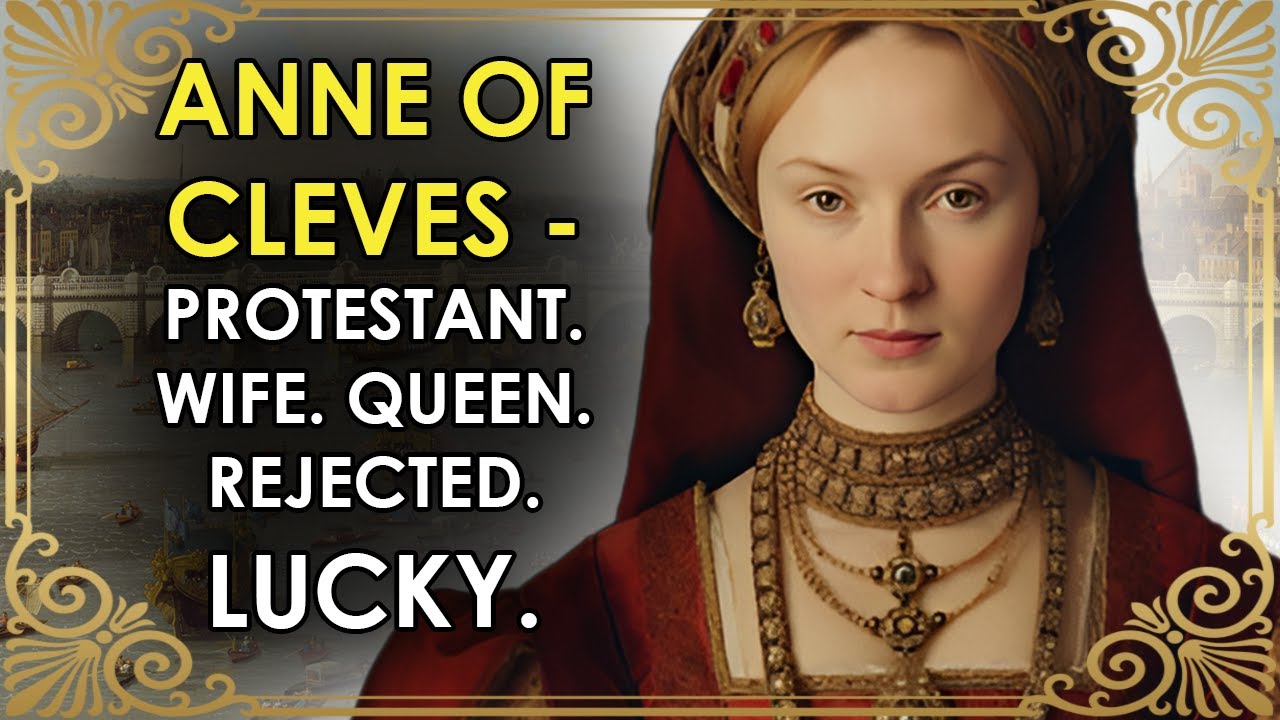
The finality of the axe had been a recurring theme in the life of Henry VIII, a monarch whose matrimonial history was written in blood and annulments. Yet, for Anne of Cleves, the fourth woman to hold the title of Queen of England, rejection proved to be the greatest gift the Tudor king could ever bestow. While her predecessor, Anne Boleyn, met her end on the scaffold, and her successor, Catherine Howard, would follow the same tragic path, Anne of Cleves navigated the treacherous waters of the English court with a quiet intelligence that secured her freedom, wealth, and ultimately, a life of unprecedented independence.
The story of their ill-fated union begins not with a meeting of hearts, but with a calculated political maneuver designed to counter the growing power of the Hapsburg Empire. Following the death of Jane Seymour, Henry’s chief minister, Thomas Cromwell, saw an alliance with the Protestant Duchy of Cleves as a vital strategic necessity. The Pope had reissued the excommunication against the English king, making an alliance with a Protestant state not just attractive, but essential for England’s security.
 The Duke of Cleves, John III, had two eligible daughters, and the prospect of a royal marriage was a tempting offer for a man eager to strengthen his own position against the Catholic Emperor.
Born on September 22, 1515, in the ducal capital of Düsseldorf, Anne was raised in the relative peace of Berg Castle, a palace that had evolved from a defensive fortress into a luxurious residence. Her upbringing was strict and deeply religious, a blend of her father’s Lutheran convictions and her mother’s devout Catholicism. Unlike many noblewomen of the era, Anne received no formal education in the arts or languages, but she was literate in German, highly skilled in needlework, and possessed a sharp, practical mind that would prove far more valuable than any courtly accomplishment in the years to come.
Her initial betrothal at the age of eleven to Francis, the young heir to the Duke of Lorraine, was a strategic move by her father to strengthen his duchy. However, due to the young ages of both parties, the match was eventually called off in 1535. This early, unresolved betrothal would later be cynically resurrected by Henry as a convenient pretext to dissolve his own marriage, a legal technicality that Anne would shrewdly accept in exchange for her freedom.
When Henry’s council first floated the idea of a marriage to Anne in 1538, the King was initially lukewarm, still mourning Jane Seymour, the only wife who had provided him with the son he so desperately craved.
It was Thomas Cromwell who championed the match, sending two Protestant ambassadors, Nicholas Wotton and Robert Barnes, to the court of Cleves in 1539. They were not greeted by the aging Duke John, who had recently died, but by his son, William, a man with ridiculously strong ideas about female modesty. When the ambassadors arrived, they were shocked to find they could barely see the faces or figures of either Anne or her sister Amalia, as they were covered in a monstrous habit gown and veil.
When Wotton gently complained, explaining that Henry wished to know what they looked like, William retorted, “Would you see them naked?”
Despite this obstacle, Cromwell dispatched the celebrated artist Hans Holbein the Younger to paint the sisters’ portraits. Holbein, in a departure from the norm, painted Anne in a three-quarter view, a perspective that cleverly disguised the length of her nose. The portrait presented a demure, sweet, and youthful face, with hands relaxed in a dignified pose, her jeweled gown and headdress signaling her high social station.
Henry was immediately taken with the image and agreed that Anne was the wife he wanted. The King, blinded by the flattering portrait and his own expectations, ignored warnings from his ambassadors that Anne was of average beauty and possessed a “resolute countenance,” a description that did not match his favored type of woman.
After a slow and arduous journey through Calais, Anne finally arrived in England on December 27, 1539. She was given a magnificent welcome, and the court was impressed by her manners, her merry demeanor, and her eagerness to please the King. She reportedly expressed a strong desire to learn English as quickly as possible.
Not one person at court said anything negative about her looks. However, the first meeting between Anne and Henry was to be a fateful disaster, orchestrated by the King himself following an old English courtly tradition of meeting his bride in disguise.
 Henry, bursting into her rooms at Rochester Abbey on New Year’s Eve, was dressed in a ragged cloak and claimed to be a messenger bearing a gift from the King. Anne, who did not understand English and had no knowledge of this bizarre tradition, was horrified when this obese, uncouth stranger grabbed her and kissed her against her will. She recoiled and turned back to the window, shaken and uncertain.
When Henry returned minutes later in his regal clothing, the realization of what had happened dawned on Anne, and she sank to her knees in embarrassment. But the damage was done. Henry’s ego, bruised beyond repair by her genuine repulsion, had turned.
He angrily told his courtiers, “I like her not! She is nothing as well as she was spoken of.”
From that moment, Henry desperately sought any legal or ecclesiastical loophole to escape the marriage. He demanded Anne appear before him and swear she was free of impediments, hoping she would be offended and refuse. Instead, Anne willingly appeared and did as asked.
With no way out and the political alliance at stake, Henry and Anne were married on January 6, 1540, at the Palace of Placentia in Greenwich. The very next day, Henry confided that he had been unable to consummate the marriage, citing that Anne smelled funny and her breasts were droopy, signs he claimed indicated she was not a virgin. He was also quick to add, in a defensive manner that belied his own insecurities, that his failure was not due to impotence, claiming he had experienced two nocturnal emissions.
Anne, far from being naive, was fully aware of her husband’s feelings. In a conversation with her ladies-in-waiting about being a virgin, she recounted how the King would merely kiss her goodnight and bid her farewell in the morning. When asked if that was all that happened, Anne confirmed it was, and that she knew she was not with child.
Despite her lack of formal education, Anne was not stupid. She understood the situation perfectly and knew the marriage had not been consummated. By June 24, 1540, Henry had had enough.
Anne was sent from court to Richmond Palace on the pretext of a plague outbreak, a transparent lie, as Henry was publicly seen rowing down the Thames to Lambeth Palace, where his new infatuation, Katherine Howard, was staying.
On July 6, Anne was woken in the middle of the night by royal commissioners. The shock was so great that she fainted, undoubtedly fearing she was about to face the same trumped-up charges that had led to Anne Boleyn’s execution. Instead, she was told that Henry, in his virtuous wisdom, had discovered a supposed pre-contract between her and the Duke of Lorraine, rendering their marriage invalid.
 Anne put on a good show of reluctance, sighing about the loss of such an amazing husband, but she quickly sent the King a letter agreeing to the dissolution. In exchange for her cooperation, she was granted an annuity of £4,000 a year, the manors of Bletchingly and Richmond, and her old home, Hever Castle, along with piles of plate and jewels. She was to be known as “The King’s Sister,” given precedence over all ladies in England except the future queen and the King’s daughters.
Henry also made it a point to declare that Anne was still a virgin and could remarry if she wished, conveniently invalidating his earlier claims about her. Anne was happy to agree to everything, recognizing the incredible freedom her new wealth and status would provide. On July 9, 1540, the marriage was officially annulled.
Anne wrote to her brother to explain the situation, adding that she would not be returning to Cleves, as her grants of land were conditional on her remaining in England. She liked it in England, she added. While her brother was privately disgusted by Henry’s treatment of his sister, Anne was perfectly content.
She was now a wealthy, independent woman, reported to be often merry, enjoying sports and recreations, and constantly wearing new, fashionable gowns.
Remarkably, Anne and Henry struck up a genuine friendship. She was often invited to court, and Henry showered her with gifts. She had come to know Princess Mary and Princess Elizabeth well, striking up a particularly warm friendship with Mary and a deep maternal fondness for the young Elizabeth.
Anne, who had no desire to marry again, found a purpose in caring for the neglected princess, asking the King’s permission for Elizabeth to visit her regularly, a request that was readily granted. During Henry’s disastrous marriage to Katherine Howard, Anne was happy to retire to the country, enjoying her pleasures and pastimes. She even had a kitchen built just for herself to experiment with meats and spices.
Not everyone got a happy ending from this affair. Thomas Cromwell was made the scapegoat, blamed for lying about Anne’s appearance. Henry, who wanted rid of him for other reasons, had him executed on July 28, 1540.
It was a botched execution, taking two strokes of the axe to sever Cromwell’s head. After Catherine Howard’s execution, Anne’s brother William suggested that Henry should remarry his sister, a proposal Henry quickly shot down. Anne, ever the smart survivor, publicly bemoaned the fact she had been rejected once more by the “most awesome King ever.”
Henry was so flattered by this performance that he assured her she would always be his beloved sister.
 When Henry married his sixth and final wife, Katherine Parr, Anne’s response was classic: “Madame Parr is taking a great burden on herself.” Anne largely retreated from public life, and when Henry died in 1547, her right to live in Bletchingly and Richmond was revoked by Edward VI’s council. She lived quietly at Hever Castle, throwing herself into renovating it to her tastes.
It wasn’t until after Edward’s death that Anne would be seen in public again. She had remained firm friends with Mary, and on the day of Mary’s coronation, she traveled in a position of honor in a litter behind the new Queen. This would be her last public appearance.
Anne readily agreed to convert back to Catholicism under Mary’s reign, a decision encouraged and praised by the Queen. She was able to find an accord between the two religions, just as her parents had. In the wake of Wyatt’s rebellion in 1554, Mary’s paranoia led her to suspect her Protestant sister Elizabeth, and Anne, who still had a close relationship with the young princess, was also viewed with suspicion.
However, after 1554, Anne was never asked to return to court. Sometime before 1557, her health began to suffer, and it is now postulated she may have had cancer. Mary allowed her to move to Chelsea Old Manor, where Anne wrote out her will, remembering everyone from her many servants to her friends.
She died on July 16, 1557, the last of Henry’s wives to pass away.
Mary ensured her friend was given the royal funeral she deserved. Anne was buried in Westminster Abbey with a full Catholic service, her tomb draped with cloth of gold. The Queen commissioned a grand tomb for her former stepmother, but it was sadly never completed.
Anne’s tomb was marked only with two small initials, “A” and “C,” until 1970 when a small plaque was placed on it. Anne of Cleves is often glossed over as the wife who was rejected, but this ignores the number of times her position became dangerous. Her careful handling of Henry’s desire to put her aside shows a woman who was astute and fully aware of her predicament.
She was a quick learner, picking up English in a matter of months, and the English people fell in love with her truly kind and sweet nature. In short, had things turned out differently, Anne of Cleves would likely have been a brilliant Queen. But as it turned out, she had arguably the best life of all Henry’s wives, dying a wealthy, independent woman who had made great friends and left a good reputation behind her.