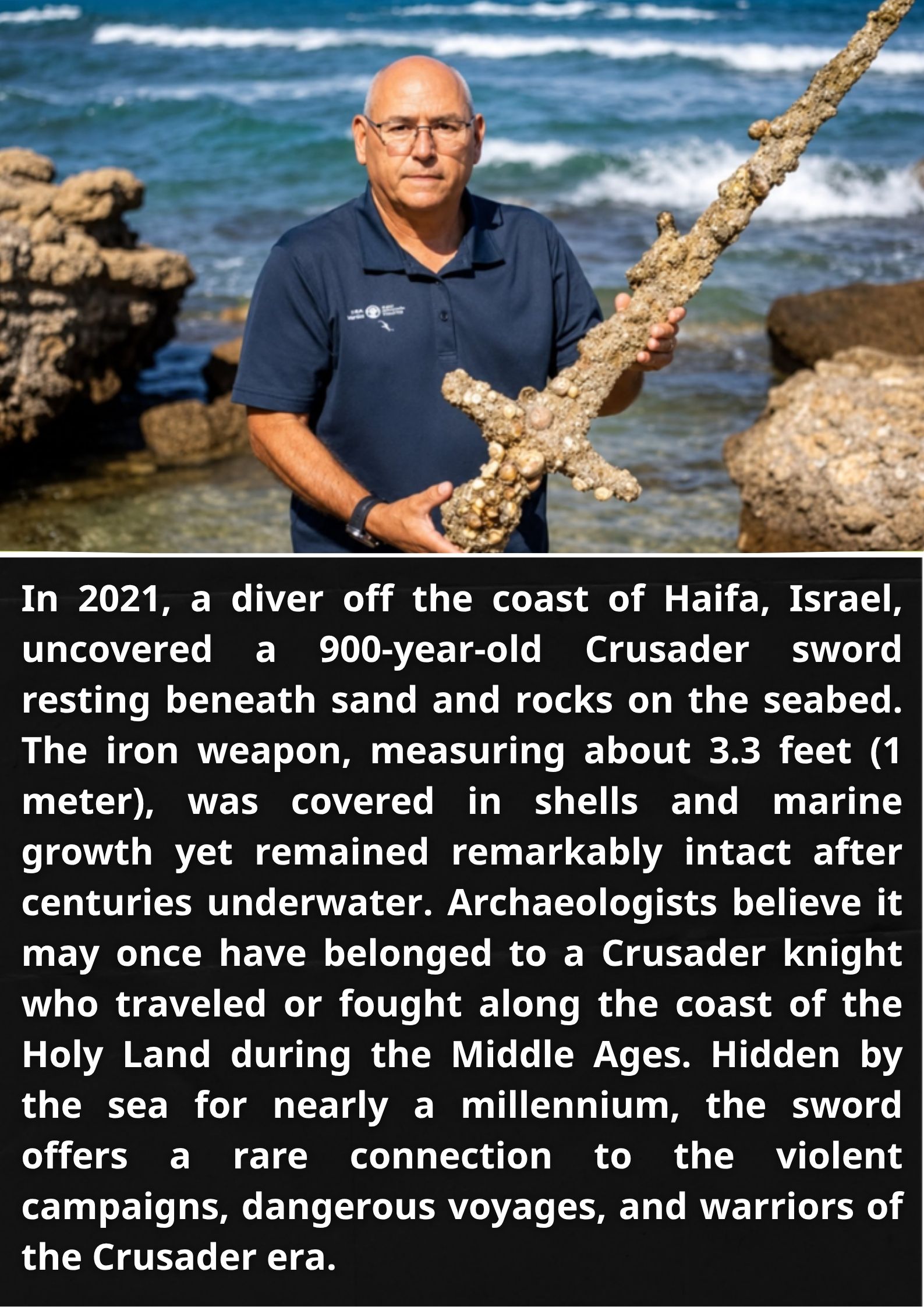
A remarkable piece of medieval history has emerged from the depths of the Mediterranean Sea off the coast of Israel. Resting beneath layers of sand, shells, and marine sediment for nearly nine centuries, a one-meter-long iron sword believed to have belonged to a Crusader knight was discovered by a recreational diver exploring the seabed. The find offers a rare and dramatic connection to the soldiers, pilgrims, sailors, and merchants who crossed these waters during one of the most turbulent periods of the Middle Ages.
The weapon was not found in a museum, tomb, or ruined fortress. It lay underwater, hidden in a natural cove where ships may once have anchored during dangerous journeys along the eastern Mediterranean coast. The sword was heavily covered with marine organisms and hardened deposits, creating a rough outer layer that almost completely concealed its original shape. Yet beneath that crust, the structure of the weapon remained surprisingly intact.
This natural covering may have helped protect the sword from further damage. Iron usually deteriorates quickly in salt water, especially over such a long period. However, when an object becomes buried beneath sediment and sealed from constant exposure to oxygen and strong currents, the rate of corrosion can sometimes slow. In this case, shells, sand, and mineral deposits formed around the blade, preserving the outline of a weapon that might otherwise have disappeared entirely.
The diver reportedly noticed the sword after shifting sands revealed part of it on the seabed. Underwater archaeological sites are constantly changing. Storms, waves, currents, and seasonal movement of sand can cover objects for hundreds of years and then suddenly expose them. A sword invisible one year may appear the next, only to be buried again within weeks. This makes accidental discoveries by divers especially important, but it also means that newly exposed artifacts can be extremely vulnerable.
Once the sword was reported, archaeologists from the local antiquities authority took control of the object. Recovering such a weapon is only the beginning of a long and delicate process. After centuries underwater, the metal can become unstable when exposed to air. If dried or cleaned too quickly, the sword could crack, flake, or suffer irreversible damage. Conservators must remove salt and sediment gradually while stabilizing the iron beneath.
The restoration process may take months or even years. Specialists often use controlled baths, careful mechanical cleaning, chemical treatment, and detailed imaging to understand what remains under the marine crust. X-rays or other scanning methods can reveal the shape of the blade, hilt, and internal structure without immediately removing all the deposits. Every step must be recorded because the layers around the sword may contain valuable clues about how and where it was lost.
Archaeologists believe the weapon dates to the 11th or 12th century, during the period of the Crusades. These military campaigns brought large numbers of European knights, soldiers, clergy, pilgrims, and settlers to the eastern Mediterranean. Ports along the coast of the Holy Land became vital entry points for men, supplies, horses, weapons, and trade goods.
The sea route was essential. Traveling overland from Europe was long, expensive, and dangerous. Ships carried Crusaders from ports in Italy, France, and other parts of the Mediterranean toward cities such as Acre, Caesarea, and Jaffa. Natural coves offered temporary shelter when weather conditions became difficult or when ships needed to unload passengers and cargo.
The presence of ancient stone and metal anchors near the sword supports the idea that the area once served as a maritime refuge or anchorage. Ships may have waited there before continuing north or south along the coast. The cove could have been used repeatedly over centuries, leaving behind equipment, cargo, weapons, and personal possessions lost during storms, accidents, ship repairs, or military activity.
The sword itself appears to have been a serious battlefield weapon rather than a decorative object. Its length, weight, and hilt design suggest it was made for trained use. A professional-quality sword was expensive and valuable. It required skilled metalworkers, carefully forged iron, and a design balanced for combat. Such a weapon would likely have belonged to a knight, experienced soldier, or person of considerable rank.
For a Crusader warrior, a sword was more than a tool. It represented status, authority, training, and personal identity. Knights often relied on swords in close combat after using lances, bows, or other weapons. The sword could also carry symbolic meaning, especially during an age when religion, warfare, and social rank were deeply connected.
What remains unknown is how the weapon reached the seabed. It may have fallen overboard while a ship was anchored. It could have been lost during a storm, a maritime accident, or a sudden attack. The owner may have dropped it while boarding or leaving a vessel. Another possibility is that the sword sank with a damaged ship whose wooden structure later decayed, leaving only heavier objects scattered across the bottom.
The mystery of the missing knight is one of the most compelling aspects of the discovery. No name survives on the visible surface, and no written record directly identifies the owner. The sword does not tell us whether its final bearer was a wealthy nobleman, a professional soldier, or a Crusader arriving in the Holy Land for the first time.
Perhaps the warrior survived the loss and continued his journey without it. Perhaps the sword disappeared during an event that also claimed his life. The sea preserves objects but often erases the stories of the people who carried them.
This is what makes underwater archaeology so powerful. A single artifact can open a window into an entire historical world. The sword connects the modern coastline of Israel to medieval ships, religious expeditions, military campaigns, and the movement of people across the Mediterranean. It reminds us that history did not unfold only in castles and battlefields. It also happened in harbors, on ships, and along dangerous sea routes.
The Mediterranean seabed is filled with layers of human activity. Ancient anchors, amphorae, coins, weapons, tools, and shipwreck remains lie beneath its waters. Some objects date to the Bronze Age, while others belong to the Roman, Byzantine, Islamic, Crusader, Ottoman, and modern periods. Together, they form an underwater archive of trade, conflict, travel, and technological change.
Unlike a traditional museum, however, this archive is difficult to access and constantly at risk. Natural forces can expose or destroy artifacts. Illegal collecting and careless removal can erase archaeological context. An object recovered without its exact location, depth, and surrounding evidence loses much of its historical meaning. For this reason, cooperation between divers and archaeologists is essential.
The Crusader sword is valuable not simply because it is old or visually dramatic. Its true importance lies in the information it may provide. The metal composition could reveal where it was produced. The shape of the hilt may help specialists compare it with known European sword types. Traces of wood, leather, or decoration could survive beneath the deposits. Even the marine growth attached to it may help researchers understand how long the sword remained exposed before burial.
Once conservation is complete, the weapon may eventually be displayed to the public. If so, visitors will see more than a medieval blade. They will be looking at an object that crossed centuries beneath the sea, protected by the same waters that once carried Crusaders toward the Holy Land.
The sword’s survival is almost as extraordinary as its discovery. For nearly 900 years, it remained hidden while empires rose and fell, coastlines changed, and generations passed above it. Then, through a chance movement of sand and the sharp eye of a diver, it returned to the human world.
Its owner remains unknown. Its final battle, voyage, or accident may never be explained. Yet the weapon still speaks through its material, shape, and location. It is a silent witness to a violent and complex age—and a reminder that the ocean floor remains one of the largest unexplored museums on Earth.