The golden gates of the Place Stanislas glowed in the autumn sunlight, untouched by the devastation that had consumed so much of France. Behind them, the cathedral stood whole, the Baroque facades unmarred, the fountains still flowing. For a city that had officially requested to be bypassed by war, Nancy had achieved the improbable, surviving one of the most aggressive campaigns of World War II without a single battle fought within its streets.
But the path to this preservation was not paved with accommodation, it was carved through a complex calculus of refusal, reconnaissance, and misdirection that would teach the Allies a lesson about the nature of modern conflict. The story of Nancy isn’t about a general ignoring a plea; it is about a general who understood that refusing a request is often a tactical choice that creates an opening, a tactical maneuver disguised as a compromise.
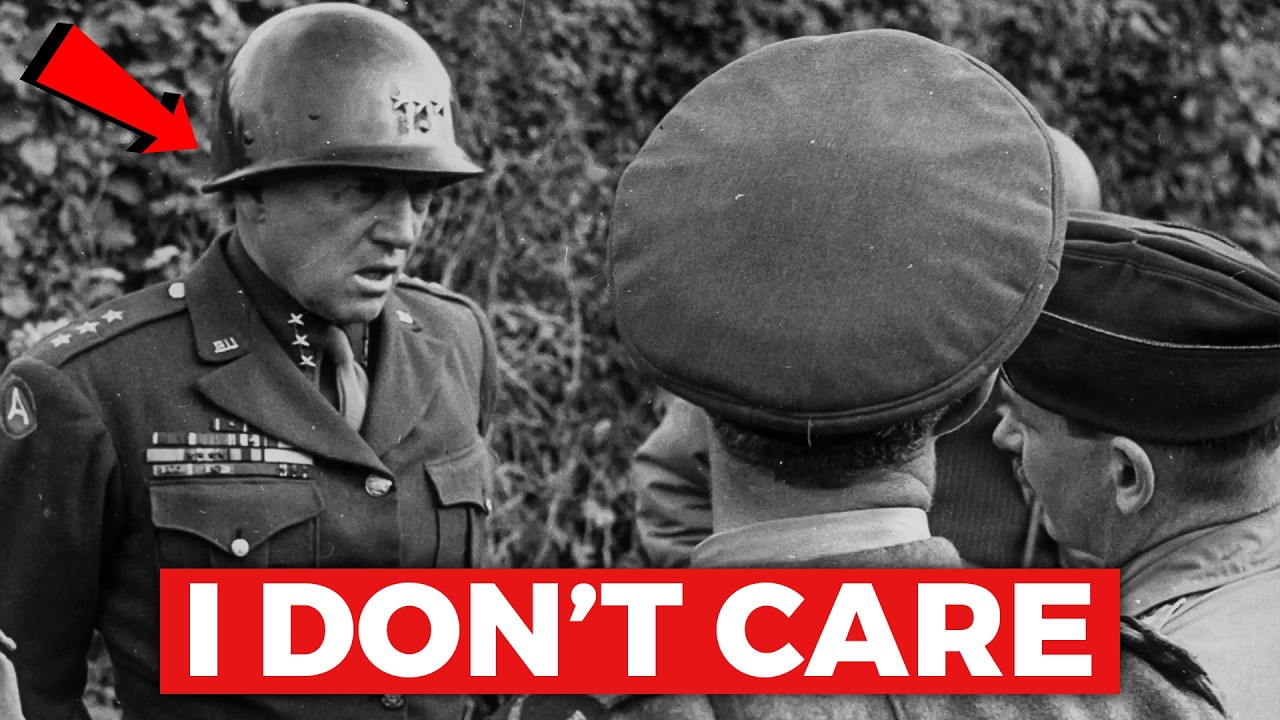 The saga began not with a threat and a response, but with a specific logistical crisis that would fundamentally alter the approach to the final stage of the war. By the end of August 1944, General George S. Patton’s Third Army had achieved what many planners had considered a fantasy.
In less than a month, they had broken the Normandy stalemate, driven hundreds of miles across France, shattered the German defense lines, and reached the banks of the Meuse River. The armored columns stood poised, looking east at the Rhine’s potential. The war felt like it might have a date attached to its end.
Then, the engines went silent. The Third Army was burning approximately 400,000 gallons of fuel daily. Bernard Montgomery’s Operation Market Garden, a massive airborne gamble in the Netherlands, had been given fuel priority.
Patton’s tanks ground to a halt, forced to wait for the resource to flow back.
For five days the Third Army sat inert in the Verdun sector. They were not halting because of enemy resistance, but because their fuel tanks were empty. This was a dynamic that military historians repeatedly examine, a stark reminder that modern warfare is a system of consumption.
It allowed the retreating German forces to stop, to breathe, and to transform the geography of the battlefield. When the fuel finally arrived in early September, the ground had changed dramatically. What was once a disorganized retreat was now a reinforced defensive network.
Directly in the path of the army’s advance stood a city that, due to that pause, had become a formidable obstruction. Nancy.
Located where the Moselle River wrapped around its western base, Nancy was in a strategic defensive position. The fast-flowing river was a natural barrier, while to the east, a chain of elevated high ground known as the Grand Couronné de Nancy dominated the approaches. The layout was simple for a defender.
The river was a problem to cross, while the high ground offered command in the form of long-range artillery. General Johanes Blockwitz understood this perfectly. He moved elements of two Panzergrenadier Divisions into the area, ordered the mining of bridges, registered artillery on likely assembly areas, and reinforced the natural and man-made high ground.
The city was meant to be a trap, but a letter was already underway.
The civilian leadership of Nancy could see the front collapsing and could see the danger. They had witnessed the destruction of various cities in France caught between armies. The mayor and the regional prefect had watched reports of other immediate artillery bombardments.
 In their letter, they argued that the city held no strategic military targets, exactly the sort of bearing that would be destroyed if the Germans chose to make an example of the historic architecture. The message was passed through the lines to the XII Corps HQ, commanded by Major General Manton Eddy. The request was for the American Army to go around the city, to leave it unassaulted.
The letter did not make it to a table-pounding though. Patton looked at a map, and looked at the Moselle crossings, and looked at the roads leading east. He knew that the bridges were a necessity, not a convenience.
Without a way to get armor across the river and onto the main road network, his advance would slow to a crawl. He couldn’t simply ignore the city. He could not simply blast through it.
The demand to go around had created a vacuum in his intelligence, forcing him to look at what the mayor was not mentioning. In essence, the refusal had drawn a map of where the defense was concentrated. The letter was not just a rude rebuff; it was an unintentional piece of intelligence.
The first attempt to cross the Moselle came on the 5th of September. The plan was straightforward. The 80th infantry division would push to the north, at Pont-à-Mousson.
The attack failed with a realistic but devastating defeat. However, the German defenders on the high ground hammered the infantry on the water. The crossing was abandoned.
Eddy considered a pause by a week to bring up more artillery. Patton rejected the notion. He understood that a pause wasn’t neutral; it was costing him the war.
German reinforcements were continually arriving south of the bridgehead.
It came at a station called Dieulor, where the river bend and the terrain was unfavorable for defenders and more favorable for attack. On the night of the 11th of September, under a driving rainstorm in near-zero visibility, the 80th moved to the waterline. No artillery preparation, just infantry, rubber assault boats and what remained of the element of surprise.
The first tanks of the 4th Armored Division started streaming across a newly constructed bridge. The crossing had been made. The point of decision had been effectively moved to a location where the city’s rejection was not relevant.
 It was now a race to flank the objective.
The orders given to Lieutenant Creighton Abrams, commanding the lead armored task force of the 4th Armored Division, were not to attack Nancy. It was a simple command. Go around it.
The maneuver was a textbook example of flanking, avoiding a fortified position in itself. They had enacted flanking, the key and the blueprint for the entire battle. Abrams’ column was moving so fast that they were appearing at road junctions before the German intelligence had even been noted on staff maps.
This fast-paced movement not only bypassed the defenses but also severed lines of communication and escape. The 80th pressed north from and 35th from the south. They weren’t making a direct brunt, they were a pincer on a city that was never being directly targeted.
The result of the mayor’s request was being achieved, but through a logistical breakdown of the periphery, not a direct shutdown of the core.
Germans within the city could not sit static. The encirclement was a powerful prize that Hitler could not allow the Allies to hold. If the connection broke, German line was compromised in a manner he couldn’t accept.
This led to the order for the 5th Panzer army, equipped with veteran units with state-of-the-art Panther tanks, to counterattack. This was intended to be a norm of the American bridgehead. The Panthers were superior to the Shermans, and self-confidence built a racist weapon.
But the battleground was about to be altered by the most effective weapon an attacking force could have: the environment.
On the 19th of September, a thick autumn fog settled over the Lorraine plateau, reducing visibility to a few hundred to a few hundred meters. The Panthers, which had been designed for long-range fires with a high velocity cannon, were now blind. The tanks lost their tactical advantages.
American 4th Infantry, using radios, worked in small teams, using terrain not known to the tank commanders and maneuvering to the flanks, neutralizing the Panzer’s superior frontal armor. The advantage was now tactical. The counterattack collapsed.
 By the 22nd of September, the armored offensive had lost all cohesion. The greatest armor threat of the western front was exhausted, and Nancy was completely encircled.
Inside the city, the German commander understood the dilemma was not a question of courage but of logistics. With supply routes cut and the reserves beaten, the orders to hold were meaningless. On the night of September 15th, the orders came to withdrawal from the city.
Before the German armor left, they attempted to destroy the bridge’s strategic to deny the choice of them to the Allies. But they triggered a detonation sequence that had been sabotaged by the French resistance. The wires had been cut, the explosives were inert.
The bridges held.
The American forces entered Nancy on the 20th of September. The tanks drove into the Place Stanislas. The French did not see humanitarianist, architecture was intact.
The city, which had been asked to be left alone, was not captured by direct attack. It was bypassed by, it was left as requested. The letter had asked for this exact result.
The mayor, in his plea, had inadvertently aided the strategy. The message had not been tossed aside; it had been studied, dismantled and used as invaluable information. The fight had taken place on the river, in the hills and at the plateau.
Nancy itself had been the objective, not the battlefield.
General Patton walked the golden gates of the Place Stanislas when he visited in the days that followed. The architecture, the mayor’s request, and the front. He acknowledged that the city’s deepest desire had been preserved, not through attempts to attack, but through the discipline needed to understand a refusal.
The general understood that refusal was a form of information about what you should not do. It was not just about aggression. It was about reading a wrong as a question.
How do I proceed? Do you bypass or depth? The premise of the result was not achieved through strength or the Germans, but through the masterful strategy of the allies to find the path of least resistance.
In the end, the gates had not been opened; they had been entered without being touched. Nancy remained an architectural pearl of the crown, a testament to a strategy that won the day not with sheer brute force, but with a calculated turning of the ivy.