Leif Erikson is remembered as the Viking who reached North America nearly five centuries before Columbus. But the final stretch of his life was consumed not by new discoveries, but by family betrayals, a deadly epidemic, and a sister whose violent ambition echoed the darkest patterns of their family line. His story began long before his birth, shaped by a pattern of bloodshed. His grandfather, Thorvald, was banished from Norway for manslaughter, forcing the family into exile.
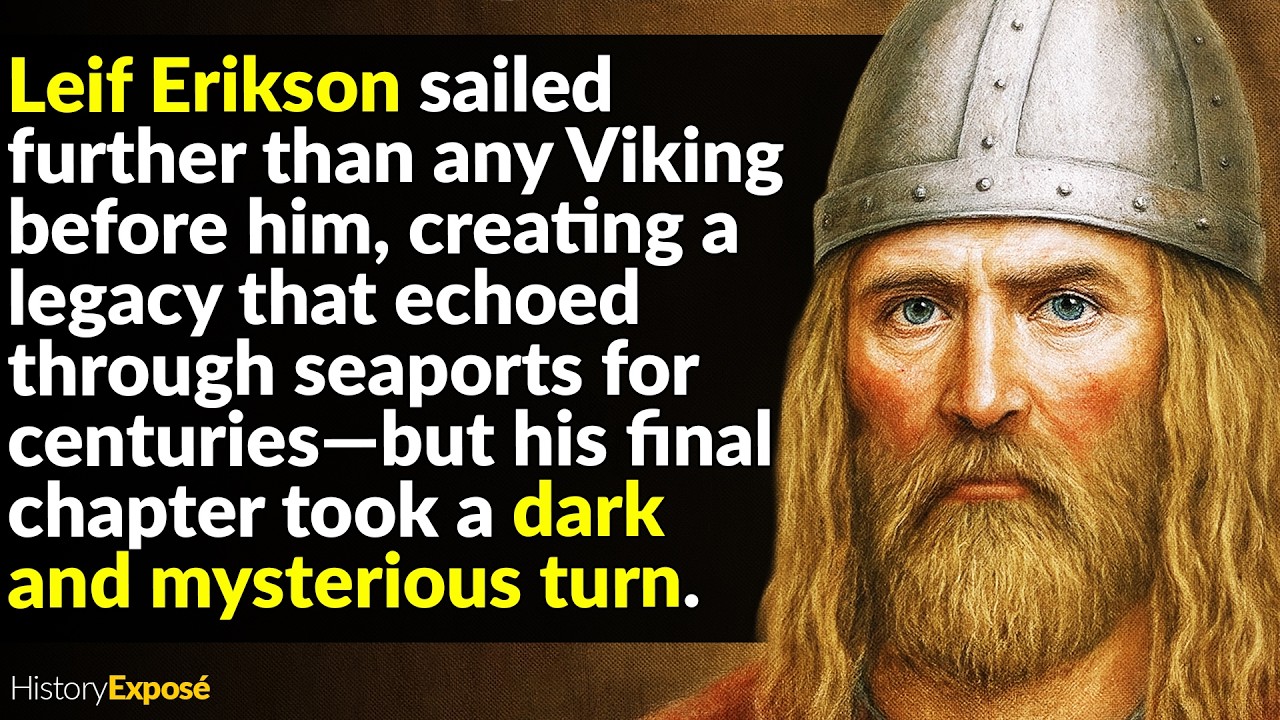
His father, Eric the Red, followed a similar path after his own violent troubles, eventually leading an expedition to Greenland. Of the 25 ships that set out for the new colony, only 14 arrived. The rest either turned back or were lost at sea. Leif grew up in that harsh, isolated settlement, the son of a larger-than-life father with towering expectations.
He spent his early years helping build a colony that would eventually grow to around 5,000 people. But unlike his hot-tempered father, Leif developed a steadier, more measured character. As a young man, Leif finally traveled to Norway to serve at the court of King Olaf Tryggvason. The journey took an unexpected turn when his ship was blown off course into the Hebrides off the coast of modern Scotland.
There, according to the Saga of Eric the Red, he fell into a whirlwind romance with a noblewoman named Thorgunna. Their relationship produced a son, Thorgils, but her parents refused to let her leave with him. Leif chose honor over love and continued on to Norway without her. At the royal court, Leif converted to Christianity, embracing the faith with the same dedication he gave to everything else.
King Olaf, eager to spread the religion, sent him back to Greenland with a dangerous mission: convert the settlers there. Leif was especially keen to bring his parents into the fold. His mother, Thjodhild, accepted the new faith eagerly and even built the first Christian church in Greenland. His father did not.
Eric the Red was furious and rejected the religion outright, reportedly deepening a rift that strained his marriage. The mission was interrupted by another stroke of fortune. On his way back to Greenland, bad winds pushed Leif off course onto a foreign shore. He and his crew found wild grapes, self-sewn wheat, and maple trees, none of which they recognized from Greenland or Iceland.
They gathered samples and named the land Vinland. Historians largely agree that this was present-day Newfoundland, which would make Leif Erikson the first European known to have set foot in North America. That achievement earned him the nickname Leif the Lucky. But another saga presents a different account.
In that version, a fellow Norse explorer named Bjarni Herjólfsson had already sighted the North American coast years earlier without landing. Leif, hearing of the discovery, reportedly bought Bjarni’s ship and set out deliberately to find the land. If that account is true, Leif was still the first European to set foot there, but he was not the first to see it. A separate story claims Eric the Red almost joined his son on the voyage but fell off his horse on the way to the ship and took it as a bad omen, robbing himself of a place in history.
Leif’s role in settling Vinland is uncertain. One account says he only collected samples and never returned. Another credits him with founding a small settlement called Leifsbudir. What is clear is that word of Vinland spread, drawing other Norse explorers to the new coast.
One of them, Þorfinn Karlsefni, followed Leif’s route with Leif’s brother Thorvald in tow, hoping to establish a permanent settlement. They found indigenous peoples, whom they treated with contempt, calling them “skraelings,” a derogatory term. The encounters turned violent. An attack on one of their northern camps forced them to abandon it.
Later, Thorvald faced an indigenous man in a confrontation and was killed by an arrow. The expedition gave up on settling the land. On the way home, Karlsefni took two indigenous boys captive and brought them back to Greenland. Leif himself had one more moment of good fortune.
On a return trip from Vinland, he came across a stranded Icelandic crew and rescued them, another act that reinforced his lucky reputation. Around the year 1000, the Greenland settlement was prospering. More immigrants were arriving each season. But one shipload brought destruction.
The new arrivals carried a plague or epidemic that swept through the isolated colony. Many community leaders died, including Eric the Red, who perished during the winter of 1002. His death changed everything for Leif. He took over as the main chieftain of the Greenland settlement, a heavy responsibility that likely kept him from ever returning to Vinland.
But the worst troubles came not from the outside but from within his own family. His sister Freydís, who took after their father far more than either of them cared to admit, asked Leif for permission to travel to Vinland and make use of the structures his people had built there. He agreed. It was a disaster from beginning to end.
Freydís brought two Icelandic brothers, Helgi and Finnbogi, on the trip, with an agreement to split the work and the profits. She immediately betrayed them. When they arrived, she claimed her brother’s buildings for herself and forced the brothers out of shelter. Then she goaded her husband into killing them so she could keep everything.
According to the saga that tells her story, the violence did not stop there. After her husband killed the brothers and their men, he left five women alive because he could not bring himself to kill a woman. Freydís took an axe and killed them herself. When she returned to Greenland, she lied to her brother.
She told Leif that Helgi and Finnbogi and their entire party had simply chosen to stay in Vinland. Leif may have wanted to believe her, but the truth came out. Word traveled across the Atlantic, and Leif eventually learned what his sister had done. His response was harsh.
He took three of the men who had returned with Freydís and tortured them until they confessed everything that had happened in Vinland. But when it came to his sister, he stopped. Even though she had been the mastermind behind the murders, Leif could not bring himself to truly punish her. He told her only that her descendants would have little prosperity, a prediction the sagas claim later came true.
Leif had only a few more years as chieftain. The last record mentioning him as alive comes from the year 1020. By 1025, the sagas report that his son Thorkel, from a different mother than Thorgils, was in charge of the settlement. After that, virtually nothing is known about Leif’s death or his descendants.
Despite the silence of the historical record, he has not been forgotten. Today, Leif Erikson Day is observed across the United States, and his story has been retold in countless books and shows. While his father embodied the fierce, impulsive Viking spirit, Leif is remembered as a more measured figure, a navigator of both dangerous seas and dangerous people, whose legacy reached a new world long before anyone else in Europe knew it existed.