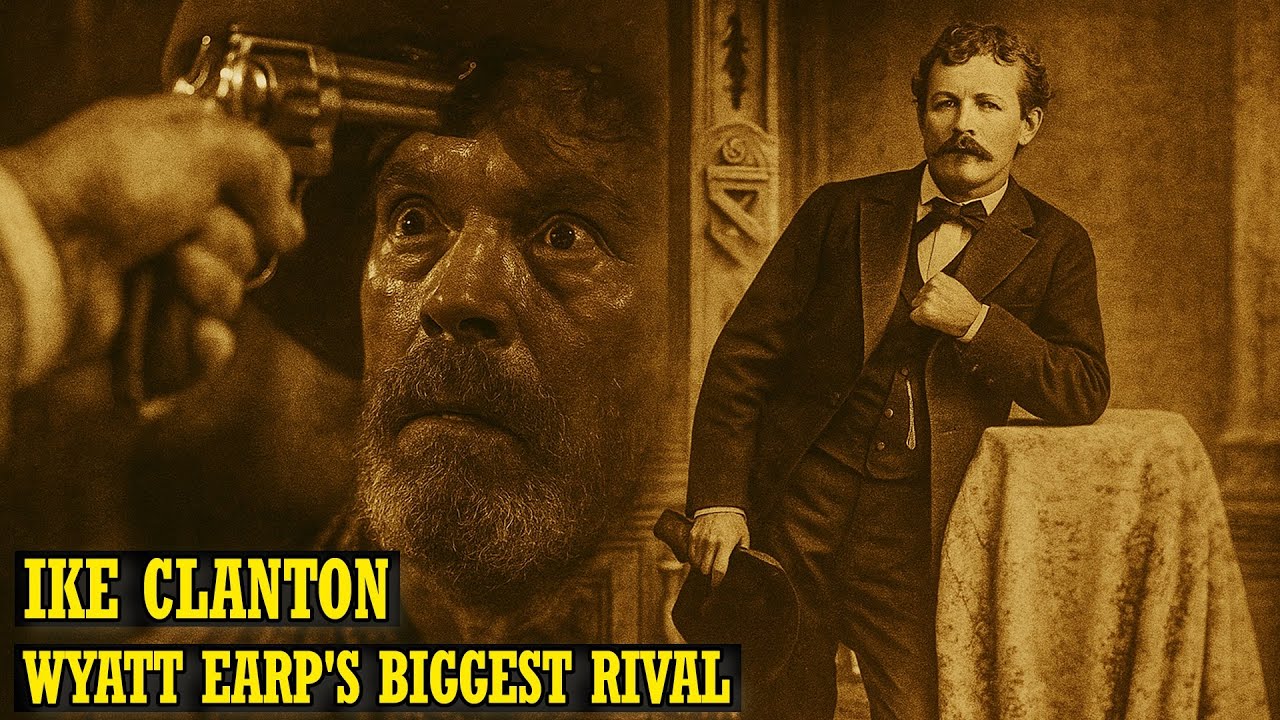
The dusty streets of Tombstone, Arizona, have long been synonymous with the legend of Wyatt Earp, a man whose name is etched into the annals of American frontier history as a symbol of law and order. However, the story of the Wild West is rarely a simple tale of good versus evil, and the narrative that has dominated popular culture for over a century often overlooks the complex and volatile figure who served as Earp’s primary antagonist. Joseph Isaac “Ike” Clanton was not merely a footnote in history; he was a catalyst, a man whose hot-headed ambition and deep-seated grudges helped ignite the powder keg that exploded into the most infamous gunfight in Old West lore.
While Earp is remembered for his steely resolve and his role as a peacekeeper, Clanton represents the chaotic, lawless underbelly of the frontier, a man who played a dangerous game in a land where the rules were written in blood and gunpowder. To understand the events of October 26, 1881, one must look beyond the smoke of the gunfight at the O. K.
 Corral and examine the life of the man who, by his own actions and rhetoric, helped set the stage for that deadly confrontation.
Ike Clanton’s story begins not in the lawless territories of the Southwest, but in the relative civility of Callaway County, Missouri. Born into a family of seven children to Newman Haynes Clanton and Mariah Ston Kelso Clanton, Ike’s early life was shaped by a father of many trades. Newman Clanton was a man who embodied the restless spirit of the era, working as a miner during the gold rush, taking up farming, and eventually finding his way into the cattle business as the family pushed westward.
The death of Ike’s mother in 1866, when he was still a young man, was a significant loss, but it did not sever the bonds between the Clanton siblings and their formidable father. By 1877, the family had relocated to the area that would soon become Tombstone, Arizona Territory, a region that was then a sparsely populated frontier before the discovery of silver transformed it into a booming, chaotic metropolis. In these early years, Newman Clanton lived with his sons, including Finn, Ike, and the youngest, Billy, establishing a presence in the San Pedro River valley.
Ike initially set up a modest food stand near the Tombstone Mill site, a location known today as Millville, but by 1881, his focus had shifted to managing the family’s cattle operation at Lewis Springs, a sprawling ranch that served as a hub for their growing enterprise.
The Clanton family, along with their hired hands and nearby associates, were part of a loosely organized faction known as the Cowboys. This group, which included figures like Curly Bill Brocius and the McClury brothers, was notorious for its rowdy behavior and its blatant disregard for formal legal boundaries, particularly those that separated the United States from Mexico. The Cowboys were frequently suspected of driving cattle across the border under questionable circumstances, engaging in a lucrative but illegal cross-border trade that was fueled by high Mexican taxes on goods moving north.
This trade made unauthorized commerce far more profitable than legitimate business, and the Clanton ranch, located close to the border, became a central hub for the movement of cattle and goods, both legal and otherwise. The family’s operation was financially successful, with Ike later testifying that they had raised and acquired roughly 700 head of cattle in a single year. However, their success was built on a shaky legal foundation, as the Clantons had never officially registered a cattle brand in either Cochise County or neighboring Pima County, a legal requirement that made their operations questionable and left them vulnerable to accusations of rustling.
The tension between the Clantons and the Earp brothers was not born overnight; it was the result of a complex web of personal grievances, political allegiances, and economic rivalries that had been simmering for years. The divide was rooted in conflicting loyalties, as the Cowboys, including the Clantons, supported the sitting sheriff, Charles Shibell, during the November 1880 election for Pima County Sheriff, while the Earps backed his challenger, Bob Paul. This political split added fuel to their existing disputes, widening the gap between the two groups and creating a climate of mutual distrust.
A specific incident in late 1879 likely intensified the resentment. Shortly after Wyatt Earp had settled in Tombstone, one of his horses went missing. Over a year later, Earp received word that the animal was being seen near Charleston, and he and Doc Holliday traveled to the Clanton Ranch to reclaim it.
According to Wyatt’s later court testimony, 18-year-old Billy Clanton made a sarcastic remark, asking Wyatt if he had any more horses to lose. Despite the comment, Billy returned the horse without being shown ownership documents, an act that Wyatt interpreted as a clear sign that Billy knew the horse had originally belonged to him. This encounter deepened Wyatt’s distrust of the Clantons and set the stage for the escalating hostilities that would follow.
Ike Clanton was known for his strong opinions, frequent public remarks, and heavy drinking, a combination that made him a volatile presence in the saloons and public gatherings of Tombstone. His outspoken nature contributed to his growing reputation as a controversial figure, and many locals viewed him as someone who talked more than he acted, a perception that both frustrated and amused his rivals. This reputation was on full display in the months leading up to the gunfight.
After being passed over by Sheriff Johnny Behan for the role of under-sheriff, Wyatt Earp began to consider a future run for sheriff of Cochise County. He believed that earning a strong public reputation, particularly through solving high-profile crimes, could boost his chances in the next election. One opportunity came after the deadly March 15, 1881, stagecoach robbery near Benson, in which both the driver and a passenger lost their lives.
According to Earp’s later statements, on June 2, 1881, he approached Ike Clanton with a proposition, offering him a financial incentive, specifically the reward posted by Wells Fargo and Company, in exchange for information that could lead to the arrest of those responsible for the stagecoach incident. Earp said the plan ultimately failed when the three main suspects died in separate unrelated confrontations before they could be captured, eliminating his chance to use the case as a platform for his political ambitions.
The simmering tension between the two factions came to a head in the days leading up to October 26, 1881. On the evening of October 25, while Ike Clanton was in Tombstone and noticeably intoxicated, tensions escalated when Doc Holliday confronted him. Holliday openly accused Clanton of spreading falsehoods about the Benson stagecoach robbery, a heated exchange that drew the attention of Tombstone City Marshal Virgil Earp.
Virgil intervened in an attempt to keep the peace, warning both men that he would place them under arrest if they didn’t settle down. After Holliday left the area, Virgil Earp remained out and joined a card game that lasted through the night, with participants including Ike Clanton, Tom McLaury, Cochise County Sheriff Johnny Behan, and another man. The game lasted until about dawn on October 26.
By around 8 a. m. , Clanton was still out, having consumed alcohol throughout the night.
 In front of the telegraph office, bartender E. F. Boyle encountered him and recommended he find a place to sleep.
Clanton declined, and Boyle later testified that Clanton was carrying a firearm and that he helped cover it to avoid drawing attention. According to Boyle, Clanton then made a troubling statement, suggesting that as soon as the Earps and Doc Holliday appeared on the street, there would be a confrontation. Concerned, Boyle went directly to Wyatt Earp’s house to report the threat, a discrepancy that would become part of the larger debate surrounding the tensions that culminated in the gunfight later that day.
Later that morning, Ike Clanton retrieved his rifle and single-action revolver from the West End Corral, where he had left them earlier along with his wagon and team. After arming himself again, he resumed drinking and was reportedly telling others around town that he was looking for either Doc Holliday or one of the Earp brothers. By around 1 p.
m. , Virgil and Morgan Earp encountered Clanton on Fourth Street. According to later accounts, Virgil approached him from behind and struck him to subdue him.
The brothers then disarmed Clanton and escorted him to face Judge Wallace for violating Tombstone’s ordinance number nine, which prohibited carrying firearms within city limits. While waiting for the judge, Clanton later testified that Wyatt Earp used strong language toward him and that the Earps offered to return his rifle and fight him on the spot inside the courthouse, an offer Clanton said he refused. Judge Wallace fined Clanton $25 along with court costs, and after paying the fine, Clanton was released without his firearms.
Around 1:30 to 2 p. m. , the situation began to escalate further.
Tom McLaury had already been involved in a separate altercation with Wyatt Earp, and word had traveled fast. That afternoon, Tom’s older brother, Frank McLaury, and Ike’s younger brother, Billy Clanton, rode into Tombstone, having heard from a neighbor that Ike and Tom had been involved in confrontations the night before. Both Frank and Billy arrived on horseback and were carrying rifles and revolvers, which was customary for men traveling through the rural areas outside Tombstone.
When they arrived, their first stop was the Grand Hotel on Allen Street, where they encountered Doc Holliday. It wasn’t long before they learned that their brothers had each been involved in separate physical altercations with the Earps earlier that day.
Around this time, a man named Coleman informed City Marshal Virgil Earp that the Cowboys had been seen leaving the Dunbar and Dexter livery stable near the O. K. Corral and were still visibly armed.
This prompted Virgil to make the decision to have them disarmed. Most of Tombstone’s main corrals, including the O. K.
Corral, were located just west of Fourth Street, within a block or two of where Wyatt Earp reportedly observed the Cowboys purchasing ammunition. Meanwhile, Cochise County Sheriff Johnny Behan, who had long-standing ties to the Cowboys, later stated he didn’t hear about the developing conflict until after 1:30 p. m.
Around 2:30 p. m. , he spotted both Clanton brothers and both McLaury brothers gathered in a narrow empty lot off Fremont Street, a location roughly six lots away from the rear entrance to the O.
K. Corral. Upon learning that Wyatt Earp had already been speaking with the Cowboys near Spangenberg’s gun shop, Virgil Earp retrieved a short double-barreled shotgun from the Wells Fargo office and concealed it beneath a long overcoat as he walked to Hafford Saloon.
There he handed the shotgun to Doc Holliday and took Holliday’s walking stick in exchange, allowing them to switch weapons discreetly. After leaving Spangenberg’s, the Cowboys walked to the rear of the O. K.
 Corral, then moved north, gathering in the vacant lot next to Fly’s boarding house, the same place where Doc Holliday resided. Virgil Earp received multiple reports that the Clantons and McLaurys were gathered on Fremont Street and visibly carrying weapons, and he decided that he needed to respond as the town marshal.
When the confrontation on Fremont Street escalated into gunfire, Ike Clanton did not join the fight. Instead, he rushed toward Wyatt Earp, insisting that he was unarmed and had no intention of engaging in violence. Wyatt later recalled telling him something to the effect of, “Then get to fighting or move out of the way.”
Clanton quickly ran into the front entrance of C. S. Fly’s boarding house and managed to escape the incident without injury.
By the end of the gunfight, Tom McLaury, Frank McLaury, and Billy Clanton had lost their lives. Their deaths marked a turning point in the ongoing conflict between the Earps and the Cowboys, with long-lasting consequences for all involved. Following the confrontation, Ike Clanton took legal action by filing murder charges against the Earp brothers and Doc Holliday.
All were arrested, but soon released on bail pending further proceedings. A preliminary hearing overseen by Judge Wells Spicer lasted for about a month. During this time, Ike Clanton gave testimony, claiming he had been mistreated by the Earps and Holliday on the evening before the shootout.
He denied ever threatening them and asserted that when Virgil Earp ordered the Cowboys to disarm, the group complied. However, under further questioning, Clanton’s version of events began to unravel. He made accusations that the Benson stagecoach robbery had been staged by the Earps and Holliday, and he went further, claiming that each of them had separately confessed their involvement in the robbery itself or in allowing the culprits to escape justice.
By the end of his testimony, Clanton’s story was full of contradictions, and rather than strengthening the prosecution’s case, his statements raised serious doubts about the reliability of the charges. Judge Wells Spicer ultimately cleared the Earp brothers and Doc Holliday of wrongdoing, highlighting that Ike Clanton, though unarmed the evening prior to the gunfight, had openly expressed hostility toward the Earps and Holliday.
The aftermath of the O. K. Corral did not bring peace to the Clanton family.
Later that year, on December 30, 1881, Virgil Earp was seriously injured in an ambush that left him with a permanently disabled left arm. Though Clanton’s hat was found near the ambush site, his supporters claimed he had been in Contention City at the time, and due to the lack of solid evidence, the case was dropped. On March 18, 1882, another tragedy struck when Morgan Earp was fatally shot while playing billiards at Hatch’s Saloon in Tombstone.
Following Morgan’s death, Wyatt Earp came to believe that the legal system would not bring the perpetrators to justice. Acting on his federal authority as a U. S.
deputy marshal, Wyatt organized a small escort to safely move Virgil and his wife to a train heading to their family home in Colton, California. In the days that followed, Wyatt assembled a larger group of allies, commonly referred to as the Earp Vendetta Ride, to track down those they believed responsible for the attacks on their family. Although they did not locate Ike Clanton, several other cowboy associates lost their lives during the pursuit.
By late April 1882, the Earps and Holliday left the Arizona Territory, and none of them would return to face legal consequences for the events that followed Morgan’s death.
Following the events at the O. K. Corral, the Clanton family sought a quieter life and relocated near their sister Mary’s property in the Springerville area of Apache County.
By 1885, both Ike and his brother Finn had established individual 160-acre ranches approximately 10 miles east of Springerville, close to the border with New Mexico. Around this time, a group of associates began to form around the Clantons, a loosely organized band that included men such as Lee Renfro, G. W.
 “Kid” Swingle, “Long-Hair” Sprague, Billy Evans, and their brother-in-law, Evan Stanley. They operated primarily from a ranch known as the Seneca Amarilla, located near Springerville. On November 6, 1885, local cattleman Isaac Ellinger and his associate Pratt Palmer shared a meal with the Clantons and Renfro at the ranch.
After dinner, an incident occurred in which Ellinger was critically wounded. He survived for several days before passing away, during which time he reportedly described the event as unjust and deliberate. Isaac’s brother, William Ellinger, was a prominent figure in the regional cattle industry and a member of the Apache County Stock Association, an organization actively working to protect livestock interests during a time when cattle theft was widespread.
Over the following year, tensions continued to mount, and on December 25, 1886, another troubling episode was linked to the group when Billy Evans allegedly committed a reckless act that resulted in the death of a local man named Jim Hail. By the mid-1880s, the Clantons and their associates were already under suspicion for their involvement in cattle theft, with reports circulating that livestock had been taken from the Springerville area and transported south through remote corridors to reach markets in Clifton and southern Arizona.
In April 1887, the Apache County Stock Association took action to address the growing issue of livestock theft. They hired a Pinkerton detective to investigate and locate the individuals responsible, and they appointed Jonas “Jake” V. Brighton, a constable from Springerville and a known range detective, to serve as a Secret Service officer in the effort.
That same month, Finn Clanton was arrested on charges related to cattle rustling and was held in St. Johns. Over the next several weeks, grand juries issued a series of indictments against the Clantons and several of their associates, including charges of cattle theft and even allegations of involvement in the death of Isaac Ellinger.
Brighton was tasked with locating Ike Clanton. After a three-day search, Brighton stayed overnight on May 31, 1887, at Jim Pegle Wilson’s Ranch along Eagle Creek, just south of Springerville. The following morning, Clanton appeared at the ranch, and Brighton recognized him immediately.
As Clanton began to leave, he retrieved his rifle, prompting Brighton to react. Clanton was struck by gunfire, which proved instantly fatal. A newspaper account from late June 1887 offered Brighton’s version of events, stating that Brighton and another man, Mr.
Miller, were eating breakfast at Wilson’s ranch when Clanton arrived. Brighton stepped out to speak with him, and upon noticing Miller, Clanton quickly turned his horse toward nearby brush for cover while preparing to use his firearm. Brighton and Miller reportedly called for Clanton to stop, but as he continued riding and began to raise his weapon, Brighton fired.
One shot was said to have passed through Clanton’s torso, and a second shot struck the saddle and slightly grazed his leg. Clanton fell from his horse and was found lifeless when Brighton and Miller approached. The rancher, Jim Wilson, informed nearby residents, and four local men assisted in identifying Clanton and arranging for a basic burial, considering the remote location and limited resources.
However, alternative accounts exist, with one version claiming Clanton’s body remained untouched for several days before being quietly buried in an unmarked grave by Mormon settlers in a cemetery southeast of Eager, Arizona, an area now known as the 26 Bar Ranch.
In modern years, some historians and writers have questioned the official version of events, speculating whether Clanton’s death may have been a result of personal motives rather than an act of law enforcement. In June 1996, a Clanton descendant, Terry Ike Clanton, joined historian James A. Browning to search for Ike Clanton’s final resting place.
Near Eagle Creek in what is today Greenlee County, Arizona, they located a shallow grave beneath a large tree, which they believed to hold Clanton’s remains. Since then, Terry Clanton has advocated for the remains to be exhumed and respectfully reinterred in Tombstone’s Boot Hill Cemetery, but his efforts have not yet received support from Tombstone officials. Ike Clanton wasn’t the fastest gun in the West, but he didn’t have to be.
His real weapon was influence, manipulation, and a deep understanding of how to stir the pot in a lawless land. While Wyatt Earp carved his legend into frontier justice, Clanton embodied the chaos that made towns like Tombstone famous. Love him or hate him, Ike Clanton helped shape the mythos of the Old West, one bold move at a time.