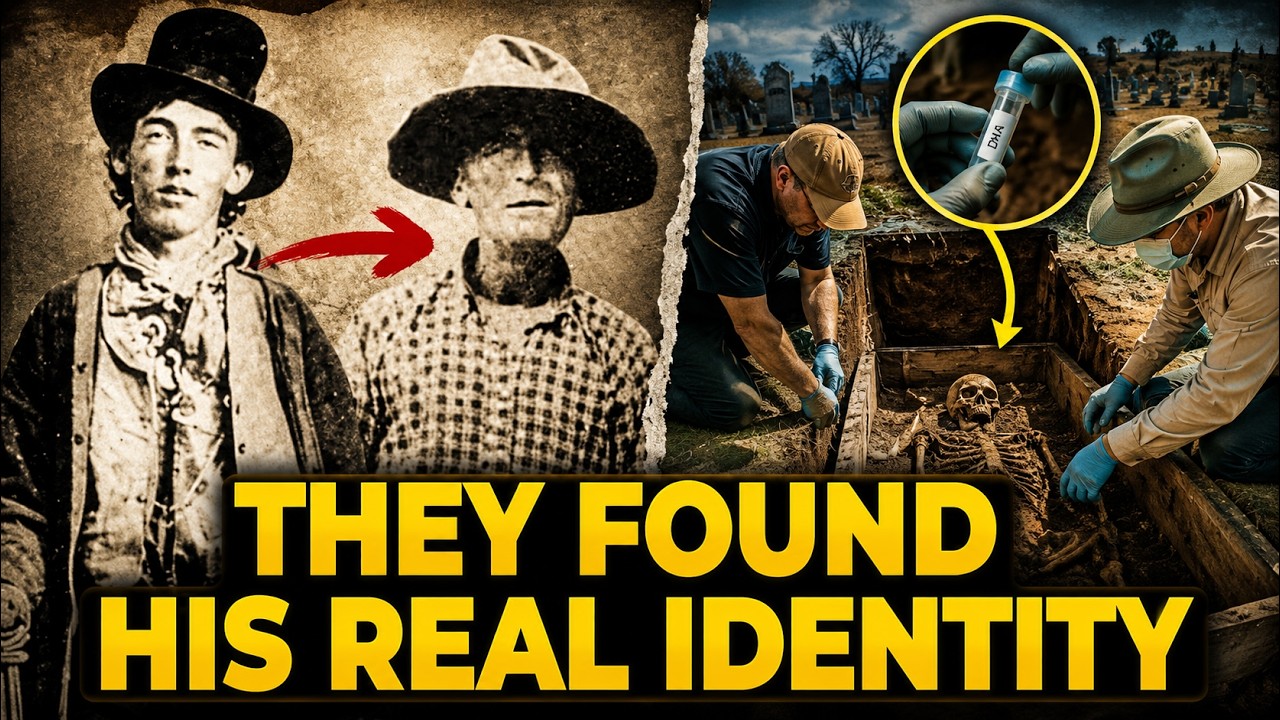
Nearly 70 years after Pat Garrett reportedly shot and killed Billy the Kid in a dark bedroom in New Mexico, an elderly Arizona man named John Miller made a stunning claim: he was the real Billy the Kid, and the outlaw had somehow survived that night in 1881. That claim launched a forensic investigation decades later, culminating in the 2005 exhumation of Miller’s remains in Prescott, Arizona, in hopes that DNA could finally settle one of the Old West’s most enduring mysteries. The case, however, produced no clear answer. The story widely accepted by historians begins on July 14, 1881, at Fort Sumner in New Mexico Territory.
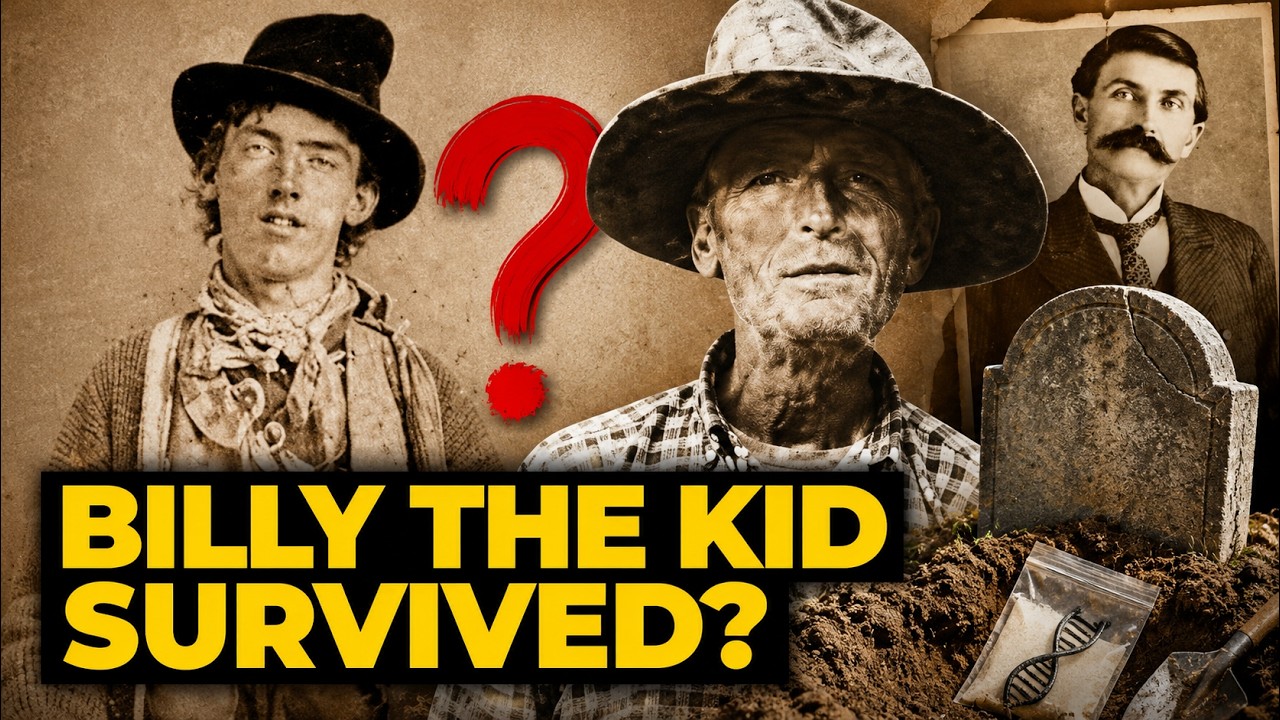
Sheriff Pat Garrett had been hunting William H. Bonney, known as Billy the Kid, after the outlaw escaped from the Lincoln County jail while awaiting execution for the killing of Sheriff William Brady. Garrett entered the home of Pete Maxwell, a local rancher who knew Billy well. According to Garrett’s account, Billy entered the dark bedroom, asked in Spanish who was there, and Garrett fired twice, striking him near the heart with one bullet.
The next day, a coroner’s jury identified the dead man as William Bonney, declared the killing justified, and named Garrett as the shooter. The jury was not drawing on a stranger’s name. Before becoming a legend, Billy the Kid lived a documented life rooted in New Mexico, where many people knew him personally. Born Henry McCarty around 1859 in New York, he moved west with his mother, Catherine, who later married William Antrim and died of tuberculosis in Silver City in 1874.
After his mother’s death, Henry drifted into trouble, starting with a jail escape in 1875 over stolen clothing. In August 1877, he shot and killed blacksmith Francis Cahill during a fight near Camp Grant in Arizona, then fled back to New Mexico and adopted the name William H. Bonney. His path into the history books came through the Lincoln County War.
Billy went to work for English rancher John Tunstall, who was killed in February 1878 during a business dispute. Tunstall’s death pushed Billy and other supporters into a group known as the Regulators, who initially operated with legal authority before the conflict spiraled into open violence. On April 1, 1878, Sheriff William Brady and a deputy were killed in Lincoln, and Billy was among the men involved, wounded in the thigh during the shooting. By late 1880, Pat Garrett had become sheriff of Lincoln County and was hunting the outlaw.
In December, Garrett’s posse tracked Billy’s group to Stinking Springs, where Billy surrendered. He was tried for the murder of Sheriff Brady, found guilty in April 1881, and sentenced to hang. On April 28, he escaped, killing two deputies in the process. His escape made him one of the most wanted men in the territory, and Garrett resumed the hunt.
The moment of Billy’s alleged death at Fort Sumner has been scrutinized for more than a century. Billy was comfortable in the largely Spanish-speaking community there, and on the night of July 14, Garrett entered Pete Maxwell’s room near midnight. When Billy came toward the room and asked who was there, Maxwell identified him, and Garrett fired. The coroner’s inquest the next day ruled the killing justifiable homicide.
This was not a story created decades later; it was a legal record made days after the shooting by people who knew Billy. The lack of modern forensic tools at the time left the physical evidence open to question. Billy’s burial place at Fort Sumner was affected by years of neglect and flooding, and there has been no modern forensic identification of the remains currently associated with his grave. That gap created room for alternative theories, especially as popular writers built Billy into a larger-than-life figure.
Claims emerged that Garrett had secretly helped Billy escape, although historians note the coroner’s report, newspapers, and other documents support the accepted version. Over the years, many men were presented as surviving versions of Billy the Kid. Most never developed into serious cases, but two became famous. In the late 1940s, “Brushy Bill” Roberts of Texas claimed the identity but was undermined by records placing his birth too late.
John Miller of Arizona was different. He did not make a public career out of the claim during his lifetime. The story grew through friends, family accounts, and later researchers who said Miller had privately admitted he was Bonney. Miller’s records contain significant problems.
One of the most repeated claims is that he married a woman named Isidora in Las Vegas, New Mexico Territory, on August 8, 1881, less than a month after Billy’s reported death, with some versions adding that he carried a large revolver and had a chest wound. But Miller’s age and birthplace shift between records. A 1900 census entry suggested he was born in December 1857, close to Billy’s estimated age, while Arizona Pioneers’ Home records said he was born in 1850 and told a very different childhood story involving adoption after his parents were killed. That does not match the documented childhood of Henry McCarty.
Miller lived a long, quiet life in New Mexico and Arizona, working around horses and ranches with his wife, Isidora, and their adopted son, Max. People who knew him remembered him as a skilled horseman comfortable with firearms, and some said he spoke Spanish and knew detailed stories about the Lincoln County War. Those details made researchers pay attention, but none are unique to Billy the Kid. A cowboy who lived for decades in the West could easily have learned Spanish and known frontier history.
The harder question was whether a documented bridge existed connecting Henry McCarty to the specific John Miller who lived into the 20th century. The strongest evidence for believers came from private statements. An acquaintance named Frank Cracy reportedly said Miller had revealed his real identity as William Bonney. Stories attached to Miller’s adopted son also said Miller claimed another man had been buried as Billy.
These accounts were popularized in Helen Airy’s 1993 book, “Whatever Happened to Billy the Kid? ” which convinced investigators that Miller deserved examination. The problem is that these statements were not recorded during Billy’s lifetime, and most were reported after Miller’s death. Memory changes, and stories spread between families, making secondhand confessions difficult to verify.
In 1937, an elderly John Miller entered the Arizona Pioneers’ Home in Prescott after reportedly being hurt in a fall from a roof. He died later that year and was buried in the home’s cemetery without a clear headstone. That detail became critical nearly 70 years later when the cemetery became the site of a modern forensic investigation. In 2003, then Lincoln County Sheriff Tom Sullivan and researcher Steve Sederwall began a modern investigation into Billy’s death, combining law enforcement methods with the tools of forensic science.
Their initial idea was to obtain DNA from remains believed to be Billy at Fort Sumner and compare it with DNA from his mother, Catherine, buried in Silver City. Those exhumations ran into legal and practical problems. The investigators then turned to John Miller as a more practical target. The entire DNA plan depended on finding a biological reference connected to Billy.
Investigators located old furniture associated with the Maxwell property, including a wooden workbench reportedly used to lay out Billy’s body after the shooting. The bench carried old blood stains, and forensic scientist Dr. Henry Lee examined the material. On paper, the plan was simple: extract DNA from the old blood and from Miller’s remains, then compare them.
In practice, it was far more complicated. The bench’s own history had to be verified, the stain had to be proven to be Billy’s rather than contamination, and the sample had to contain enough intact genetic material. Crucially, there was no universally accepted modern DNA profile from Billy himself to serve as a control. On May 19, 2005, investigators opened the area believed to contain John Miller’s remains at the Arizona Pioneers’ Home Cemetery.
Forensic anthropologist Dr. Laura Fulginiti supervised the examination. The work immediately became complicated. Miller’s grave had no clear headstone, the coffins had deteriorated, and the bones were fragile.
Most importantly, the team encountered two sets of male remains in neighboring graves, just a few feet apart. Cemetery records indicated another man, William Hudspeth, had been buried close to Miller. The team now faced an identification problem before DNA testing even began. The two skeletons offered different clues.
One set had prominent front teeth and significant healed trauma on the right scapula, the shoulder blade. Sullivan and Sederwall were interested because Billy the Kid was known for his noticeable front teeth in his famous tintype photograph, and the shoulder injury seemed potentially consistent with a gunshot. Fulginiti was more cautious, confirming trauma but saying she could not determine it was caused by a gunshot. The second skeleton showed no such shoulder damage but had a hip injury still healing at the time of death.
That mattered because Miller was reported to have suffered a serious fall before entering the Pioneers’ Home. Fulginiti therefore considered the skeleton with the healing hip injury the better candidate for Miller. Sullivan disagreed, favoring the skeleton with the shoulder injury. The two sets of remains became known informally as “scapula man” and “hip man.
”
The DNA results added another complication. Dr. Rick Staub of Orchid Cellmark in Dallas worked on samples from the exhumation. Reports from the time said usable DNA could not be obtained from the hip-man skeleton, the remains Fulginiti thought most likely to be Miller.
A usable sample was obtained from scapula man, the skeleton Sullivan preferred. That meant the investigators had DNA from the more visually interesting set of remains, but the identity of that man was disputed. If scapula man was actually the neighboring William Hudspeth, comparing his DNA with the bench would say nothing about John Miller. Both ends of the comparison carried uncertainty.
The DNA testing did not produce the clear public answer many expected. In 2005, reporting indicated the laboratory work was delayed in part because Orchid Cellmark was also handling identification work connected to Hurricane Katrina victims. Years passed without a peer-reviewed report establishing that John Miller was Billy the Kid. PBS later noted that Miller’s bones were disinterred and compared with blood believed to be Billy’s, but that no test result proving the identity was made public.
A 2015 Washington Post report described the comparison results as useless. There is no publicly accepted genetic identification of John Miller as William Bonney, nor a clean exclusion that settles every version of the Miller story. The exhumation also created legal questions. The remains were eventually returned and reburied, but disputes arose over what permission had been given and whether investigators were authorized to remove bones from the cemetery.
A complaint accused Sullivan and Sederwall of grave robbery, but in 2006, prosecutors declined to bring charges, explaining that officials believed the people involved had permission to conduct the exhumation. Separate lawsuits over public records continued for years, adding another layer to the case. The paperwork confirmed that serious forensic work had been attempted, but it did not produce a simple verified statement showing that John Miller and Billy the Kid were the same person. Today, the evidence falls into different categories with very different weights.
For Billy the Kid, the historical record documents his life under multiple names, the Fort Sumner shooting on July 14, 1881, the coroner’s jury naming him as the dead man, and burial at Fort Sumner. For John Miller, there are census records, photographs, accounts of his cowboy life, and secondhand stories that he privately claimed to be Bonney. The 2005 exhumation added physical evidence but exposed a basic identification problem: two skeletons in adjacent graves, a shoulder injury never confirmed as a gunshot wound by the forensic anthropologist, and a bench reference whose history and biological source were uncertain. No publicly accepted DNA result has identified John Miller as Billy the Kid, and the Arizona Pioneers’ Home continues to list him only cautiously, describing him as “considered by some” to be the famous outlaw.
The historical record still identifies the man killed by Pat Garrett at Fort Sumner as William Bonney.