In May 2005, investigators opened a grave in Prescott, Arizona, hoping to resolve one of the Old West’s most enduring mysteries. Instead, their efforts raised as many questions as they answered. For over a century, the accepted version of Billy the Kid’s death has placed the outlaw at Fort Sumner, New Mexico, where Sheriff Pat Garrett claimed to have shot him on July 14, 1881. Garrett reported finding the Kid at the home of rancher Pete Maxwell, firing after Maxwell identified the man who had entered the darkened room.
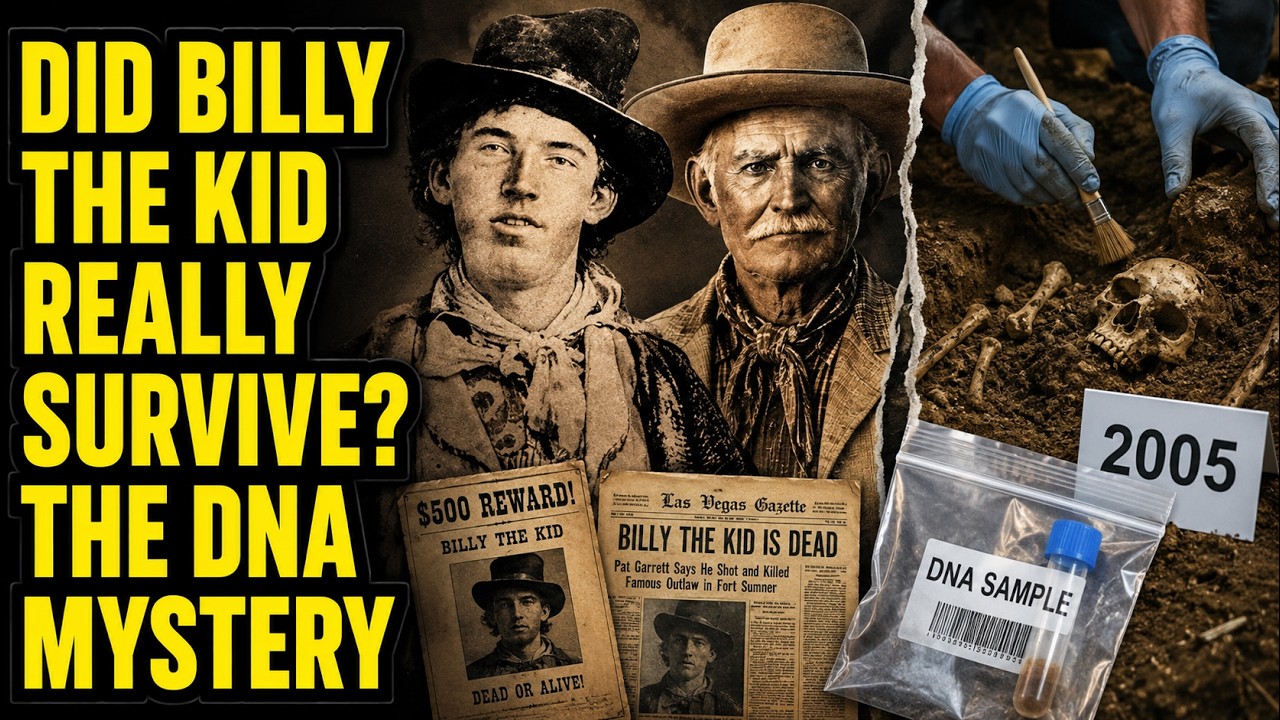
A coroner’s jury ruled the shooting justified, and the body was buried at Fort Sumner the same day. The paper trail supporting that account is substantial. New Mexico state archives hold Billy’s death warrant, the certificate of his courthouse escape, the coroner’s jury verdict confirming his death, and records concerning the reward paid to Garrett. That documentation links the escape, the pursuit, the reported shooting, the inquest, and the burial through records created close to the events.
Still, gaps in the historical record gave rise to persistent rumors that the Kid survived. Garrett published his detailed version in 1882 with the help of journalist Marshall Upson, making the account come from the very man who fired the fatal shot. There was no modern death certificate, no confirmed photograph of the body, and no scientific identification. Floods later damaged the Fort Sumner cemetery and washed away early markers, making it difficult to know exactly where the remains now lie.
These problems matter when searching for physical evidence, but they do not erase the testimony recorded in 1881. Local people reportedly viewed the body, a coroner’s jury identified it, newspapers reported the death, and Garrett’s reward was processed through territorial records. There are two distinct questions here: whether anyone can point to Billy’s bones today, and whether the people at Fort Sumner believed the dead man was Billy at the time. The first remains difficult, but the second has much stronger historical support.
The most famous survival theory centers on John Miller. His earliest clearly documented appearance dates to August 8, 1881, when he married Isidora in Las Vegas, New Mexico territory. That was only 25 days after Garrett reported killing Billy, which supporters of the theory see as a clue that the outlaw adopted a new identity almost immediately. Miller later lived in New Mexico and Arizona, working around ranches and horses.
He arrived at the Arizona Pioneers Home in Prescott on March 14, 1937, after a fall from a roof injured his hip, and he died there about eight months later. But the Pioneers Home files contain details that conflict with the Billy theory. They reportedly listed Miller as born in 1850, roughly nine years before Billy’s generally accepted birth year, and said he had been adopted by Kia people after his parents were killed. Billy’s known childhood followed a different path, with his mother alive until he was a teenager and records placing the family in several towns before New Mexico.
These files may have come from Miller himself and may not be perfectly reliable, but they do not naturally match the documented life of Henry McCarty, one of Billy’s real names. The case for Miller rests heavily on memories collected by writer Helen Airy. Her 1993 book argued that the outlaw survived under another name. People who knew Miller reportedly said he sometimes admitted in private that he was Billy.
One story described him at his August 1881 wedding looking pale and weak with bandages covering a chest injury. Supporters also pointed to his prominent front teeth, his skill with horses and firearms, his command of Spanish, and his detailed knowledge of the Lincoln County War. These details have limits. Horse skills, Spanish, and familiarity with outlaws were not rare among men who lived in New Mexico and Arizona.
A similar physical feature is not an identification, especially when descriptions and photographs are limited. Knowledge of Billy’s story could have come from personal experience, local conversation, newspapers, or later books. Most importantly, the strongest statements were recorded many years after the events. The published case did not present a verified 1881 letter in which Miller identified himself as Billy, a verified early photograph linking the two identities, or a contemporary lawman who documented finding Billy alive under Miller’s name.
The Miller theory gained new weight in the early 2000s when Tom Sullivan, a former sheriff of Lincoln County, and Steve Sederwall, a former federal officer and former mayor of Capitan, New Mexico, began treating Billy’s death like a cold case. They questioned parts of Garrett’s account, looked into the location of Billy’s grave, and sought ways to compare DNA. One possible reference route involved the grave of Billy’s mother in Silver City, while another involved the Fort Sumner grave itself. Both faced problems, since old cemeteries had been moved, flooded, or poorly marked, making an exhumation potentially yield the wrong person’s remains.
There were also legal disputes over permission to disturb graves. Sullivan and Sederwall then focused on John Miller because his body was believed to be in a state-owned cemetery in Prescott. Their plan was to recover DNA from Miller, compare it with material associated with Billy, and see whether science could connect the two men. The difficulty was that neither side of the planned comparison had a completely secure identity.
The proposed reference sample came from a wooden workbench connected to Pete Maxwell’s property. Investigators said a Maxwell descendant had preserved furniture from the ranch, including the bench on which Billy’s body was supposedly placed after the shooting. The wood reportedly carried a large amount of old blood, and forensic scientist Henry Lee was able to recover DNA from it. That sounded promising, but the object’s history was not certain enough to make it a verified Billy sample.
Investigators needed to establish that it was the correct bench, that the stains came from the body laid there in 1881, and that the blood belonged to Billy rather than another person. They also had to account for more than a century of handling, storage, moisture, dirt, and possible contact with other biological material. DNA testing is powerful, but it does not attach a historical name to a sample by itself. A laboratory normally compares an unknown sample with a sample from a known person or verified relative.
Sensitive testing can recover genetic material from tiny or degraded traces, but that same sensitivity makes contamination especially important. Even a strong laboratory match would connect the tested remains to the tested blood. It would identify John Miller as Billy only if the remains were truly Miller’s and the bench blood was truly Billy’s. On May 19, 2005, the team opened the area believed to contain Miller’s grave at the Arizona Pioneers Home Cemetery in Prescott.
The grave had no headstone. Investigators used a cemetery map that located Miller’s plot only within an area of about 20 square feet. The old coffins had collapsed and the bones were fragile. Then the search became more complicated: the team uncovered two sets of male remains in neighboring graves separated by only a few feet.
No one could immediately say which skeleton was John Miller. Samples were taken from both sets so the laboratory would not depend on a single guess. Some reporting identified the neighboring burial as cattleman William Hudspeth, who died only days before Miller, making careful separation of the two sets of remains especially important. The exhumation also led to a legal dispute.
The cemetery superintendent had given permission to open Miller’s grave, but critics questioned whether that authorization covered removing bone samples and remains from the neighboring grave. Authorities investigated while Sullivan and Sederwall maintained they believed the work had been approved. The forensic examination produced clues pointing in opposite directions. One skeleton had prominent front teeth and damage to the scapula, or shoulder blade.
Sullivan and Sederwall believed the damage could fit the wound described in Garrett’s account and favored this man as Miller. The supervising forensic anthropologist, Laura Fulginiti, was more cautious. She confirmed trauma to the shoulder blade but said she could not determine it had been caused by a gunshot. The second skeleton showed no comparable shoulder injury, but it did have a hip injury still healing when the man died.
That matched the story that Miller had injured his hip falling from a roof shortly before entering the Pioneers Home. Based on that evidence, Fulginiti proceeded on the assumption that the second man was Miller. The investigators preferred the first. The DNA results added another layer of uncertainty.
Laboratory specialist Rick Staub was unable to obtain usable DNA from the skeleton with the healing hip. He did obtain a usable sample from the skeleton with the shoulder blade trauma. This meant the testable DNA came from the body the anthropologist was less likely to identify as Miller. The sample may have belonged to Miller, to the neighboring cattleman, or to someone whose burial location had been recorded incorrectly.
Later reporting described the laboratory comparison between the remains and the bench material as useless rather than conclusive. That result was not simply a failure of modern science. The identity of the tested skeleton was uncertain, the identity and history of the blood on the bench were uncertain, and the material was old and possibly degraded or contaminated. There was no verified sample taken directly from Billy’s known remains, and efforts to obtain a comparison through his mother’s grave did not move forward.
A DNA profile answers a limited question. It can show that two samples are consistent with coming from the same person, that they may share a family line, or that they do not match. It cannot prove the story attached to either sample. A match between the testable skeleton and the bench would still require proof that the skeleton was John Miller and that the blood was Billy’s.
A non-match would not automatically clear the case either because the team might have tested Miller’s neighbor or blood from someone else. The surviving documentation for Billy’s death is wider than Garrett’s book alone. New Mexico State Records Center and Archives holds Billy’s death warrant, the certificate describing his courthouse escape, the coroner’s jury verdict verifying his death, the legal opinion concerning Garrett’s reward, and later approval of that payment. Historians defending the Fort Sumner account have also pointed to eyewitness statements and newspaper reports from the time.
The Miller claim rests on a different kind of record: a marriage dated less than a month after Billy’s reported death, later accounts from people who knew Miller, physical similarities, a disputed injury story, and the fact that his earlier history remains difficult to trace. It also includes conflicting information in the Pioneers Home files and the uncertain identification of two skeletons uncovered in Prescott. The investigation produced a real exhumation, real bone and tooth samples, and a real attempt to compare DNA with blood from an old bench. It did not produce a conclusive finding identifying John Miller as Billy the Kid.
Because the tested skeleton itself was disputed, the laboratory work did not reliably exclude Miller either.