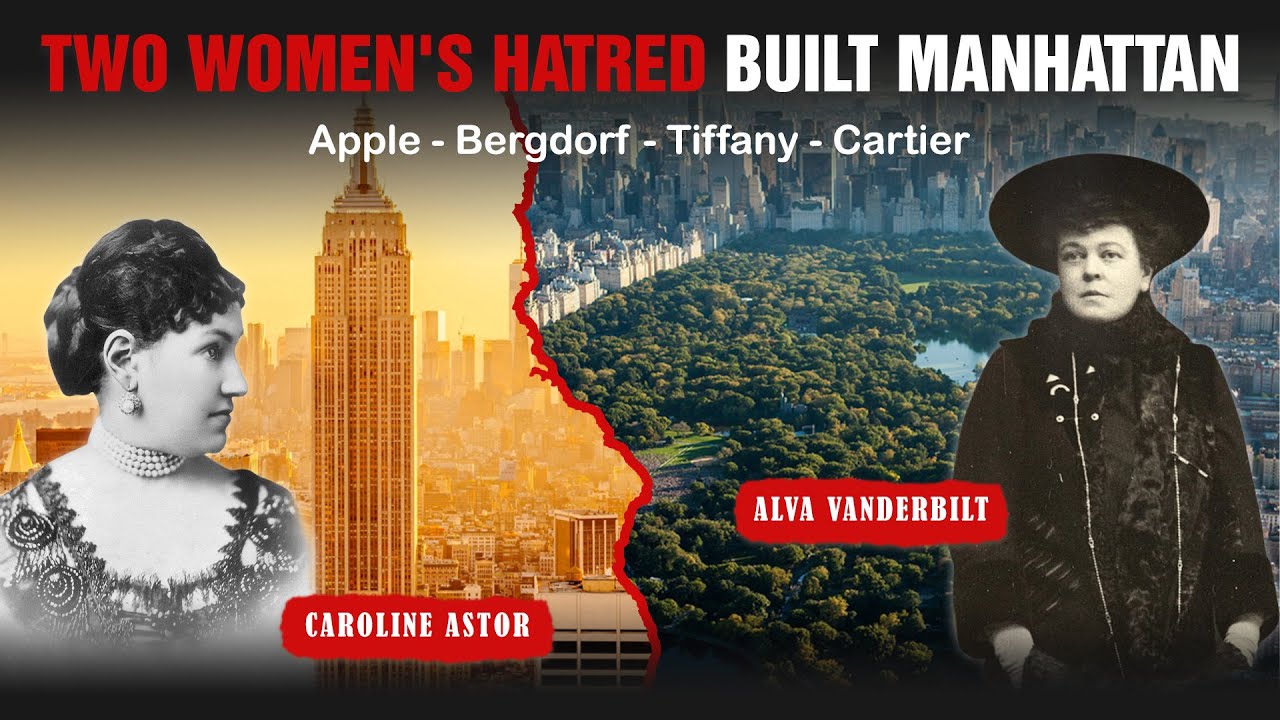
The limestone dust has long been swept from the sidewalks, and the sound of carriage wheels has faded into the hum of traffic, but the ghosts of a legendary conflict still patrol the pavement. The gleaming facades of glass and steel that define modern Manhattan obscure a startling truth: the most valuable real estate on Earth was won and lost in a bitter struggle between two women who never held a title, never voted, and never spoke a single word to each other in open hostility. The battle for Fifth Avenue was a war fought with calling cards and chateaus, and its aftershocks dictate the very geography of New York City today.
That conflict began in earnest in the spring of 1883, with a costume ball so extravagant it reordered the social universe. But before the fireworks, there was a quiet dynasty. Caroline Webster Schermerhorn Astor was the unquestioned matriarch of New York society, the arbiter of who mattered and who would be consigned to oblivion.
 Her family traced its roots to the old Dutch patricians, and her marriage into the Astor fortune—fur trading and real estate empire—had solidified her place in the firmament. Her power was not derived from walls or armed guards, but from the simplicity of a velvet rope drawn around precisely 400 names. Her ballroom at 350 Fifth Avenue was the epicenter of this universe, a space where a coveted invitation could make a family, and a silent snub could break a fortune.
She was the embodiment of old money, which whispers through influence and inheritance, not public displays of acquisition.
Alva Smith Vanderbilt was the challenger. Hailing from Mobile, Alabama, she was deemed a “nobody” by the established elite, a woman with a bankrupt father and a Southern pedigree that drew more sneers than respect. But her marriage to William Kissam Vanderbilt, one of the grandsons of the Commodore, gave her access to a treasury so immense it dwarfed the national government’s spending.
The Vanderbilts had amassed–and more often, taken–so much through shipping and railroads that they held economic power that threatened the very balance of the Republic. Yet, in New York society’s parlors, they were nothing. They were the men and women who drove the trains but were not invited to the depot’s finest party.
Caroline saw their wealth as vulgar, unearned by generations of cultured restraint. Alba saw Caroline’s exclusion as a deliberate insult to her own worth and to the sheer potency of her bank account.
Determined to shatter the glass ceiling of the patrician society, Alva did not attempt to win over its older members. She designed to make the entire old guard obsolete. In 1878, she commissioned the first Parisian-trained American architect, Richard Morris Hunt, to build her a chateau at 660 Fifth Avenue.
The decision was not a request, it was a proclamation. The site, at 52nd Street, was nearly in countryside compared to the more central Astor enclave, but the construction became a public spectacle. Over $3 million was spent on the palace at a time when a middle-class family lived on a few thousand dollars a year.
Limestone blocks were shipped by special trains from the Midwest. Carvers worked for two years on the frenetic facade, covering with Gothic spires, gargoyles, and slate roofs that peaked at improbable angles. The result was a shimmering French Renaissance bastion that mimicked the chateaux of the Loire Valley, built in the heart of Gotham.
Mrs. Astor’s disdain for this architectural excess was tempered by a pressing personal problem. She had a daughter, Carrie, who was eager to be part of the grand new era.
When Alva Vandenberg announced a grand costume ball for March 26, 1883, the event became the only topic of conversation in the city. The invitation list was drawn up with a peacock’s pride. The event was designed as a costume party where participation was demanded, not optional.
Carrie Astor had been practicing for the “star quadrille” with her friends, a planned performance. Her costume, a masterpiece of white silk and diamonds, was ready. But the invitation for her never arrived.
When the delay was noticed by Astor’s court, Alva’s assistant offered the chilling justification: “Miss Astor would be welcome, but her mother never called on me.”
In the rigid social code of the era, this was a checkmate on a classic chessboard. A married woman of any status would call upon a newcomer to the city or a newcomer to marriage, to welcome them. The higher-status individual would never call on a lower one.
If Mrs. Caroline Astor was to see her daughter, she would have to present her own card at the Vanderbilt door. She would have to call upon Alva Smith Vanderbilt.
 The old queen was faced with the one choice she could not have anticipated. On a chilly afternoon not long before the ball, a coach pulled up to the stone towers of the Vanderbilt castle, and a footman delivered a single, pristine card. It was not a message from Caroline, but her calling card.
Within hours, a velvet-embossed invitation was racing in the opposite direction, bound for the Astor residence. The 400 was conquered. Not by doublet and sword, but by the simple act of a visiting card.
The night of the ball itself became a legendary spectacle. Fifth Avenue was swarmed with thousands on the street, held back by police, as the creme-de-la-creme arrived. Alba’s interior decorator had created a tropical jungle, a medieval hallAnd a Versailles- scale throne room.
The costumes were audacious beyond imagination. Alice Vanderbilt, the wife of the younger brother, came as an “electric light,” with tiny bulbs sewn into her dress, powered by an integrated battery, sparkling in the gaslight era. Miss Astor arrived with her many dresses glinting, but the victory was already won.
When Caroline, in her typical black velvet and diamond aigrette, crossed the threshold to the shimmering giant of a room, the eyes of all New York—polite and not—were watched as he saw her walk up to her rival and engage. The newspapers the next day featured the event as the great de-walling of society. In one night’s party, Alba constructed a new society whose currency was not lineage but monumental, onward.
The 1880s and 1890s became a headlong race of architectural ego. Cornelius Vanderbilt II, Alba’s brother-in-law, sought to out-build his sister’s feminist triumph. He expanded his brownstone into a palace that swelled to a full city block at 57th and Fifth.
The mansion, built over many years, had 130 regular rooms, a gargantuan five-story Great Hall, a ballroom for a thousand guests, and a grand staircase that was a public spectacle. The Breakers in Newport, which were a summer haven, was version, but in Manhattan, he built the largest private residence that was, to that date, built in the United States. Real estate that could have been hospitals or schools became a private statement that the individual could, with enough money, own the physical environment.
This lavishness was a direct reply to Alva’s chateau. But Astor, beaten in her own game, sought a weapon that was entirely new and ruthlessly effective: the development of a region.
After a holding by her nephew but then yielding to the Waldorf-Astoria hotel built next to her house, she recognized a new vulnerability. The battle for Fifth Avenue was moving north. She hired Richard Morris Hunt, her former enemy’s architect, and constructed two adjoining mansions at 65th Street, one for herself and one for her son, Jack.
These twin structures connected by a shared ballroom that could hold 1,200. By moving her court 30 blocks north of the industrial hum and the encroaching retail, she reposited the pinnacle of social status. In less than five years, every family that mattered followed her, and the Upper East Side was born as a refuge for old money.
The land values exploded. The cheapest lot at 65th was gold. The city’s center of gravity—and its most expensive real estate—had been shifted by a physiological retreat, not a defensive blockade.
But in that move, she forfeited the terrain of old New York. The area around 34th Street and 57th Street, which was a palace of a realm, turned into a series of hotels and businesses. The Waldorf Hotel, with its elaborate German Renaissance style, and the new 16-story building, the Astoria, combined into the Waldorf-Astoria, an entity that had a lobby more aristocratic than any private home.
Fifth Avenue began to change. The single-family dwellings were replaced by. The wealthy were building apartments eventually, but on that avenue, retail soon took over.
 The fall of the mansion district, ironically, was sealed by the success of the very culture it had invented.
By 1900, the avenue was a mix of memory and future. On September 9th of that year, Caroline Astor, then a widow of many years, saw the engine of her power fading. The opening of the actual mega-mall, the Hotel Astor on 44th Street, added more business, but the paradigm had been overturned.
The magnificent mansion that was built by her and the one built by the Vanderbilts were, within a generation, razed. The block of Caroline’s old mansion at 65th was torn down to build the Temple Emanu-El. The Metropolitan Museum of Art expanded on a mansion property that he’d bought.
The city’s memory of Alabella’s limestone Château, a building so massive they couldn’t dismantle it, was demolished in 1927 to build a glass-and-steel skyscraper on the site of her glory.
The catalyst of their rivalry, which was as personal as any, has been transformed into an abandoned yet effective transfer. The Apple Store’s glass cube at 59th Street stands near the site of the old iron and, near the former battle of Caroline’s. Saks Fifth Avenue, anchored at 50th and 5th, sits on the block that held home of the famous.
Bergdorf Goodman anchors the former site of the Cornelius Vanderbilt palace, someday the site of the finest Louis Quatorze details not for a living family but for handbags. At 52nd and Fifth, Cartier now occupies the former mansion of Morton Plant, acquired in a trade for a double rope pearl necklace worth over a million dollars. The jeweler’s crown is the only surviving mansion on that stretch.
It is a fossil of an era.
The true legacy is not in those physical structures but in the intangible urban landscape. The Stone Paths that are “Millionaire’s Row” are now the home of luxury flagship stores that compete to create the most attention-grabbing facades. At any given moment, the Apple Experience is filled with consumers.
Cartier’s ogling displays of gemstones. They don’t know that they are standing in the ruins of a ballroom, where Caroline Astor looked Alva Vanderbilt in the eyes and surrendered her queenly crown. The refined Mad Avenue, a parallel street a few blocks west, was once the service route, the servants’ entrance to these great lords.
Now, it is the location of boutique suits, exclusive art galleriesembl and dining, its very design born from the distance created by the original landowners.
The social template created by these two women is even more lasting than the buildings that crumbled. The very idea of a “Met Gala” is a direct descendant of the 1883 Costume Ball. The viewing of a glittering, celebrity-studded affair to confirm a person’s status is the modern equivalent of Alva’s display.
The “reality television” genre, where wealthy and idle people compete in artificial transport of social protocol, is effectively Caroline and Alva’s conflict on camera. The fluctuating status of a tech entrepreneur who spends $100 million on a satellite like the Mar-a-Lago party is in the same playbook as Alva’s fake ballroom was. The old money’s quiet dominance and the new money’s barrage of spectacle are the Q and A of American wealth that defines participation in society.
And it is a intellectual on the system. Was Alva victory only? She catapulted her family to the highest tier, but Caroline’s architectural choice of the Upper East Side, arguably more lasting, set the geography of power.
 Alva’s own aristocratic influence was usurped by the sheer excess of her own financial class, that got too big, too many people, and eventually fiscal depression bankrupted the old families. Modern New York real estate is not built for a few, but for the manyhundreds of condos in a tower. But there is a sense that Fifth Avenue, as it stands today, is a museum of the old power clash.
It provides that palatate, to honestly think people can walk into a store to buy a diamond, ignoring that the floor beneath them used to be the arena for the most misunderstood war in the history of the city.
The city’s modern identity as a center of laissez-faire excess is a direct gift from these two women. The Astor and the Vanderbilt families, with their nearly bottomless finances, cemented the notion that New York was a place where money could build a physical reality on an even shorter timeline than anywhere else in Europe. They traded in history- aesthetic permanence.
They normalized the idea of building a chateau or a Renaissance palazzo, only to tear it down when the taste changed or the lot’s value. They seemed to burn money like they were producing it, and in doing so created a culture where destruction and reconstruction are constant motors of the city’s energy.
Today, as the latest condominium rises, glass bubbles and architecture flourishes rise on the midsection of the pristine, we are seeing an echo of the same game. Social success, in New York, is synonymous with proximity to this hallowed avenue. The upper fifth undergo the fluorishing of the old 400, now a renting class of billionaires, but the soil is the same.
The public parks, the early expansion of the Museum Mile, the sanctuary of the Frick Collection, and the high fences of the Met all speak to the early plan of Caroline Astor, who built in order to protect. Now, the very institutions that replaced her palaces have become the standard of culture and heritage, whereas the mansions themselves have been removed, their stones seem to have seeded the ground with a conceptual vocabulary.
The transformation from these family fortresses to the commercial castle is a harrowing part of the public urban history. In one, iron beams and steel, as if a nightmare of a city architect, and in place of a palace, a vertical office for commerce. These commercial energies now own the original location of the war.
But there is an irony that the Vandenberg fortune was built on railroads that shipped carved stone to build the ear. Now, the same vest-store resells them as high fashion. The iconography of the whole is, in modern Manhattan, at the corner of Fifth and 65th the Rose Center, where the old Astor mansion, the primary cathedral of any religion, still surfaces as a reminder.
The great rediscovered of their time is that the shadow of these women’s existence is not the buildings but the social fabric. Walk up Fifth Avenue, and you’re walking the route of the Irish and Chinese as they delivered food to a wedding. The route of the more prosperous carriage, the long the way that they drove in to see themselves.
The entire neighborhood is a creation of agape and choice. That the wealthy would choose to be north of the Astor andVanderbilt households set the tone for every suburban city in America. The notion of a “zip code” to determine a child’s future is a direct descendant of Caroline’s original, at the 400th and Alva’s choice of 52nd Street.
Now, as the city faces a new, unknown future, in the face of ghost empties, the lessons have once. The recent of its past may have been as unurban, but the prehistoric movement is alive in the surface of every designer label: Old money and new coutures negotiate on the same platforms. The Astor-Vanderbilt feud that had.
It was the instantiation of a new capability of the present—that excess looks good on a façade, but it’s the presence of an unconfided war that makes a Name.
The is only the photograph. In stone. In glass.
In the very real-estate values that have continued to climb. They are metaphor for an endless competitive, a never-ceasing duel for rewards that credible testament during the day, but are carried as a value system at night. On the wide thoroughfare known as home to Olympic, there will never be a military flag raised, but there is a the Astor name on a center in Bergdorf’s.
The Alva name might be on a plaza at some point. But what endures is the friction between the people who think in terms of questions of heritage, and those who think in terms of experience today. As long as it do, the Fifth Avenue will be the dominant street anywhere.

 It was this persona that would eventually conquer the folk-rock world, albeit at a devastating price.
 Once she was in the group, the music was golden. “California Dreamin'” and “Monday, Monday” became the soundtrack of the decade, with Elliot’s vocals anchoring the massive, layered sound. But the degradation didn’t cease; it infiltrated the lyrics.
 The Caesar’s Palace cancelled the remaining 3 weeks. She was humiliated.
 A cruel and visceral urban legend sprang that she died choking on a ham inked sandwich. This was a grotesque lie. It preyed on his lifelong struggles with her weight and public persona, which had been mocked.