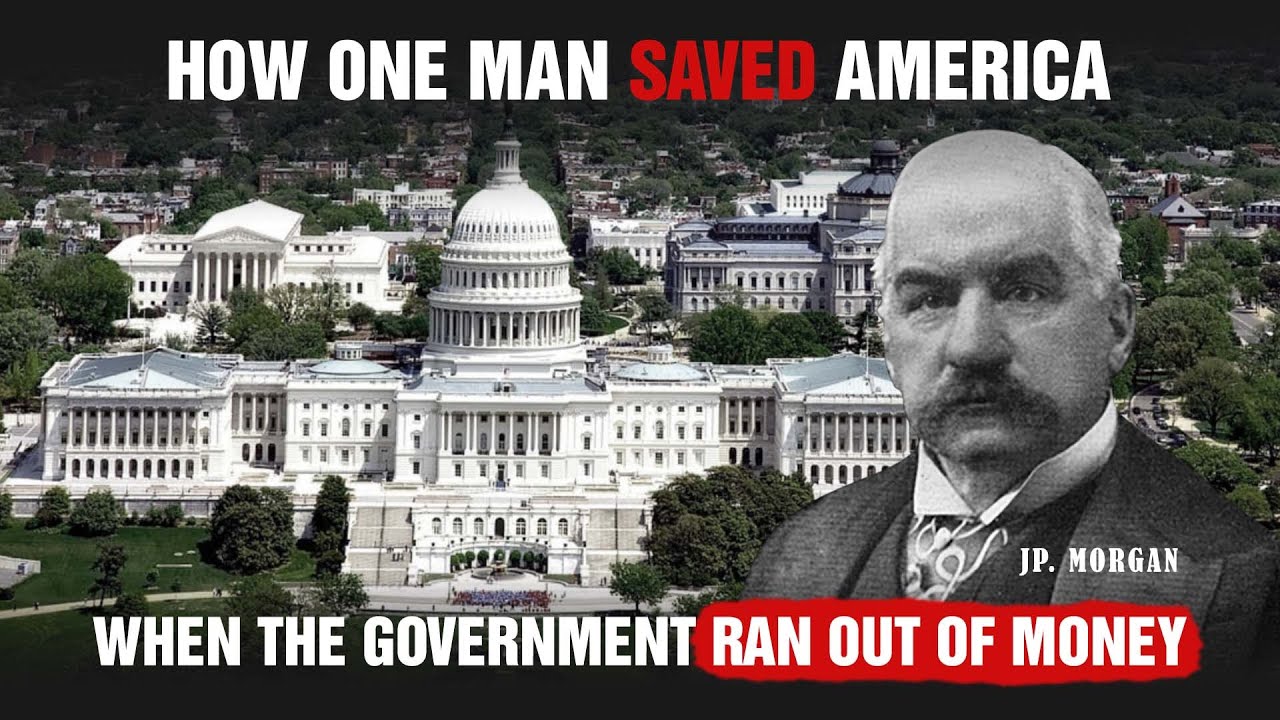
ROME, ITALY – The private god of Wall Street died quietly in his sleep, and the American financial system barely flinched.
John Pierpont Morgan, the 75-year-old colossus who had single-handedly rescued the U. S. Treasury from collapse, dictated the fate of railroads, and welded a steel empire together with sheer force of will, was pronounced dead at 9:17 a.
 m. local time in suite 402 of the Grand Hotel. He had been suffering from acute nervous exhaustion and complications from a lifetime spent bending markets to his will.
When telegraphs carried the news across the Atlantic and hit the floor of the New York Stock Exchange the following morning, traders braced for carnage. It never came. Stocks opened soft, dipped a fraction, then held.
By the closing bell, the Dow Jones Industrial Average had shed barely a point. There was no panic. No runs on banks.
No emergency meetings of executives fighting for their corporate lives.
That stillness in the markets at the moment of his death tells the real story of what killed the Gilded Age and the men who built it.
Morgan, the legendary investor who had become a living monument to concentrated American power, died thinking he was essential to the system he controlled. In truth, the system had already moved past him. The institutions were being forged before he drew his final breath that would replace him.
The funeral trains are being prepared to carry his body from the Grand Hotel to his private yacht, the Corsair, which will carry him home to New York. But the thrones he occupied across the financial boardrooms of America were already being dismantled in his name.
For four decades, Morgan built and operated his empire, a network of corporations and fortunes unrivaled in human history. His critics called it monopoly. Morgan and his allies called it efficiency.
The reality, however, was far more untouchable. His reach was so vast at its peak that he controlled over 40 percent of the nation’s railroads, steel production was dominated by U. S.
Steel, which he created in 1901 for the first time as a “billion-dollar” corporation. His financial empire stretched through scores of banks and he personally sat on the boards of dozens of companies.
Morgan’s corporate empire was so extensive that officials in Washington believed he controlled nearly one quarter of all American wealth. More than many foreign governments could boast, his assets were so vast that even the U. S.
 federal government, with its annual budget under $500 million, had to bow to his scale. Yet for all his command over the economy, Morgan could not control the forces already gathering at the gates of his tightly-held empire before his death, and the world he had helped create was already pulling away from him.
The first force that shattered his gold-plated era was labor unrest. Men like Morgan’s friend Andrew Carnegie, who he bought out in the largest business transaction to that date, could deal with a union by deploying a private army of 300 guards — Pinkerton detectives — on barges at dawn, as he did in Homestead, Pennsylvania in 1892 against steelworkers. A 12-hour battle erupted that day, leaving 10 dead and 17 wounded.
Federal troops had to be called in to crush the unrest. But the days when you could simply crush the working man were numbered. By the time the great coal strike arrived ten years later, in 1902, President Theodore Roosevelt, the man who proudly used the office as a “bully pulpit,” made the unprecedented choice of calling both sides to the White House, treating labor as equals to manipulate capital.
Morgan watched the ground swallow his old assumptions in real time.
The second force came from political change. During 1904, the Supreme Court declared Morgan’s railroad trust, Northern Securities, illegal under the Sherman Act. Roosevelt, a man from Morgan’s own social class, said he wouldn’t “fix things up,” as Morgan had snobbily asserted private men should.
Instead, Washington began to sue the other monopolies, shattering Standard Oil and American Tobacco in the years after. A “trust-busting” fever gripped the country.
Yet it was the third force, the institutional replacement, that ultimately drove the knife into the man’s world before he lay down to rest. It grew from a financial catastrophe of his own doing: the Panic of 1907. The crisis that October brought with it the brutal realization that the federal government had no central bank to stop the bleeding.
They had no mechanism to combat a financial run, the kind of destabilization that destroyed investor certainty with chilling speed.
In desperation, the president called on the strongest instrument he could find to stabilize the economy: J. P. Morgan.
For a long few days and nights in November 1907, Morgan locked his banking rivals inside his three-story library on Madison Avenue in New York City, a secure showpiece he had built as a fortress to hold his rare books. There, wreathed in cigar smoke, playing solitaire with a copied deck of cards, Morgan personally decided which institutions would be saved and which would fail. He forced healthy banks to shore up the system’s weakest points and pledged his own fortune to fill the void.
 By morning, the run had subsided, but the psychological damage was even more lasting.
The Panic of 1907 had exposed a terrible truth to every American citizen reading the morning headlines: the fate of the economy rested ultimately hinge on the goodwill and health of one financier conducting a “private negotiation” behind a locked bronze door. Morgan was hailed as Jupiter, a hero. But the nation realized for the first time that Jupiter could die, or one day just refuse to save them.
Congress came with a klieg light in December 1912, with the Pujo Committee’s “money trust” investigation. After months of hearings, the public saw that the American economy came down to the interlocking directorates of a tiny class of men at the top of a gatekeeping pyramid. For Morgan, it was all about social character morphism and trust.
Testifying before them, he famously declared that “character” bore the measure of a commercial note, more than any amount of money or consensus. That worldview, in which wealth flowed to men of proven judgment, men very much like himself in makeup, was crumbling.
The progressives already had the blueprint to dismantle that idea using Systems designed to replace the Titans. In 1913 alone, the 16th Amendment guaranteed the legal foundation for a federal income tax, a direct challenge to concentrated wealth held for good. The direct election of senators via the newly ratified 17th Amendment would pull state power away from backroom arrangements.
And even with the resulting atmosphere of his own death, Congress was racing to write the Federal Reserve Act, institutionalizing Morgan’s rescue for countless 1997 to create a lender of last resort that didn’t need to rely on the character of any person.
The sheer indifference of Morgan’s death was vivid testimony to that fact. His life had revolved around an economy where he was the colossal protective force. In his tomb, the afterworld will be run by federal boards, committees, and corporate trustees, a regulated and accountable architecture.
His phrase “like man was a class” perhaps proved itself too perfectly. His social philosophy: concentrated power in righteous hands built the country; everyone incarnated in belonging to a class of sturdy, financially sophisticated industrial kings.
But no single ruler merely built their heroic stature. For every railroad Morgan rationalized, a worker died in welds. For every bank he saved, a poor family was evicted.
The stability he personally stitched in a crisis didn’t reduce the threat of concentrated wealth. Instead, it became radically a cautionary tale against relying on a future one. The calculations at the committee made it clear, long before citizens turned to respect the death, that the Moneyt route was socialism.
 It presented an undeniable undeniable. Boardrooms interests in private.
As the funeral of Jay Parker Morgan takes shape, what remains from his own house at Madison Avenue is remarkable. The man had spent his wealth not just on public assets but also palaces. His own mansion at 219 Madison Avenue, that showcase of his own monumental rise, was torn down in 1928, a decade before the Great Depression would discredit imperial giants.
The space is rented by another bank. In its domain is the caretaker library, opened to the public. The man, who once took his word to be law, now accepts its tribute at a museum.
In reality, then, the world doesn’t just mourn the man. The obituary should read that a whole era got buried Tuesday. For a generation, J.
P. Morgan had been the titan, acting as a one-man national bank, the rescuer of capitalism, the finest Hoover dam against daily chaos. His life and actions represented a startling statement that at certain gilded moments in history, the private amassing of American power was once what stood between civilization and Dickensian darkness.
He would have recognized the new century he died at the edge of as an alien one. The president might still solicit his advice. But power no longer dented in his guestroom.
His market rooms still existed, but now they were supervised by historians, not critics. In the story of his last hours, there’s one haunting element. According to his servants, he passed away surrounded by deep silence, having spent this journey abroad on a desperate hunt for the quiet that eluded him, as the empires he built, and the industrial grit, perhaps pushed him to mental exhaustion.
The boom in the bank defaults was quiet, his health consumed.
And in the silence, as the final blow of April 1 came to Wall Street, they didn’t cry. They didn’t stagger to attention. They looked around at the new structure they had created and knew it would go on without him.
His vertical networks were being sliced up by regulation. His interlocking directorates, overseen by trustees. The power which he practiced and fostered, the absolute control by capable individuals, was under the control of no one man.
The epic that was J. P. Morgan represents the life of a dineofold of elite flexibility.
As he was being buried alive, an entire economy was finally purpose built so that his species could not exist again.
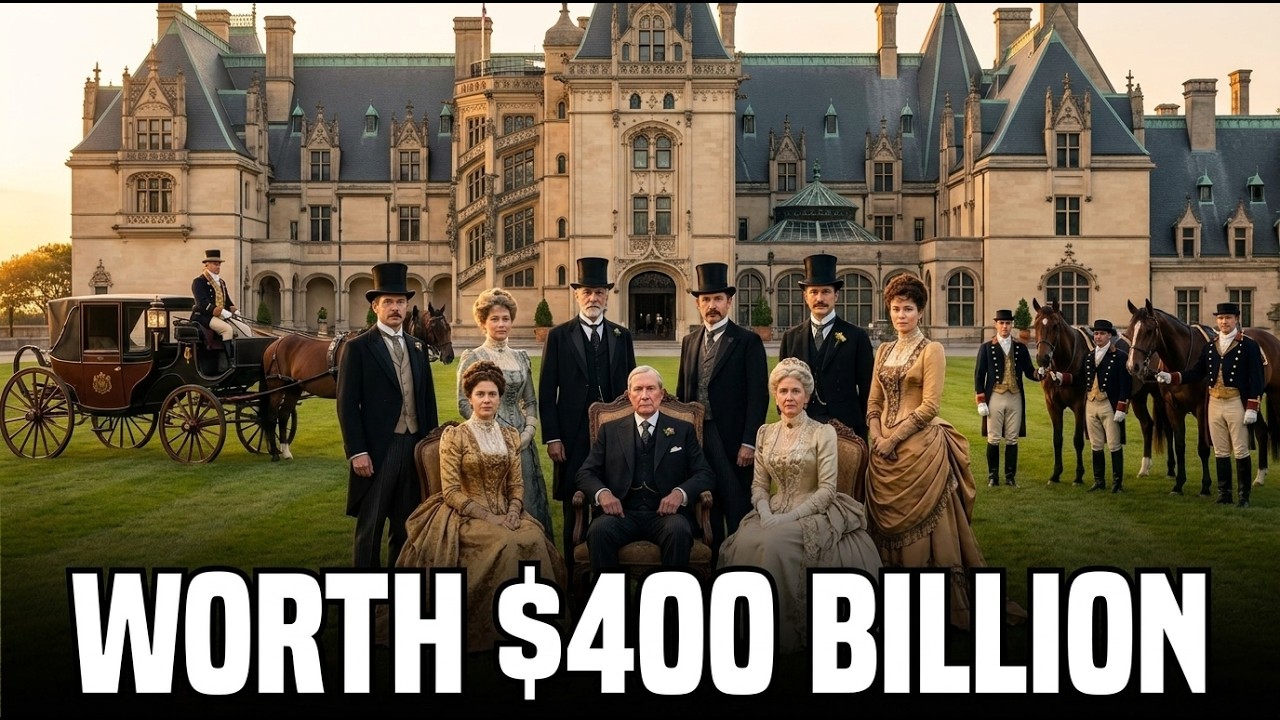
 The extraordinary numbers are the first thing to understand because they defy all modern comprehension, and at his peak, John D. Rockefeller’s personal net worth was equivalent to roughly four hundred billion dollars in today’s money, not million, billion, with a B, which is an amount of money so large it is effectively a number, a piece of theoretical wealth that has no bearing on the reality of daily life, and he was not alone. The Vanderbilts, the Astors, the Carnegies, the Morgans, and a handful of other families controlled a combined amount of wealth greater than the bottom half of the entire United States, a statistic so staggering it is often left out of the history books, not because it is untrue, but because it is too disruptive to consider, and this explosion of capital happened for a very specific and terrifying reason.
 If the Gilded Age had a queen, her name was Caroline Astor, known to the public as Mrs. William Backhouse Astor, Junior, and she did not build the biggest mansion or throw the most expensive parties. Her power was more subtle and far more damaging, because she is the person who decided who was worth knowing, which is emphatically a massive power on the east coast.
 And nothing illustrated this excess more clearly to millions of Americans than the Bradley Martin Ball of 1897, when the era’s most daring social climb happened in one single evening, and it was misunderstood by an entire nation. Bradley Martin and his wife Cornelia decided to throw a costume ball at the Waldorf Hotel in New York City, with the court of Versailles as the theme. Guests came dressed as Louis XIV, Marie Antoinette, Mary Queen of Scots, and various European nobles, and Mrs.
 When he was forced to respond, he gave an interview, defending the ball by claiming that the value spending on the party had helped the local economy, but the public did not see the merit in that argument. The Bradley Martins left for England, never to return, and they took a world with them.
 This is the story of Ellen Walsh, the mill-town laborer’s daughter who became one of America’s wealthiest and most reclusive women. She was not Ida Wood. She was not a Louisiana aristocrat.
 She arrived in a city where to be poor was a sin, and she saw that a fortune teller could be a patron saint. This fortune teller had read her palm and made a promise: she, Ida, would marry a rich man and have everything she wanted. She believed it.
 This is the pathos of the “Countess of Herald Square” as the gossip pages called her. She had built a prison not of bars, but of privacy, where the streets were safe and the fortune was a nightgown. But her story, the magazine and the unreliable narrator, would not end with her.
 When the bank was dust, the dollars were still in her skirt. In the next decades, she sat on daily with a fortune in her pillowcase, but the earth spun, the buildings fell, the layers of the fortune evaporated, and she stayed.